


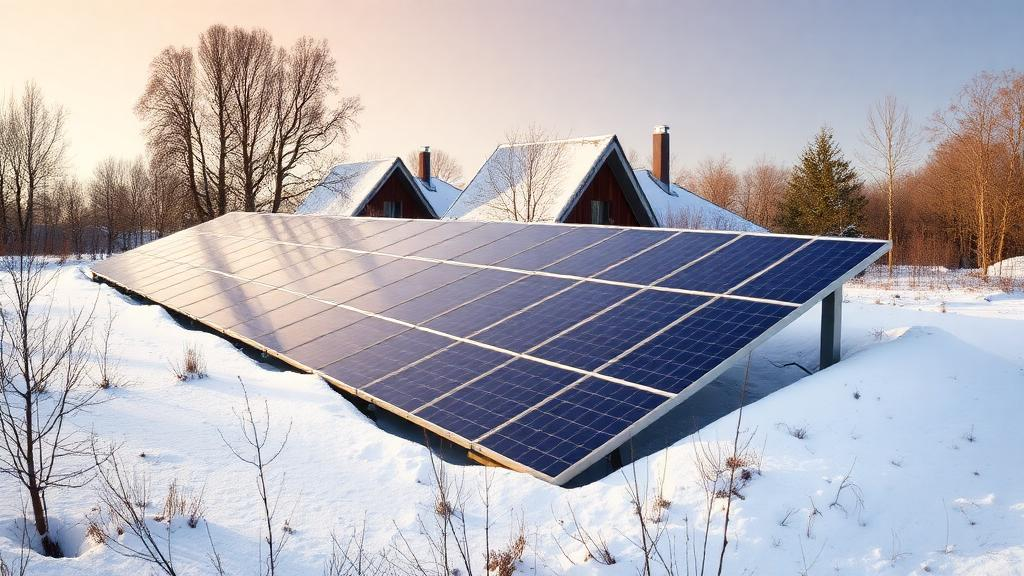
Solar power in one of the world’s coldest corners may actually benefit from climate change, according to a new study published in Communications Earth & Environment. Researchers at KTH Royal Institute of Technology and the Swedish Meteorological and Hydrological Institute set out to answer a question that most assessments of future solar energy have quietly ignored: what happens to photovoltaic generation when you explicitly model snow, not just sunshine and temperature? Their answer, drawn from 150 years of simulated weather across four Swedish cities, is that photovoltaic generation in Sweden could rise by roughly 5 percent by 2100 compared with the historical period, even under a high-emission pathway that reduces incoming sunlight. The finding runs counter to many earlier projections, and the reason is buried in the snowpack.
The study’s central insight is that in high-latitude countries, the standard metric used to estimate solar potential, known as photovoltaic power generation potential, is fundamentally incomplete. That metric typically considers only solar irradiance and ambient air temperature. But in Sweden, where fixed-tilt, non-tracking panels dominate the market and snow can blanket arrays for weeks, two additional factors matter enormously: the tilt angle at which panels are installed and the accumulation, melting and sliding of snow on the module surface. Snow alone is estimated to strip roughly 15 percent from annual photovoltaic generation in Stockholm. Ignoring it, the authors argue, produces systematically misleading forecasts for cold regions.
To build a more realistic picture, the team applied a validated photovoltaic installation model that runs at an hourly timestep and incorporates air temperature, solar radiation and a full snow model covering snowfall, accumulation, covering, sliding and melting. The model calculates snow albedo as a function of snow depth, distinguishes dry winter snow from wetter spring conditions, and applies a sliding factor that lets partially cleared panels keep generating as snow slips off tilted surfaces. Melting rates differ between winter and spring, reflecting empirical values for Swedish urban conditions. The model was validated against measured data from a real rooftop plant, giving the projections a grounding that purely theoretical estimates often lack.
The researchers ran their model for four cities chosen to span Sweden’s climatic range: Malmö, Gothenburg, Stockholm and Kiruna, the last of which sits well above the Arctic Circle. Climate inputs came from the HCLIM regional climate model, part of the EURO-CORDEX downscaling of CMIP6 global simulations, run at 12.5 kilometer resolution and driven by three different global climate models: CNRM-ESM2-1, MPI-ESM1-2-HR and MIROC6. Two Shared Socioeconomic Pathways bracketed the future: SSP1-2.6, a lower-forcing sustainability scenario, and SSP3-7.0, a higher-forcing pathway with limited mitigation. The historical reference period ran from 1951 to 2014, with projections extending to 2100.
The projected climates diverge sharply by scenario. Under SSP3-7.0, annual global horizontal irradiance declines by around 30 to 40 watts per square meter in all four cities, while under SSP1-2.6 it remains essentially stable. Air temperatures in the three southern cities rise from roughly 4 to 9 degrees Celsius historically to 6 to 13 degrees by 2100, with warming trends of about 0.33 to 0.38 degrees per decade under the high-emission scenario. Kiruna warms fastest of all, at up to 0.51 degrees per decade, reaching an increase of approximately 4.42 degrees by century’s end. Snowfall declines significantly everywhere, with southern Sweden expected to retain only about two-thirds of historical snowfall under SSP1-2.6 and a nearly negligible amount under SSP3-7.0. Kiruna, remarkably, keeps about 90 percent of its snow, roughly 300 millimeters a year.
Against this backdrop, the photovoltaic results are striking. With panels installed at their calculated optimal tilt angles, annual generation is expected to be about 5 percent higher in the future than in the historical period, equivalent to roughly 33 kilowatt-hours per kilowatt-peak, under both scenarios. The gain is concentrated in spring, when reduced snow cover allows panels to exploit what is already one of the sunnier stretches of the Swedish year. This is precisely where the new study parts company with earlier work: previous assessments that neglected snow processes generally projected declines, because they saw only the falling irradiance and the efficiency penalty of warmer modules. Once snow is modeled explicitly, the loss of snow-related downtime outweighs both.
The interplay between variables is subtle. Correlation analysis using daily values shows that photovoltaic generation is positively associated with irradiance and air temperature but negatively with snowfall, with irradiance the dominant factor overall. Yet temperature’s role is double-edged: warmer cells convert sunlight less efficiently, but warmer air melts and slides snow off panels. The positive snow-melting effect only operates when two conditions coincide, namely no active snowfall and air temperatures above freezing. Below zero, extra warmth does nothing to clear the panels. In the milder south, where snow losses shrink, temperature’s negative effect on module efficiency begins to dominate, and the net temperature effect becomes small. In the snowier north, the melting effect remains significant.
A sensitivity analysis made the point vividly. By pairing radiation from one scenario with snow-and-temperature conditions from the other, the researchers showed that swapping the snow-and-temperature inputs alone could flip the sign of the generation trend, turning an increasing trajectory into a declining one or vice versa. In several city-model combinations, the combined effect of snowfall and air temperature matched or exceeded that of solar radiation itself. No single meteorological driver dominates universally across all locations and simulations, which is why the authors stress that multi-model assessments are essential for reliable projections in snow-affected regions.
The study also delivers practical engineering guidance. The median optimal tilt angle across all four cities and scenarios is approximately 35 degrees, and installing panels at these city-specific optima rather than the 15-degree angle most common in the current Swedish market would raise annual generation by 3 to 6 percent, or about 20 to 40 kilowatt-hours per kilowatt-peak. Under a recent change in Sweden’s building-permit framework, rooftop owners now have more freedom to choose their panel tilt, making this optimization immediately actionable. Future output is also projected to be less variable year to year than in the historical record, and the number of days with zero generation, along with the longest consecutive zero-output streaks, generally declines, in southern cities potentially halving under SSP3-7.0. That could ease the storage and backup burden of integrating solar into the grid.
There are caveats, and the authors are candid about them. Only four cities were analyzed, which may not capture the full regional variability of a country spanning wide latitudes at 12.5 kilometer model resolution. The snow model is deliberately simple, omitting the effects of precipitation on melting, and only three regional simulations were used, a small subset of the available ensemble, leaving room for systematic model biases. Prolonged zero-generation periods of one to two consecutive weeks remain possible in some years, and individual extreme years can still produce unusually high intermittency, with some high-emission projections for Stockholm exceeding the historical range. Kiruna’s polar nights, 22 days without sun, remain an irreducible constraint. Still, with Swedish photovoltaic capacity growing at more than 55 percent annually and national targets calling for a fully renewable power sector by 2040, the message for planners, investors and grid operators is clear: in the cold latitudes, the future of solar depends as much on what falls from the sky and sticks to the panel as on what shines on it.
Subject of Research: Climate change impacts on snow-affected photovoltaic power generation in high-latitude Sweden through 2100
Article Title: Impact of climate change on the photovoltaic power potential in Sweden across 21st century
Article References: Ruan, T., Wang, F., Laumert, B., Aldama-Campino, A., & Wang, W. (2026). Impact of climate change on the photovoltaic power potential in Sweden across 21st century. Communications Earth & Environment, 7(1), Article 822. https://doi.org/10.1038/s43247-026-04091-w
Image Credits: AI Generated
DOI: 10.1038/s43247-026-04091-w
Keywords: photovoltaics, solar energy, climate change, Sweden, snow cover, EURO-CORDEX, CMIP6, SSP scenarios, tilt angle optimization, renewable energy, high-latitude climate, energy modeling
Cite Scienmag News
Faith Mcneil. (October 11, 2026). Warming Winters Could Boost Sweden’s Solar Power by 5 Percent, Study Finds. Scienmag. https://scienmag.com/warming-winters-could-boost-swedens-solar-power-by-5-percent-study-finds/
Faith Mcneil. "Warming Winters Could Boost Sweden’s Solar Power by 5 Percent, Study Finds." Scienmag, 11 October 2026, https://scienmag.com/warming-winters-could-boost-swedens-solar-power-by-5-percent-study-finds/. Accessed 11 October 2026.
Faith Mcneil. "Warming Winters Could Boost Sweden’s Solar Power by 5 Percent, Study Finds." Scienmag. October 11, 2026. https://scienmag.com/warming-winters-could-boost-swedens-solar-power-by-5-percent-study-finds/


