

Tuesday, October 27, 2026
Science
No Result
View All Result
  • Login
  • HOME
  • SCIENCE NEWS
  • CONTACT US
  • HOME
  • SCIENCE NEWS
  • CONTACT US
No Result
View All Result
Scienmag
No Result
View All Result
Home Science News Biology

Soil Microbes Mapped Along Morocco’s Mount Toubkal for the First Time

October 27, 2026
in Biology
Morgan Morrow
By Morgan Morrow Scienmag Editorial Profile - Bacteriology
Reading Time: 2 mins read
0
Soil Microbes Mapped Along Morocco’s Mount Toubkal for the First Time

Soil Microbes Mapped Along Morocco's Mount Toubkal for the First Time

65
SHARES
587
VIEWS
Share on FacebookShare on Twitter
ADVERTISEMENT

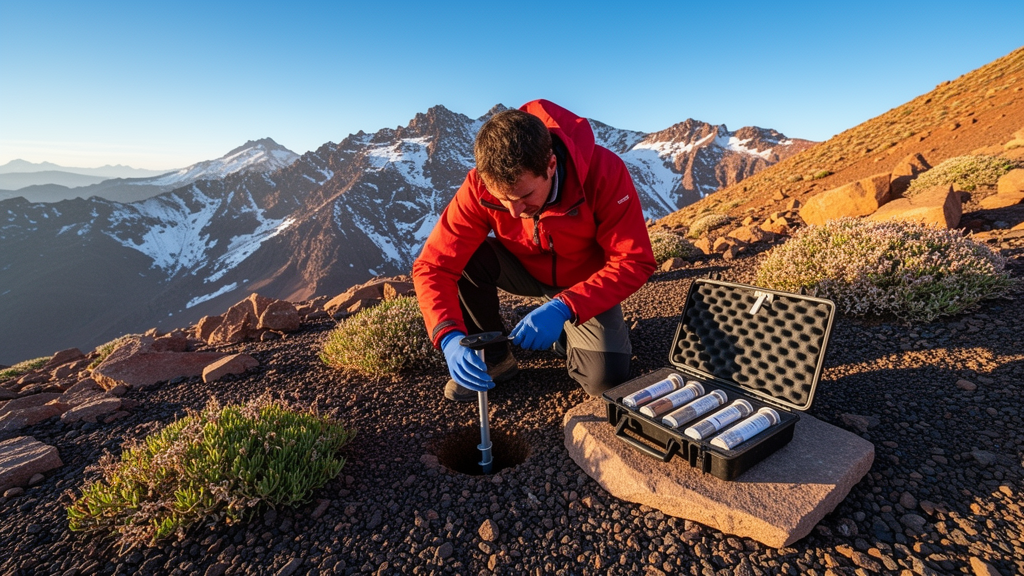
Researchers have reported the first comprehensive survey of soil bacterial and fungal communities on Mount Toubkal, North Africa’s highest peak, covering an elevational gradient from 500 to 4,165 meters in Morocco. The study, published open access in the journal Microbial Ecology on 27 October 2026 as a peer-reviewed accepted manuscript, combined next-generation sequencing of 16S rRNA and ITS1 markers with measurements of soil physicochemical properties and enzyme activity across nine sampled elevation-sites.

The central finding is a divergence in how the two groups of microbes vary with altitude. Bacterial alpha diversity remained comparatively stable along the transect, whereas fungal richness decreased toward higher elevations. A site-level analysis confirmed a negative association between fungal richness and elevation, with a Spearman correlation of rho = -0.70 (P = 0.036, n = 9). Fungal richness and Shannon diversity were both positively associated with soil organic matter at the site level (rho = 0.83, P = 0.005, and rho = 0.77, P = 0.016, respectively), while bacterial richness was associated with available phosphorus, pH, and phosphatase activity.

Community composition also differed among the sampled elevation-sites. Actinobacteriota was the dominant bacterial phylum throughout the transect, while Ascomycota dominated fungal communities at most sites. One notable exception occurred at 3,500 meters, where Chytridiomycota became the dominant fungal group. The authors note that the observed compositional differences among sites reflected both community-centroid and dispersion differences, a methodological caveat that matters when interpreting beta-diversity patterns.

Compositional turnover along the transect was further indicated by increasing community dissimilarity with absolute elevation difference between sites. Overall, microbial diversity and composition were associated with variation in soil organic matter, available phosphorus, and pH along the sampled gradient. These soil variables, rather than elevation alone, appear to track the observed microbial patterns, although the study’s site-level correlations are based on a small number of sampling locations and describe associations rather than causal effects.

High-mountain ecosystems are widely described as sentinels of global environmental change, and the authors position this dataset as the first soil-microbiome baseline for Mount Toubkal. Because the soil microbial communities of North Africa’s highest peak had not previously been explored, the work expands current knowledge of microbial biogeography in North African mountain ecosystems and provides a reference point for future monitoring. The published version is subject to further editorial edits before the final Version of Record replaces the accepted manuscript.

Subject of Research: Soil bacterial and fungal communities along an elevational gradient on Mount Toubkal, Morocco

Article Title: Elevation-Associated Patterns of Soil Bacterial and Fungal Communities Along Mount Toubkal, North Africa’s Highest Mountain

Article References: Idbella, M., Abelouah, M. R., Benmrid, B., Ibnyasser, A., Idbella, A., Nouj, N., Haddine, M., Hazzoumi, Z., Bargaz, A., & Bonanomi, G. (2026). Elevation-Associated Patterns of Soil Bacterial and Fungal Communities Along Mount Toubkal, North Africa’s Highest Mountain. Microbial Ecology. https://doi.org/10.1007/s00248-026-02921-0

Image Credits: AI Generated

DOI: 10.1007/s00248-026-02921-0

Keywords: Mount Toubkal, soil microbiome, elevation gradient, bacterial diversity, fungal diversity, 16S rRNA, ITS1, soil organic matter, Morocco, microbial biogeography, Actinobacteriota, Ascomycota

Cite Scienmag News

Morgan Morrow. (October 27, 2026). Soil Microbes Mapped Along Morocco’s Mount Toubkal for the First Time. Scienmag. https://scienmag.com/soil-microbes-mapped-along-moroccos-mount-toubkal-for-the-first-time/

Morgan Morrow. "Soil Microbes Mapped Along Morocco’s Mount Toubkal for the First Time." Scienmag, 27 October 2026, https://scienmag.com/soil-microbes-mapped-along-moroccos-mount-toubkal-for-the-first-time/. Accessed 27 October 2026.

Morgan Morrow. "Soil Microbes Mapped Along Morocco’s Mount Toubkal for the First Time." Scienmag. October 27, 2026. https://scienmag.com/soil-microbes-mapped-along-moroccos-mount-toubkal-for-the-first-time/


Tags: 16S rRNAActinobacteriotaActinobacteriota and Ascomycota dominancealtitude effects on microbial diversityAscomycotabacterial diversityelevation gradientfungal diversityITS1microbial biogeographymicrobial community compositionmicrobial ecology in MoroccoMoroccoMount ToubkalMount Toubkal elevation gradientnext-generation sequencing of soil microbessoil bacterial communitiessoil enzyme activitysoil fungal communitiessoil microbial diversitysoil microbiomesoil organic mattersoil organic matter and microbial diversitysoil physicochemical properties
Share26Tweet16
Previous Post

MRI bright stripes after bisphosphonates mimic disease flare in childhood bone disease

Next Post

Thyrotoxicosis linked to unstable blood sugar and strikingly low cholesterol in one patient

Related Posts

Research report: Presence records of Aedes vexans ( Diptera , Culicidae ) in Germany
Biology

Research report: Presence records of Aedes vexans ( Diptera , Culicidae ) in Germany

October 27, 2026
New assassin bug species from Myanmar reveals first fully inflated endosoma in reduviids
Biology

New assassin bug species from Myanmar reveals first fully inflated endosoma in reduviids

October 27, 2026
Herbal compound diosbulbin B worsens doxorubicin liver injury in mice
Biology

Herbal compound diosbulbin B worsens doxorubicin liver injury in mice

October 27, 2026
Golden Jackal Helpers Step Up When Breeders Vanish, Study Finds
Biology

Golden Jackal Helpers Step Up When Breeders Vanish, Study Finds

October 27, 2026
New framework proposes how to pick safer targets for senolytic immunotherapy
Biology

New framework proposes how to pick safer targets for senolytic immunotherapy

October 27, 2026
Agriculture blocks gene flow in fragmented sloth bear populations of India’s Terai
Biology

Agriculture blocks gene flow in fragmented sloth bear populations of India’s Terai

October 27, 2026
  • Mothers who receive childcare support from maternal grandparents show more optimized

    Mothers who receive childcare support from maternal grandparents show more parental warmth, finds NTU Singapore study

    27656 shares
    Share 11059 Tweet 6912
  • University of Seville Breaks 120-Year-Old Mystery, Revises a Key Einstein Concept

    1061 shares
    Share 424 Tweet 265
  • Bee body mass, pathogens and local climate influence heat tolerance

    682 shares
    Share 273 Tweet 171
  • Researchers record first-ever images and data of a shark experiencing a boat strike

    546 shares
    Share 218 Tweet 137
  • Groundbreaking Clinical Trial Reveals Lubiprostone Enhances Kidney Function

    531 shares
    Share 212 Tweet 133
Science

Embark on a thrilling journey of discovery with Scienmag.com—your ultimate source for cutting-edge breakthroughs. Immerse yourself in a world where curiosity knows no limits and tomorrow’s possibilities become today’s reality!

RECENT NEWS

  • Thyrotoxicosis linked to unstable blood sugar and strikingly low cholesterol in one patient
  • Soil Microbes Mapped Along Morocco’s Mount Toubkal for the First Time
  • MRI bright stripes after bisphosphonates mimic disease flare in childhood bone disease
  • Chronic widespread pain linked to higher cardiovascular risk in type 2 diabetes

Categories

  • Agriculture
  • Anthropology
  • Archaeology
  • Athmospheric
  • Biology
  • Biotechnology
  • Blog
  • Bussines
  • Cancer
  • Chemistry
  • Climate
  • Earth Science
  • Editorial Policy
  • Marine
  • Mathematics
  • Medicine
  • Pediatry
  • Policy
  • Psychology & Psychiatry
  • Science Education
  • Science News
  • Social Science
  • Space
  • Technology and Engineering

Subscribe to Blog via Email

Enter your email address to subscribe to this blog and receive notifications of new posts by email.

Join 5,151 other subscribers

© 2025 Scienmag - Science Magazine

Welcome Back!

Login to your account below

Forgotten Password?

Retrieve your password

Please enter your username or email address to reset your password.

Log In
No Result
View All Result
  • HOME
  • SCIENCE NEWS
  • CONTACT US

© 2025 Scienmag - Science Magazine

Discover more from Science

Subscribe now to keep reading and get access to the full archive.

Continue reading