


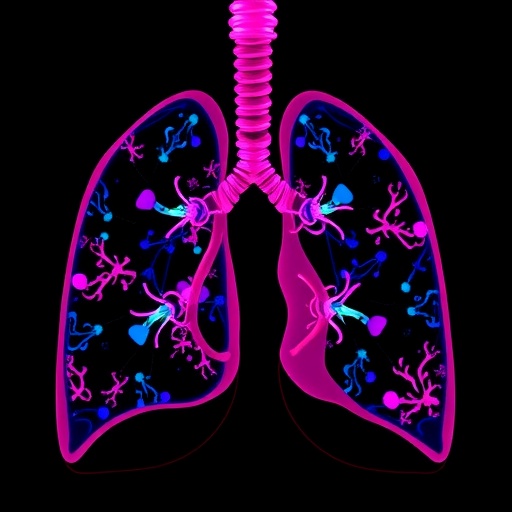
In the relentless battle against non-small cell lung cancer (NSCLC), one of the most formidable challenges faced by oncologists is overcoming the tumor cells’ resistance to radiation therapy. A groundbreaking study recently published in Cell Death Discovery reveals a vital molecular mechanism underpinning this resistance, spotlighting the SOHLH2-RAD54L axis as a powerful driver of radioresistance through the enhancement of homologous recombination repair pathways. This discovery not only deepens our comprehension of cellular repair machinery in cancer but also opens promising new avenues for therapeutic intervention.
Lung cancer remains the leading cause of cancer-related mortality worldwide, with NSCLC accounting for approximately 85% of all cases. Radiation therapy constitutes a cornerstone in the treatment regimen for NSCLC, yet its efficacy is significantly compromised by the ability of cancer cells to evade radiation-induced cell death. Deciphering the molecular basis of such evasion remains critical for improving patient survival rates.
The study conducted by Yang and colleagues meticulously demonstrated that the transcription factor SOHLH2 orchestrates the upregulation of RAD54L, a pivotal protein in the homologous recombination repair (HRR) pathway. Homologous recombination is a high-fidelity mechanism for repairing double-strand DNA breaks caused by ionizing radiation, effectively preserving genomic integrity but inadvertently enabling tumor cell survival. The SOHLH2-RAD54L axis exerts a concerted effect to refine this repair process, thereby equipping NSCLC cells with enhanced capabilities to resist radiotherapeutic damage.
To dissect this complex molecular interplay, the researchers employed an integrative approach combining in vitro experiments, patient-derived tumor samples, and advanced bioinformatics analyses. They identified that upon radiation exposure, SOHLH2 expression is significantly induced, leading to increased transcription of RAD54L. Functional assays established that upregulated RAD54L facilitates the recruitment and stabilization of repair complexes at sites of DNA damage, expediting the homologous recombination repair pathway. This mechanistic insight elucidates how NSCLC cells circumvent the cytotoxic consequences of radiotherapy.
Importantly, the study highlighted that silencing SOHLH2 or disrupting its interaction with the RAD54L promoter markedly impaired HRR efficiency, sensitizing cancer cells to radiation and triggering apoptosis. This finding is compelling as it underscores SOHLH2’s potential as a therapeutic target. By inhibiting this axis, it may be possible to potentiate the effects of radiation and overcome one of the principal hurdles in NSCLC treatment.
Furthermore, transcriptomic analyses revealed that elevated expression levels of SOHLH2 and RAD54L correlate strongly with poorer clinical outcomes and enhanced radioresistance in NSCLC patients. This ties molecular findings directly to clinical relevance, suggesting that both components could serve as biomarkers to predict treatment response and stratify patients for personalized therapy.
The functional ramifications of the SOHLH2-RAD54L axis extend beyond repair kinetics. The study demonstrated that this axis also promotes cellular survival pathways, mitigating the induction of senescence and apoptosis after DNA damage. Such multifaceted protection reinforces the tumor’s resilience, highlighting the urgent need for strategies that can dismantle this protective barrier.
Therapeutically, agents that inhibit components of the homologous recombination machinery are already under investigation in a variety of cancers. The insight into SOHLH2’s regulatory role offers a novel lever to modulate these repair processes more precisely. Targeted therapies designed to disrupt SOHLH2’s transcriptional activity or interfere with RAD54L function could act synergistically with radiation, transforming resistant tumors into ones that are radiosensitive.
This study also paves the way for future research exploring the interplay between the SOHLH2-RAD54L axis and other DNA repair pathways and cell cycle checkpoints. The integration of these signaling networks determines the overall genomic stability landscape in cancer cells, influencing their adaptability under therapeutic pressure.
Moreover, the elucidation of such a specific molecular axis provides an opportunity for the development of cutting-edge diagnostic tools. Liquid biopsies monitoring circulating tumor DNA could incorporate SOHLH2 or RAD54L expression levels, enabling real-time assessment of radioresistance development and guiding adaptive treatment strategies.
The clinical implications of deciphering the SOHLH2-RAD54L axis cannot be overstated. Current treatment paradigms for NSCLC rely heavily on empirical evidence and broad-spectrum approaches. A molecularly targeted rationale informed by this research can improve therapeutic precision, reduce collateral damage to normal tissues, and ultimately enhance patient quality of life.
Beyond NSCLC, the underlying principles discovered by this study might hold relevance across other malignancies where homologous recombination drives therapy resistance. The universality of DNA repair pathways implies that similar regulatory mechanisms might exist in breast, ovarian, or prostate cancers, all of which could benefit from this breakthrough.
As radiation therapy remains a cornerstone of oncologic management, the identification of molecular determinants for resistance establishes a paradigm shift. Harnessing the vulnerabilities exposed by the SOHLH2-RAD54L axis offers hope for augmenting the efficacy of this time-honored treatment modality in an era increasingly defined by precision medicine.
In summary, the pioneering research by Yang et al. elucidates a novel axis involving SOHLH2 and RAD54L that significantly promotes radioresistance in NSCLC by enhancing homologous recombination repair. This discovery not only clarifies key elements of the cellular DNA damage response but also identifies actionable targets to overcome therapeutic resistance, heralding a potential revolution in lung cancer treatment strategies. Continued exploration of this axis promises to yield impactful translational applications, ultimately transforming patient care.
Cite Scienmag News
Nathaniel Bowman. (January 14, 2026). SOHLH2-RAD54L Axis Drives Radioresistance in Lung Cancer. Scienmag. https://scienmag.com/sohlh2-rad54l-axis-drives-radioresistance-in-lung-cancer/
Nathaniel Bowman. "SOHLH2-RAD54L Axis Drives Radioresistance in Lung Cancer." Scienmag, 14 January 2026, https://scienmag.com/sohlh2-rad54l-axis-drives-radioresistance-in-lung-cancer/. Accessed 4 September 2026.
Nathaniel Bowman. "SOHLH2-RAD54L Axis Drives Radioresistance in Lung Cancer." Scienmag. January 14, 2026. https://scienmag.com/sohlh2-rad54l-axis-drives-radioresistance-in-lung-cancer/


