


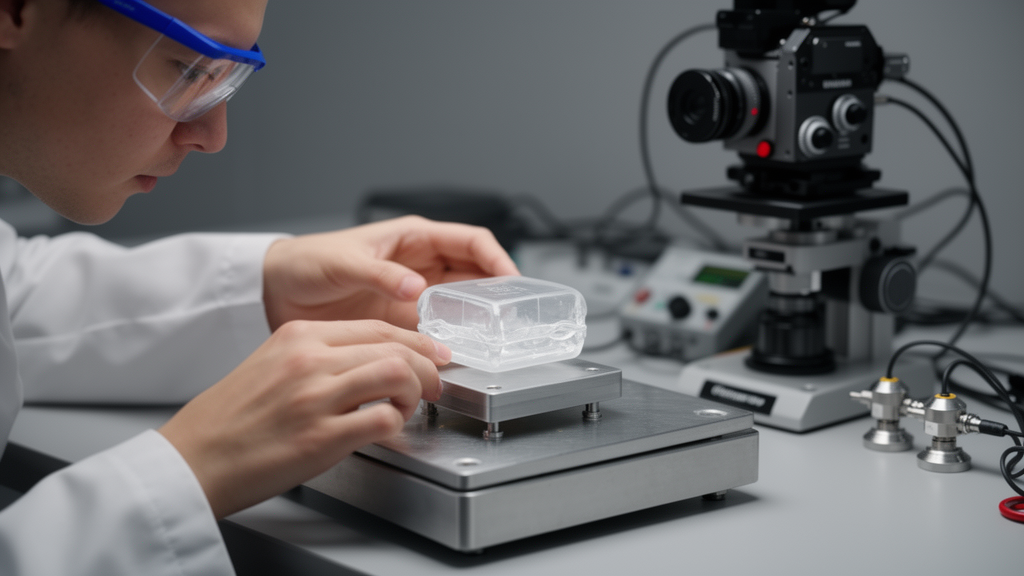
Recreating the violent, millisecond-long pressure pulse of a close-range explosion has always forced engineers into an uncomfortable trade-off. Real blast tests deliver the most faithful loading, but they are expensive, tightly regulated, and notoriously difficult to instrument: fireballs, turbulent near-field flow, and the random position of the detonator can scramble pressure sensors or distort their signals. A new study published in Case Studies in Construction Materials offers a strikingly simple alternative — swap the explosive for a falling steel hammer, and swap the chaos of detonation for a carefully chosen layer of thermoplastic polyurethane (TPU) whose hardness becomes the tuning knob for the entire blast-like waveform.
The research team, led by Jian Ma with colleagues including Can Cui, Weiming Zhang, Guangkun Liu, and Linzhi Wu, built their approach around a self-developed pneumatic–hydraulic hybrid-driven drop-weight platform. Unlike conventional drop towers limited by drop height and energy, this machine can drive a massive flat-faced hammer — up to 900 kilograms — onto a target at controlled velocities ranging from 5 to 45 meters per second. Between the hammer and an 800 by 800 by 30 millimeter Q235 steel plate sits the crucial ingredient: a 60-millimeter-thick cushion assembled from 36 modular TPU blocks, each 100 by 100 millimeters, covering the hammer’s 600 by 600 millimeter impact face.
What makes the study more than another drop-test campaign is its systematic treatment of cushion hardness as an explicit design variable. The researchers characterized four TPU grades with Shore A hardness values of 30, 40, 50, and 60 under both quasi-static and dynamic compression. Quasi-static tests on an Instron 5967 machine, compressing cast cylindrical specimens to 70 percent strain, showed the elastic modulus climbing steadily with hardness — from about 2.26 megapascals for the softest grade to roughly 4.87 megapascals for the hardest. Dynamic characterization on a split Hopkinson pressure bar with 35-millimeter titanium alloy bars revealed pronounced strain-rate sensitivity: higher impact velocities produced steeper stress–strain curves and dramatically higher dynamic stress levels, a dynamic stiffening that becomes central to how the cushion shapes the load pulse.
The physics of why a rubbery layer can mimic an explosion comes down to stress-wave mechanics. When the hammer strikes the cushion, the compliant interlayer modifies the local contact stiffness, the deformation pathway, and the transmission of stress waves into the plate, converting a sharp mechanical impact into a smooth, controllable pressure pulse. An analytical model based on one-dimensional elastic wave propagation and momentum conservation captures the essentials: peak pressure, transmitted impulse, and load duration each depend on the wave impedances of the hammer, cushion, and plate, as well as the hammer mass and impact velocity. Introducing a soft layer, the theory shows, stretches the loading duration and gives engineers far more flexibility in sculpting the waveform than a bare steel-on-steel impact ever could.
The experiments confirmed the theory with impressive fidelity. With the hammer mass fixed at 200 kilograms, the impact velocity at 10 meters per second, and the cushion thickness at 60 millimeters, simply swapping TPU hardness shifted the measured peak pressure from 2.15 megapascals with the softest 30 HA cushion to 2.94 megapascals with the hardest 60 HA grade — while the load duration shortened in step. Three pressure sensors embedded flush in the target plate recorded the response, and their arithmetic mean defined the representative pressure–time history, with coefficients of variation across the measurement locations falling between roughly 7 and 10 percent. Impulse, notably, changed only slightly across the hardness range, revealing that hardness primarily shapes the pressure peak and pulse duration rather than the total momentum delivered.
A three-dimensional explicit finite-element model extended the experimental picture far beyond what the test matrix could cover. The steel hammer and plate were modeled with a strain-rate-sensitive plasticity model, while the TPU cushion used a simplified rubber/foam material model fed with the tabulated rate-dependent stress–strain curves measured in the Hopkinson bar tests. After a careful mesh sensitivity study — coarser meshes underestimated peak pressure, and a 4-millimeter mesh kept deviations within about 1 percent — the model reproduced the measured pressure, impulse, and duration histories with errors generally below 6 percent across all four hardness cases, validating its use for broader parametric exploration.
The numerical sweeps mapped out how each parameter steers a different feature of the blast-like pulse. Impact velocity emerged as the dominant lever on peak pressure and impulse, with both rising nearly linearly as velocity climbed from 5 to 45 meters per second, while duration barely budged. Hammer mass and thickness raised all three characteristics, pushing the cushion deeper into its strain-hardening regime and raising the instantaneous effective stiffness. Cushion thickness worked in the opposite direction on the peak: thicker layers lowered peak pressure following a power-law trend and stretched the pulse almost linearly, because a thicker cushion offers a longer stress-wave path and a gentler stiffness development. Hardness, meanwhile, acted as a pulse-shaping material parameter — raising the peak and sharpening the rising edge while leaving impulse largely untouched.
To turn these insights into a practical design tool, the team distilled the physics through dimensional analysis. Using the Buckingham theorem, they reduced the problem to a handful of dimensionless groups — the peak pressure normalized by the cushion modulus, the impulse scaled by a characteristic impulse measure, the duration scaled by a kinematic time, and ratios capturing the hammer-to-cushion thickness and stiffness contrast. Regression across 105 numerical cases, arranged in a four-factor, nine-level orthogonal design, produced a compact four-parameter prediction model. Calibrated coefficients of determination reached 0.86 for peak pressure, 0.996 for impulse, and 0.97 for duration, and external validation against the four experimental hardness cases — deliberately excluded from fitting — yielded mean absolute percentage errors of 13.1, 5.3, and 8.6 percent respectively.
The practical payoff is a recipe: given a desired charge mass and stand-off distance, empirical blast equations estimate the target peak overpressure, positive-phase impulse, and duration, and the prediction model then guides the coordinated selection of cushion hardness, cushion thickness, hammer mass, and impact velocity to match that pressure–time history on the laboratory floor. The authors are careful to scope the claim — the method regulates the load characteristics at the target interface, not the full detonation physics, fireball evolution, or fluid–structure interaction, and the current calibration covers a specific supported steel plate within defined parameter ranges. Still, the approach aligns with a growing international effort, from the hydraulic blast simulator at UC San Diego to the electrically driven e-BLAST system in Europe, to reproduce structural blast response without explosives.
What elevates the work from incremental to potentially viral among protective-design researchers is its elegance: a commodity elastomer, priced by the sheet and cut into blocks, becomes a programmable filter for one of the most extreme loading conditions engineers must design against. Harder TPU suits cases demanding high load-bearing capacity with limited deformation; softer grades excel at large-deformation buffering and energy dissipation. By quantifying exactly where each hardness level lands on the pressure–impulse–duration landscape, the study transforms cushion selection from trial and error into calculation — bringing repeatable, explosive-free blast simulation a significant step closer to any structural laboratory with room for a very heavy hammer.
Subject of Research: Hardness-dependent TPU cushioning layers for regulating drop-weight-generated near-field blast-like loading
Article Title: Hardness-dependent TPU cushioning layers for regulating drop-weight-generated near-field blast-like loading
Article References: Ma, J., Cui, C., Zhang, W., Liu, G., & Wu, L. (2026). Hardness-dependent TPU cushioning layers for regulating drop-weight-generated near-field blast-like loading. Case Studies in Construction Materials, 25, Article e06626. https://doi.org/10.1016/j.cscm.2026.e06626
Image Credits: AI Generated
DOI: 10.1016/j.cscm.2026.e06626
Keywords: blast simulation, thermoplastic polyurethane, drop-weight impact, near-field blast, cushioning layer, Shore A hardness, strain-rate sensitivity, finite element model, pressure-time history, dimensional analysis, protective structures, waveform tailoring
Cite Scienmag News
Denise Maddox. (October 18, 2026). Softer or Harder? Tuning Plastic Cushions to Recreate Blast Waves Without Explosives. Scienmag. https://scienmag.com/softer-or-harder-tuning-plastic-cushions-to-recreate-blast-waves-without-explosives/
Denise Maddox. "Softer or Harder? Tuning Plastic Cushions to Recreate Blast Waves Without Explosives." Scienmag, 18 October 2026, https://scienmag.com/softer-or-harder-tuning-plastic-cushions-to-recreate-blast-waves-without-explosives/. Accessed 18 October 2026.
Denise Maddox. "Softer or Harder? Tuning Plastic Cushions to Recreate Blast Waves Without Explosives." Scienmag. October 18, 2026. https://scienmag.com/softer-or-harder-tuning-plastic-cushions-to-recreate-blast-waves-without-explosives/


