


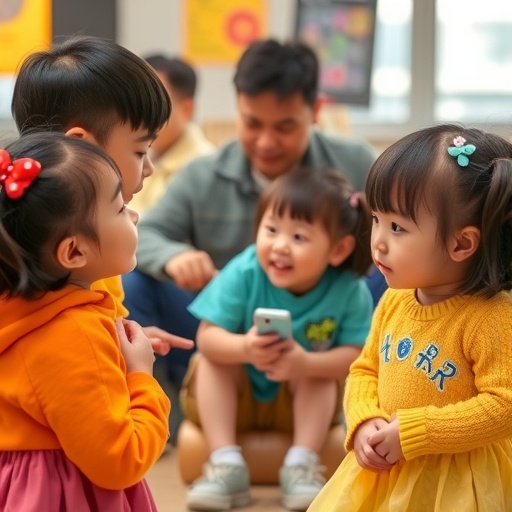
In a groundbreaking study set to reshape our understanding of early childhood development, researchers Zhu, Shen, and Li delve into the intricate interplay between social avoidance, behavioral self-regulation, and social adjustment among Chinese kindergartners. Published in the latest volume of BMC Psychology, this work provides crucial insights into how young children navigate the complex social environments they encounter during their formative years, highlighting mechanisms that could illuminate pathways toward healthier psychological development in early childhood.
Early childhood is a pivotal period marked by rapid cognitive, emotional, and social growth. The ability of a child to regulate behavior and engage effectively with peers is not merely a reflection of innate temperament but also the product of multifaceted interactions involving internal regulation capacities and external social demands. Zhu and colleagues’ research focuses on social avoidance—a tendency to shy away from social interactions—which can have profound implications on a child’s ability to self-regulate behavior and adapt socially within kindergarten settings.
Social avoidance, although often viewed simply as shyness or introversion, is a complex behavioral phenomenon with roots in both neurobiological predispositions and environmental influences. The study meticulously examines how such avoidance may relate to deficits or variations in behavioral self-regulation, a set of executive functions including impulse control, attentional focusing, and emotional regulation. These executive functions enable children to modulate responses and behave in socially accepted ways, thus fostering social adjustment, which refers to the degree to which a child successfully navigates social relationships and norms.
Methodologically, the researchers employed a robust sample of Chinese kindergartners, utilizing observational protocols and standardized behavioral assessments to measure social avoidance behaviors and self-regulation capacities. Such methodological rigor allows for the disentangling of nuanced relationships, revealing that children who exhibit higher degrees of social avoidance also tend to demonstrate challenges in behavioral self-regulation. These challenges, in turn, significantly predict poorer social adjustment outcomes, suggesting a cascading effect beginning from avoidance, through self-regulatory difficulties, to social maladjustment.
The cognitive mechanisms underlying these associations are particularly fascinating. Behavioral self-regulation involves complex neural networks encompassing prefrontal cortex functions that mature considerably during early childhood. Children who socially avoid may have fewer opportunities to engage in the dynamic social exchanges that promote the maturation of these neural circuits. This deprivation, coupled with potentially heightened anxiety or inhibition, could limit the development of adaptive behavioral controls, perpetuating a cycle of avoidance and social difficulty.
Moreover, the cultural context of the study adds an enriching dimension to the findings. China’s sociocultural environment emphasizes collectivism, social harmony, and cooperative behavior, expectations that may intensify the pressures on children to conform socially. In such contexts, social avoidance could be particularly detrimental, potentially stigmatizing children and interrupting their ability to integrate healthily into peer groups. Understanding how cultural norms shape these developmental trajectories is essential for tailoring interventions that respect societal values while promoting children’s well-being.
Importantly, this study underscores the interaction between internal psychological processes and external social contexts. Social avoidance does not exist in isolation but is tightly interwoven with a child’s capacity to exercise behavioral self-regulation within a community of peers and adults. The dynamic, reciprocal nature of these relationships suggests interventions aimed solely at modifying behavior may fall short unless they also address the child’s internal regulatory capacities and the social environment’s responsiveness.
From an applied perspective, the implications of this research are profound. Early identification of children exhibiting social avoidance coupled with difficulties in behavioral self-regulation could enable educators and psychologists to implement targeted strategies that promote social inclusion and regulate emotional responses. Emphasizing play-based social skills training, parental involvement, and school environment adaptations could mitigate the risks associated with social avoidance.
The findings also beckon further investigation into whether social avoidance in early childhood is a transient developmental phase or indicative of more enduring psychological patterns. Longitudinal data could disentangle these possibilities, determining whether early self-regulatory difficulties serve as developmental stepping stones or maladaptive routes leading to later social and emotional disorders.
Neuroscientific advances dovetail elegantly with this work. Future research integrating neuroimaging may reveal how neural development correlates with observed behavior patterns in social avoidance and self-regulation, potentially leading to biomarker identification for early detection and intervention. Such a blend of psychological assessment and neuroscience promises a holistic understanding of child development.
Additionally, the role of caregivers and educators emerges as critical in shaping the trajectories of socially avoidant children. Responsive caregiving that sensitively acknowledges the child’s emotional states while scaffolding social engagement represents a promising avenue for fostering resilience and promoting adaptive self-regulation strategies within the kindergarten milieu.
This study by Zhu, Shen, and Li also raises essential questions about the universality versus cultural specificity of developmental constructs such as social avoidance and behavioral self-regulation. Comparative studies across diverse sociocultural contexts could illuminate how cultural norms modulate these phenomena, informing culturally sensitive frameworks for assessing and supporting child development globally.
Moreover, the research highlights the importance of early childhood interventions that do not merely focus on external behaviors but also cultivate internal self-regulatory skills. Training children to recognize and modulate their emotions, sustain attention, and inhibit maladaptive impulses could enhance their social experiences and overall adjustment, bearing long-term benefits for academic achievement and psychosocial health.
In sum, the interplay between social avoidance, behavioral self-regulation, and social adjustment is a delicate balance influenced by neurodevelopmental, psychological, and cultural factors. Zhu and colleagues’ study provides a sophisticated analysis of these interrelations, advancing our knowledge frontier in developmental psychology and opening new pathways for research and practice that prioritize holistic, culturally attuned support for young children.
As the demands on children navigating increasingly complex social worlds grow, understanding the mechanisms by which some children struggle or thrive becomes paramount. This research offers a crucial window into the early foundations of social competence, emphasizing the intertwined roles of behavior, cognition, and environment in shaping children’s journeys through the social landscape of kindergarten and beyond.
Future applications of these findings could reshape educational policies and mental health initiatives aimed at fostering inclusivity and emotional well-being from the earliest stages of schooling. By recognizing and addressing the challenges faced by socially avoidant children through the lens of self-regulation and social adjustment, stakeholders can create nurturing ecosystems that encourage every child to flourish socially and emotionally.
This pioneering research in the Chinese context thus not only enriches our theoretical frameworks but also signals important practical directions for supporting the next generation’s social and psychological development amid the intricate interplay of cultural expectation and individual difference.
Cite Scienmag News
Glenn Wilkins. (September 1, 2025). Social Avoidance and Self-Regulation in Chinese Kindergartners. Scienmag. https://scienmag.com/social-avoidance-and-self-regulation-in-chinese-kindergartners/
Glenn Wilkins. "Social Avoidance and Self-Regulation in Chinese Kindergartners." Scienmag, 1 September 2025, https://scienmag.com/social-avoidance-and-self-regulation-in-chinese-kindergartners/. Accessed 4 September 2026.
Glenn Wilkins. "Social Avoidance and Self-Regulation in Chinese Kindergartners." Scienmag. September 1, 2025. https://scienmag.com/social-avoidance-and-self-regulation-in-chinese-kindergartners/


