


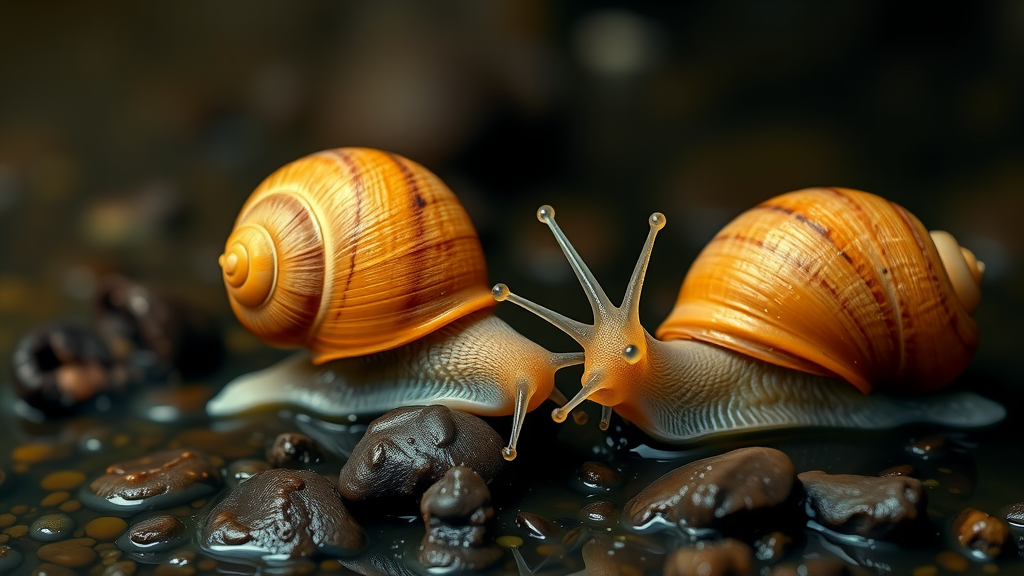
Some of the most telling witnesses to water pollution do not wear sensors or carry microchips. They carry shells. A new systematic review published in Environmental Monitoring and Assessment argues that freshwater snails, long overshadowed by fish and other vertebrate models in endocrine disruption research, deserve a far more prominent role in the detection of estrogenic pollutants in aquatic environments. The review, led by Burhan Basaran of Recep Tayyip Erdogan University together with colleagues at Tehran University of Medical Sciences and other Iranian institutions, synthesizes the evidence that snails respond measurably and consistently to estrogenic compounds, and that simple snail-based bioassays could become routine sentinels in treatment plants, rivers, lakes, and even rice paddies.
The problem the review addresses is both vast and largely invisible. Compounds with estrogenic activity, including natural steroid estrogens excreted by humans and livestock, synthetic hormones from contraceptives, and a sprawling family of industrial chemicals known as xenoestrogens such as bisphenol A, nonylphenol, phthalates, and organotin compounds, are continuously released into ecosystems through industrial activity, agriculture, and domestic wastewater. Conventional chemical analysis can identify and quantify these substances, but it cannot by itself answer the question that matters most ecologically: are the compounds present in a given water body biologically available and actively interfering with the endocrine systems of living organisms? That is where bioassays, tests using living organisms or their tissues to measure biological effect, come in, and where the review makes its case for snails.
The authors conducted a systematic search of the scientific literature using relevant keywords, screened the resulting manuscripts according to predefined criteria, and extracted data from the selected studies. Their synthesis shows that snails have now been used to assess estrogenic activity across a striking range of aquatic settings: drinking water, river and lake water, rice fields, and waste liquids both before and after treatment. In each of these contexts, snail-based endpoints provided a readout of estrogenic pressure that complemented, and in some cases exceeded, the information available from chemical measurement alone. The breadth of environments covered is significant, because it suggests that a single, relatively simple test organism can be deployed across the full spectrum of water quality monitoring, from pristine sources to heavily impacted effluents.
Why snails? Part of the answer lies in their biology. Mollusks are extremely sensitive to endocrine-active compounds, and their reproductive output is easy to observe and count. Many freshwater gastropods reproduce prolifically under laboratory conditions, laying eggs in predictable patterns, which means that changes in the rate of reproduction, the number of eggs or embryos produced, or the timing of breeding can be quantified without sophisticated equipment. The review highlights that some assessments, such as the rate of increase in reproduction, are simple enough to be carried out by laboratories that lack advanced analytical instrumentation. This simplicity is precisely what makes the authors recommend deploying snail bioassays in sensitive environments such as urban and industrial treatment plants, where a fast, cheap, and biologically meaningful indicator of estrogenic activity would be most valuable.
The underlying literature assembled in the review illustrates how this sensitivity plays out in practice. Studies on the freshwater snail Biomphalaria alexandrina established the species as a model organism for assessing the endocrine-disrupting effects of 17β-estradiol, the primary natural estrogen, while other work documented endocrine-disruptor effects of the herbicides atrazine and glyphosate on the same genus. In Europe, researchers used the mudsnail Potamopyrgus antipodarum in in situ cage experiments, placing the animals directly into rivers and lakes to capture real-world exposure, and in effect-directed analysis of riverine sediments to confirm endocrine disruption in vivo. Caged mudsnails deployed as an integrated field biomonitoring tool have revealed reprotoxic effects of water column contamination that would be difficult to reconstruct from spot samples of water chemistry alone.
Other studies reviewed by the authors extend the picture to different species and settings. The snail Physella acuta was used in an in situ bioassay across three Iberian river basins to ask whether its reproduction was affected by endocrine-disrupting compounds, and the golden apple snail Pomacea canaliculata showed alterations of biochemical indicators in its hepatopancreas in paddy fields in Taiwan, demonstrating the value of snails in agricultural monitoring. Work on the freshwater snail Parafossarulus striatulus characterized an estrogen receptor and its expression profiles under both laboratory and field exposure, while single-molecule real-time sequencing of freshwater snails exposed to estrogens and androgens has begun to reveal the molecular responses that underlie the whole-organism effects. Even bisphenol A has been traced from river water around a secure landfill into the tissues of freshwater snails collected on site, closing the loop between environmental occurrence and biological uptake.
The review also situates snail bioassays within the broader toolkit of endocrine disruption assessment, and in doing so exposes a gap. Much of the regulatory and scientific attention to estrogenic pollution has focused on fish, where the production of vitellogenin, an egg-yolk precursor protein, serves as the canonical biomarker of estrogen exposure. Yet recent cross-laboratory surveys have highlighted methodological challenges in fish vitellogenin analysis, and questions have been raised about whether changes in vitellogenin concentrations in fish are always reliable indicators of chemically induced endocrine activity. Snails offer an alternative and complementary endpoint: direct measurement of reproductive output in an organism that is often easier and cheaper to maintain, and whose responses integrate exposure over time in a way that a single blood sample from a fish cannot.
None of this means that snails are a perfect or complete solution, and the review is careful to frame them as one component of a monitoring strategy rather than a replacement for chemical analysis. The molecular machinery of estrogen signaling in mollusks differs in important ways from that of vertebrates, and the evolutionary history of estrogen receptors across the animal kingdom remains an active area of research. Some studies reviewed found no substantial changes in estrogen receptor or estrogen-related receptor gene transcription in the snail Marisa cornuarietis exposed to estrogenic chemicals, a reminder that responses can be species-specific and that transcriptional endpoints do not always track reproductive outcomes. The strength of the snail approach lies in its whole-organism, population-relevant endpoints, such as fecundity and embryo production, which are directly tied to ecological consequences even when the precise molecular pathway remains unresolved.
The practical implications of the review are considerable. Wastewater treatment plants are a critical control point for estrogenic pollution, because natural and synthetic estrogens, bisphenol analogues, alkylphenols, and pharmaceuticals pass through conventional treatment with variable efficiency. Advanced treatment processes such as ozonation and activated carbon filtration have been shown to reduce in vitro endocrine activity, yet studies using in vivo test batteries have found that reproductive toxicity is not always eliminated, underscoring the need for biological verification rather than reliance on chemical removal targets alone. A snail bioassay deployed at the outfall of a treatment plant, or upstream and downstream of an industrial discharge, would provide a direct measure of whether the effluent is biologically active, at a cost and complexity that many facilities could realistically absorb. The same logic applies to drinking water, where the occurrence of natural estrogens and bisphenol analogues in treatment plants has been documented, and to rice fields and livestock wastewaters, where estrogens from animal husbandry enter surface waters.
What emerges from this systematic review is a picture of an underused tool on the verge of wider adoption. The evidence base now spans multiple snail species, multiple continents, and multiple classes of estrogenic compounds, from steroid hormones to industrial xenoestrogens, and it consistently supports the conclusion that snails can be used to assess the estrogenic activity of different aquatic environments. Because the most informative endpoints are simple, reproducible, and ecologically meaningful, the authors argue that the deployment of these bioassays should be actively encouraged in sensitive settings, particularly urban and industrial treatment plants where the stakes for downstream ecosystems and human water supplies are highest. In an era when endocrine-disrupting chemicals are increasingly recognized as threats to reproductive health in wildlife and humans alike, the humble snail may prove to be one of the most effective early-warning systems that environmental science has overlooked for too long. The shells, it turns out, were listening all along.
Subject of Research: Using snail bioassays to assess estrogenic pollutants in aquatic environments
Article Title: Assessment of estrogenic pollutants in aquatic environments with snail (bio)tests: a systematic review
Article References: Basaran, B., Ghazi-Khansari, M., Akbari, N., Gholami-Ahangaran, M., Bekheir, S. A., & Sadighara, P. (2026). Assessment of estrogenic pollutants in aquatic environments with snail (bio)tests: a systematic review. Environmental Monitoring and Assessment, 198(10), Article 1089. https://doi.org/10.1007/s10661-026-15931-9
Image Credits: AI Generated
DOI: 10.1007/s10661-026-15931-9
Keywords: snails, estrogenic compounds, endocrine disruptors, bioassay, water quality, wastewater treatment, ecotoxicology, freshwater mollusks, xenoestrogens, environmental monitoring, reproductive toxicity, Potamopyrgus antipodarum
Cite Scienmag News
Violet Maxwell. (September 23, 2026). Snails Emerge as Surprising Sentinels for Estrogen Pollution in Water. Scienmag. https://scienmag.com/snails-emerge-as-surprising-sentinels-for-estrogen-pollution-in-water/
Violet Maxwell. "Snails Emerge as Surprising Sentinels for Estrogen Pollution in Water." Scienmag, 23 September 2026, https://scienmag.com/snails-emerge-as-surprising-sentinels-for-estrogen-pollution-in-water/. Accessed 5 October 2026.
Violet Maxwell. "Snails Emerge as Surprising Sentinels for Estrogen Pollution in Water." Scienmag. September 23, 2026. https://scienmag.com/snails-emerge-as-surprising-sentinels-for-estrogen-pollution-in-water/


