


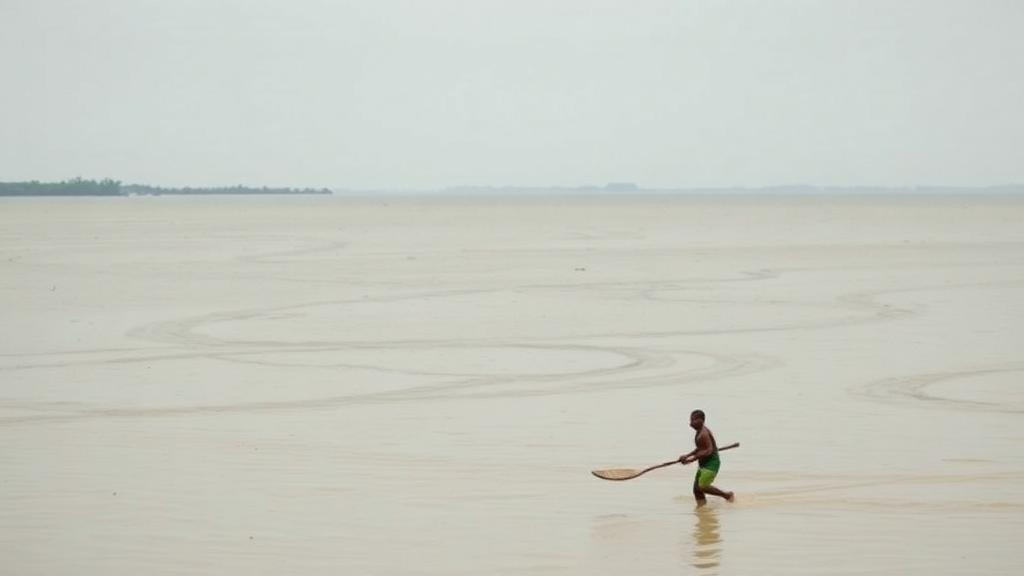
On the riverine island of Gabura Union, cut off from the mainland of Satkhira district by the Kholpetua River, every single household surveyed in a new study reported having been displaced at some point by environmental or livelihood pressures. Yet only 40 percent of those households said at least one member had actually migrated, and more than half of all respondents declared they would rather endure hardship than abandon their ancestral land. That paradox—universal exposure to climate hazards but selective, mostly temporary migration—sits at the heart of research published in Discover Oceans that examines the causes, consequences and processes of climate-induced coastal migration in Bangladesh.
The study, led by Md Minarul Hoque of the Bangladesh Oceanographic Research Institute, is grounded in the recognition that Bangladesh ranks among the world’s most climate-vulnerable nations. The Global Climate Risk Index 2021 placed it seventh for vulnerability to extreme weather between 2000 and 2019, while the World Risk Index 2023 ranked it ninth for overall disaster risk. The country’s southwestern coast, facing the Bay of Bengal—a basin that generates five to six more tropical cyclones each year than the Arabian Sea—has been battered in recent decades by Cyclones Sidr, Aila, Amphan and Yaas. Sidr alone affected more than eight million people and caused over 3,400 deaths and USD 1.7 billion in damage; Aila displaced three million; Amphan touched ten million lives and inflicted USD 131 million in losses.
To understand how these shocks translate into human movement, the researchers surveyed 60 households and conducted eight focus group discussions across Gabura’s villages, complementing their fieldwork with meteorological records from the Bangladesh Meteorological Department covering 2000 to 2020. The team deliberately adopted an exploratory, perception-based design, documenting how affected households themselves articulate the drivers of mobility rather than attempting to establish formal causal mechanisms. Respondents were selected through simple random sampling, and thematic saturation—repetition and consistency across accounts—was reached within the sample, consistent with methodological guidance for qualitative migration research.
The environmental picture that emerged is unambiguous. All respondents reported year-round exposure to salinity intrusion, alongside recurrent cyclones, tidal surges, flooding and waterlogging. Sea level in the region is rising at an estimated 5 to 7.5 millimeters per year, and salinity-affected land in coastal Bangladesh expanded from 8,330 to 10,560 square kilometers between 1973 and 2009. Saltwater encroachment has degraded soil fertility, reduced crop yields and compromised drinking water, while the mangrove ecosystems that buffer cyclones and sustain fisheries are themselves under threat. Meteorological records confirmed an upward trend in cyclone frequency and tidal flooding intensity over the past two decades, matching residents’ accounts that major migration waves followed Sidr in 2007, Aila in 2009 and Amphan in 2020.
But the socioeconomic data reveal why climate alone does not explain who leaves. Seventy-three percent of households were classified as poor and 10 percent as very poor, with 56.7 percent dependent on a single income earner. Half of respondents had no formal education and only 3.3 percent had completed higher education. Occupational transformation was striking: just 10 percent still fished, while 43.3 percent had turned to woodcutting—known locally as Bawali—and 23.3 percent to day labor, reflecting the collapse of traditional fishing viability under resource depletion, rising costs and repeated disasters. The population is also markedly older than in other coastal communities studied in Teknaf, Cox’s Bazar and along the Padma and Meghna rivers, a pattern the authors interpret as evidence of selective out-migration of the young and economically active, leaving behind an aging population with reduced adaptive capacity.
The statistical analysis sharpened this picture. Chi-square tests found a significant association between livelihood category and migration decision, with people in environmentally sensitive occupations such as fishing and woodcutting more likely to move, while gender showed no significant effect. Pearson correlations revealed a moderate positive relationship between salinity exposure and migration frequency and a negative relationship between income change and migration, meaning households facing income losses were more likely to migrate. A binary logistic regression model, statistically significant and correctly classifying 78.3 percent of cases, identified salinity exposure as the most influential predictor, roughly doubling the odds of migration, while higher household income significantly reduced the likelihood of leaving. The authors stress these inferential results are exploratory indicators of association within a small, case-based sample rather than generalizable causal proof.
Migration from Gabura, the study concludes, is best described as climate-linked rather than purely climate-induced. Environmental shocks—cyclones, surges, salinity—act as triggers that destroy assets and undermine livelihoods, but the decision to move is ultimately driven by the search for income, security and services, filtered through poverty, indebtedness and limited local employment. Most movement is internal and often temporary, with migrants seeking work in nearby districts such as Jashore, Satkhira and Khulna, typically leaving dependents behind. Male wage earners usually decide on migration while women follow or stay, reinforcing traditional household power dynamics. Meanwhile, 53.3 percent of respondents preferred to stay despite hardship, reflecting a deep emotional and cultural attachment to place that the authors frame as voluntary immobility—a form of cultural continuity rather than a failure to adapt.
The broader national context amplifies the stakes. Between 2008 and 2014, 4.7 million Bangladeshis were displaced, and 7.1 million were displaced in 2022 alone. The World Bank estimates South Asia may see 17 to 36 million internal climate migrants by 2050, one-third of them potentially in Bangladesh, and warns that 13.3 million Bangladeshis could be displaced over the next three decades through the combined effects of sea level rise, water scarcity and agricultural decline. Up to 70 percent of slum dwellers in Dhaka are already considered climate migrants, making environmental displacement what the study calls a silent urban crisis. Comparable dynamics are visible globally, from seasonal labor migration in Vietnam’s salinity-stricken Mekong Delta to relocation pressures in Kiribati and Tuvalu, though Gabura’s weaker institutional support and stronger place attachment constrain adaptive mobility in distinctive ways.
From these findings the authors derive a set of exploratory policy directions: establishing a national database on climate migrants to replace unrecorded movement with proactive planning; investing in climate-resilient infrastructure, including embankments, cyclone shelters, early-warning systems and community desalination or rainwater harvesting to counter salinity; and developing localized adaptation strategies such as salt-tolerant crops, aquaculture training and livelihood diversification for single-earner households. They argue such measures could be operationalized through existing frameworks like the Bangladesh Delta Plan 2100 and the National Adaptation Plan, and that early-warning and embankment investments are cost-effective relative to future disaster recovery and displacement costs.
The study acknowledges its limitations—a single union, a small sample dominated by male household heads, reliance on retrospective self-reports, and a cross-sectional design that cannot track change over time—and calls for longitudinal, gender-balanced and spatially explicit follow-up research. Its central message, however, is clear: effective policy must address environmental risk and socioeconomic vulnerability together, recognizing both the right of coastal communities to remain in safety and the right of those who must move to do so with dignity. In Gabura, climate change operates not as a solitary force but as a powerful catalyst within a wider web of poverty, livelihood insecurity and cultural attachment—and it is that web, the authors contend, that ultimately determines who stays and who goes.
Subject of Research: Climate-induced migration and its socioeconomic drivers in coastal Bangladesh
Article Title: Causes, consequences and processes of climate induced coastal migration in Bangladesh
Article References: Hoque, M. M., Ahmed, N., Khan, M. A. I., & Bhuyan, M. S. (2026). Causes, consequences and processes of climate induced coastal migration in Bangladesh. Discover Oceans, 3(1), Article 10. https://doi.org/10.1007/s44289-026-00126-4
Image Credits: AI Generated
DOI: 10.1007/s44289-026-00126-4
Keywords: climate-induced migration, Bangladesh, coastal communities, salinity intrusion, tropical cyclones, sea level rise, livelihood insecurity, internal displacement, climate adaptation, Gabura Union, Satkhira, place attachment
Cite Scienmag News
Violet Maxwell. (October 5, 2026). Climate Shocks Push Coastal Bangladesh to the Brink, but Poverty Decides Who Leaves. Scienmag. https://scienmag.com/climate-shocks-push-coastal-bangladesh-to-the-brink-but-poverty-decides-who-leaves/
Violet Maxwell. "Climate Shocks Push Coastal Bangladesh to the Brink, but Poverty Decides Who Leaves." Scienmag, 5 October 2026, https://scienmag.com/climate-shocks-push-coastal-bangladesh-to-the-brink-but-poverty-decides-who-leaves/. Accessed 5 October 2026.
Violet Maxwell. "Climate Shocks Push Coastal Bangladesh to the Brink, but Poverty Decides Who Leaves." Scienmag. October 5, 2026. https://scienmag.com/climate-shocks-push-coastal-bangladesh-to-the-brink-but-poverty-decides-who-leaves/


