


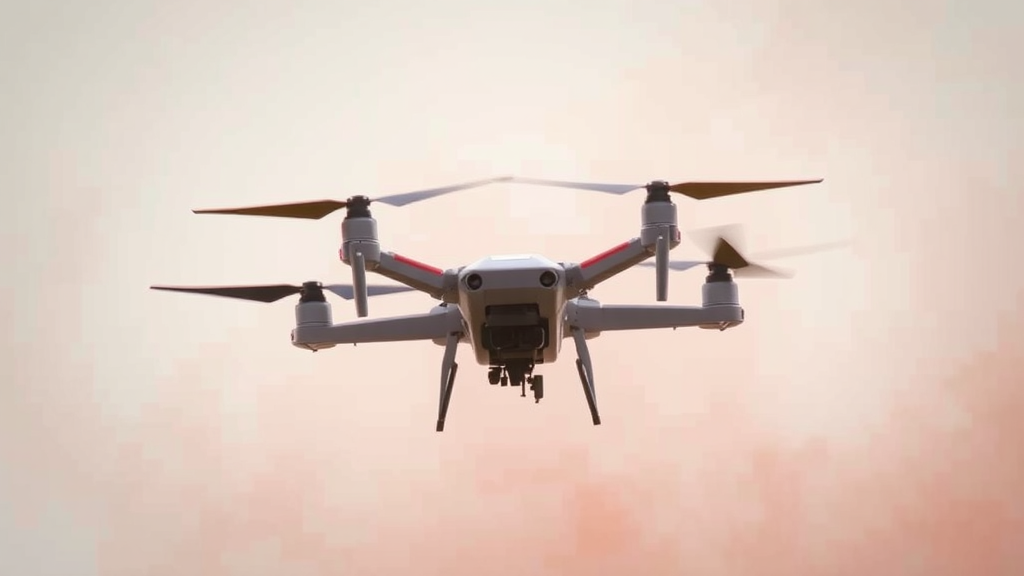
When an electro-optically guided missile locks onto a high-value target in the final seconds of its flight, defenders have only a handful of opportunities to break the kill chain. One of the oldest tricks in the defensive playbook—hiding the target behind a cloud of obscuring smoke—remains one of the most effective, but only if the smoke is in exactly the right place at exactly the right time. A new study published in the International Journal of Aeronautical and Space Sciences shows just how unforgiving that timing problem really is, and how a coordinated swarm of small drones could solve it. Researchers Jiajun Xu, Zhifeng Liu, and Changxuan Cao of East China University of Technology in Nanchang have built an optimization framework that jointly choreographs the flight paths, release timing, detonation delays, and task assignments of multiple smoke-screen-carrying unmanned aerial vehicles, turning what has traditionally been a matter of rehearsed procedure into a computationally rigorous planning problem.
The core challenge the researchers tackle is the geometry of terminal missile defense. Electro-optical seekers home in on the infrared or visible signature of a target along a line of sight that changes continuously as the missile closes in. A smoke cloud that blocks the seeker’s view at one instant may be useless a second later, because the missile’s viewing angle has shifted, the cloud has drifted with the wind, or the cloud itself has expanded and thinned as it disperses. Static, pre-planned smoke barriers therefore waste most of their obscuration potential. The team’s answer is a time-varying line-of-sight occlusion metric: a quantitative measure, recomputed continuously throughout the engagement, of how much the missile-to-target sightline is actually blocked by the evolving smoke field. Rather than asking whether a cloud exists near the target, the framework asks whether the cloud sits on the shrinking, rotating corridor of sightlines that the incoming seeker can actually use.
Modeling this properly requires three coupled components. The first is a multi-stage kinematic model that describes each phase of the engagement: the UAVs maneuvering into position, the smoke canisters being released with a programmable delay, their ballistic free-fall, the detonation event, and the subsequent growth, drift, and decay of the smoke cloud. Each stage feeds the next, so an error in a release heading propagates into where the cloud forms, which in turn determines whether it ever intersects the missile’s line of sight. The second component is the occlusion metric itself, which integrates the geometric overlap between the sightline corridor and the smoke cloud volume over time. The third is the optimizer, a hierarchical genetic algorithm that searches over the full decision space—UAV trajectories, release points, fuse delays, and which drone handles which missile—without requiring the problem to be simplified into a form where those couplings disappear.
Genetic algorithms are well suited to this kind of problem because the search space is riddled with discrete choices and nonlinear couplings. A hierarchical structure lets the algorithm handle different layers of the decision separately while still exchanging information between them: task assignments at one level, continuous trajectory and timing parameters at another. The fitness function rewards solutions that maximize the time-integrated occlusion of all incoming missiles simultaneously, subject to UAV dynamics and coordination constraints. In effect, the algorithm plays out thousands of candidate engagements, keeps the ones that hide the target longest, and breeds new candidates from the winners until the shielding performance stops improving. The result is a deployment plan that no fixed doctrine could produce, because it exploits the specific geometry of each scenario—missile arrival directions, speeds, and timing—rather than assuming a generic threat.
The quantitative payoff is striking. In the paper’s benchmark scenarios, a cooperative team of five UAVs facing three simultaneous missiles achieved 14.44 seconds of effective shielding of the protected target. A comparable fixed-parameter deployment—essentially, the traditional approach of releasing smoke according to preset rules—managed only 1.42 seconds. That is roughly a tenfold improvement in the window during which the target is invisible to the incoming seekers, and in terminal defense, where the entire endgame may last only tens of seconds, an extra thirteen seconds of obscuration can be the difference between a saved asset and a destroyed one. The comparison makes clear that the gain comes not from better smoke chemistry but from better placement: the same obscurant, delivered by coordinated drones at optimized times and locations, works dramatically harder.
Equally important, and perhaps more sobering for anyone hoping to field such a system, is the study’s sensitivity analysis. The researchers found that heading errors of just two to three degrees in UAV navigation cut the achievable shielding time by more than half. The feasible window for releasing the smoke payload turned out to be only 0.5 to 0.8 seconds wide. These numbers quantify, with unusual precision, how little margin exists in terminal smoke-screen defense. A drone that arrives a beat late, or flies its approach a few degrees off, may as well not have shown up. The authors present these constraints not as a weakness of their framework but as actionable engineering guidance: they translate directly into requirements for navigation accuracy, guidance-loop performance, and timing synchronization among the UAVs in a real deployment. In other words, the optimization does not just produce a plan; it tells system designers how good the plan’s execution must be to matter.
The framework also clarifies how the drones must cooperate. Because multiple missiles arrive on different trajectories, no single smoke cloud can cover all of the relevant sightlines at once. The hierarchical optimizer therefore assigns UAVs to missiles and coordinates their release schedules so that clouds bloom where each seeker needs them, when it needs them, while the drones avoid conflicting with one another. The authors are explicit about the simplifications involved: UAV dynamics are streamlined, and collision avoidance is handled through assumptions rather than full deconfliction planning, choices that keep the optimization tractable. The revised study addresses scalability and these modeling assumptions directly, laying out where the framework’s predictions can be trusted and where higher-fidelity simulation or flight testing would be needed before operational use.
What makes the work notable beyond its headline numbers is the way it reframes an old defensive concept as a modern autonomy problem. Smoke screens have protected ships, vehicles, and installations for a century, but their use has always been bounded by human planning and the physics of fixed launchers. Putting the obscurants on agile aerial platforms and letting an algorithm decide where and when to spend them converts the smoke screen from a static curtain into a dynamic, reactive shield that tracks the engagement as it unfolds. The time-varying line-of-sight metric is the conceptual hinge: it forces the planner to think the way the missile’s seeker does, continuously, from the missile’s changing vantage point, rather than from the target’s fixed one.
The implications reach across several domains. For military planners, the study offers a template for drone-based soft-kill defense of airbases, ships, and other high-value assets against imaging infrared seekers, complementing hard-kill interceptors that are expensive and often outnumbered during saturation attacks. For the robotics community, it is a case study in coupled trajectory-and-task optimization under hard timing constraints, demonstrating how hierarchical evolutionary search can handle decision spaces that defeat classical trajectory planners. And for the broader field of countermeasure science, it underscores a recurring lesson: performance is dominated not by the countermeasure material itself but by the precision of its delivery. As autonomous platforms proliferate, the authors’ framework suggests that the future of passive protection will belong less to better smoke and more to smarter, faster, and more tightly synchronized swarms—flying mathematics that puts a wall of fog precisely where a missile’s eye is about to look.
Subject of Research: Coordinated multi-UAV smoke-screen deployment for protecting high-value targets from electro-optically guided missiles using time-varying line-of-sight occlusion optimization.
Article Title: Coordinated Multi-UAV Smoke-Screen Deployment for Terminal Target Protection: A Time-Varying LOS-Based Optimization Framework
Article References: Xu, J., Liu, Z., & Cao, C. (2026). Coordinated Multi-UAV Smoke-Screen Deployment for Terminal Target Protection: A Time-Varying LOS-Based Optimization Framework. International Journal of Aeronautical and Space Sciences. https://doi.org/10.1007/s42405-026-01282-9
Image Credits: AI Generated
DOI: 10.1007/s42405-026-01282-9
Keywords: multi-UAV coordination, smoke-screen deployment, line-of-sight occlusion, hierarchical genetic algorithm, terminal missile defense, electro-optical guided missiles, UAV trajectory optimization, obscuration, sensitivity analysis, defense autonomy, Coordinated, Multi-UAV
Cite Scienmag News
Grant Pearson. (September 22, 2026). Smoking Out Missiles: UAV Swarms Optimize Smoke Screens to Shield High-Value Targets. Scienmag. https://scienmag.com/smoking-out-missiles-uav-swarms-optimize-smoke-screens-to-shield-high-value-targets/
Grant Pearson. "Smoking Out Missiles: UAV Swarms Optimize Smoke Screens to Shield High-Value Targets." Scienmag, 22 September 2026, https://scienmag.com/smoking-out-missiles-uav-swarms-optimize-smoke-screens-to-shield-high-value-targets/. Accessed 4 October 2026.
Grant Pearson. "Smoking Out Missiles: UAV Swarms Optimize Smoke Screens to Shield High-Value Targets." Scienmag. September 22, 2026. https://scienmag.com/smoking-out-missiles-uav-swarms-optimize-smoke-screens-to-shield-high-value-targets/


