


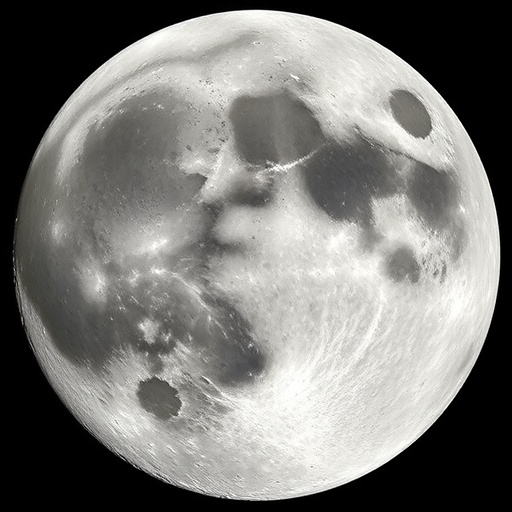
In an unprecedented feat that reshapes our understanding of lunar geology, scientists have realized the first comprehensive global mapping and analysis of small mare ridges (SMRs) on the Moon—features intricately tied to the tectonic activity that continues to modulate our celestial neighbor’s surface. This groundbreaking study, conducted by researchers at the Smithsonian Institution’s National Air and Space Museum’s Center for Earth and Planetary Studies, along with their collaborators, brings to light a previously underappreciated class of tectonic landforms that pepper the moon’s maria—the expansive, basaltic plains that define its near side. Their findings, published in The Planetary Science Journal on December 24, 2025, reveal that SMRs are not only widespread but also geologically young, underscoring ongoing tectonic processes that may influence future lunar exploration and habitation plans.
Unlike Earth, whose lithosphere is fragmented into distinct tectonic plates that constantly converge, diverge, and slide past one another, the Moon’s crust operates under a different tectonic paradigm. The terrestrial tectonic cycles sculpt mountainous ranges, oceanic trenches, and active volcanic arcs. In contrast, the lunar crust lacks these large-scale plates but still experiences internal stresses that imprint characteristic landforms. Previously documented lobate scarps—steep, cliff-like ridges prevalent in the lunar highlands—are one such signature of crustal deformation, formed as the moon gradually contracts. These scarps emerge from thrust faults where the crust is compressed, driving rock masses over adjacent surfaces and creating distinctive ridges. Their formation in the highlands, dating back around a billion years, represents about 20% of the Moon’s timeline and was the earliest indicator of ongoing contractional tectonics.
The narrative changed remarkably in 2010 when co-author Thomas Watters, a senior scientist emeritus at the Center for Earth and Planetary Studies, identified that the moon is slowly contracting—a process primarily responsible for the creation of lobate scarps. However, these scarps only accounted for part of the moon’s contractional structures. The lunar maria, dark basaltic plains formed from ancient volcanic activity, host a different set of ridges that had eluded comprehensive documentation—small mare ridges. SMRs, while sharing a genesis closely linked to the same compressive forces as lobate scarps, occupy distinctly different crustal contexts and exhibit subtle but important morphological differences. The delineation of SMRs thus enhances the broader tectonic narrative, reflecting recent crustal deformation processes restricted to maria regions.
In an ambitious endeavor to chart the presence and distribution of SMRs, the research team undertook exhaustive imagery analysis, mining data collected from the Lunar Reconnaissance Orbiter Camera (LROC) and other orbital datasets. Through meticulous cataloging, they identified an astonishing 1,114 new SMR segments on the lunar near side, more than doubling the previous count and culminating in a tally of 2,634 mapped SMRs. These ridges, on average, date back approximately 124 million years, a strikingly recent epoch in lunar geological history. This age correlates closely with that of lobate scarps (about 105 million years), suggesting that SMRs and lobate scarps emerged concurrently as young tectonic features.
The methodical investigation of the nature of faults responsible for SMR formation reveals compelling parallels to those that create the highland lobate scarps. Both arise along thrust faults driven by crustal compression during lunar contraction. Interestingly, in numerous instances, lobate scarps in the highlands transition seamlessly into SMRs in adjoining mare regions, reinforcing the hypothesis of a unified origin mechanism underlying both structures. Such observations signify a more dynamically interconnected lunar crust than previously appreciated and establish a more holistic framework for interpreting recent tectonic activity across diverse geological settings on the Moon.
This refined understanding has profound implications for lunar geophysics, particularly regarding moonquakes—seismic tremors occurring within the lunar interior. Watters’ earlier research established a definitive link between lobate scarp-associated tectonic activity and the occurrence of moonquakes mostly confined to the highland terrains. However, with the confirmation that SMRs are generated by similar compressional tectonic mechanisms, it stands to reason that moonquakes could be widespread across the maria as well, localized along these small ridges. This revelation broadens the geographical scope of potential seismic hazards, a critical consideration for the planning and safety of future crewed missions on the Moon.
The existence of active contractional features like SMRs indicates that the Moon remains dynamically evolving, albeit at a slow pace, which challenges earlier conceptions of the Moon as a geologically quiescent body. The contraction process, driven by thermal cooling of the lunar interior, exerts substantial stress on the crust. This stress manifests differently across the Moon, with lobate scarps characterizing highlands and SMRs marking the maria, yet collectively they trace the Moon’s gradual shrinkage. Such tectonic contractions alter surface topography, influence regolith layering, and directly impact the mechanical environment of potential lunar habitats, necessitating detailed seismic hazard assessments.
Moreover, this refined tectonic framework enhances our comprehension of the Moon’s internal thermal history. By dating contractional features and linking their formation to thermal contraction cycles, scientists can infer rates of cooling and solidification within the lunar mantle and crust. These data feed into models predicting the Moon’s thermal evolution, informing theories about its initial formation, differentiation, and subsequent geological quiescence or activity phases. These processes distinctly contrast with Earth’s tectonic dynamics, providing a rare comparative planetary context that enriches understanding of planetary interiors throughout the solar system.
The practical applications of this research extend beyond scientific modeling; they have direct ramifications for lunar exploration strategies such as NASA’s Artemis program and other international lunar missions. Knowledge of active tectonism and the presence of small mare ridges provides essential input for site selection, infrastructure design, and long-term habitation planning. Sites exhibiting active tectonics may harbor elevated seismic risks, potentially jeopardizing human activities, equipment integrity, and safety. Conversely, they serve as rich laboratories for in situ geological investigations, offering windows into physical processes shaping the Moon today.
Furthermore, the integration of SMR data with the existing catalog of lobate scarps creates the first global picture of contractional tectonics spanning both highlands and maria. This comprehensive mapping facilitates a refined understanding of stress distributions, fault mechanics, and temporal evolution of tectonic features across the entire lunar near side. It opens avenues for comparative analyses with other planetary bodies, especially those exhibiting tectonism without plate tectonics, such as Mercury and some icy moons, broadening the conceptualization of tectonic regimes in the solar system.
The moon’s tectonic activity also has implications for its subsurface structure and seismic behavior. SMRs and lobate scarps’ faulting likely influence fracture networks and rock permeability, potentially affecting the stability and movement of subsurface volatiles, an aspect crucial for future resource utilization. Additionally, understanding fault distributions supports the design of seismic networks intended to monitor moonquakes. Enhanced seismic monitoring will unravel the Moon’s ongoing geological processes, shedding light on its contemporary interior state and facilitating risk mitigation for lunar explorers.
In summary, the mapping of small mare ridges marks a monumental advance in lunar science. By establishing these features as youthful and tectonically significant, scientists offer novel insights into the Moon’s contraction and seismicity. This revelation uncovers a nuanced and dynamically active lunar landscape far more complex than formerly understood. As human presence on the Moon edges closer to reality, these scientific advancements not only inform fundamental lunar research but also directly influence the safety, engineering, and logistical frameworks guiding exploration and potential colonization. The Moon, often perceived as a static witness to the solar system’s formation, is underlined once again as a dynamic world with ongoing geological evolution.
News Publication Date: 24-Dec-2025
Web References: https://iopscience.iop.org/article/10.3847/PSJ/ae226a
References: The Planetary Science Journal, DOI: 10.3847/PSJ/ae226a
Keywords
Lunar tectonics, small mare ridges, lobate scarps, moonquakes, lunar geology, lunar maria, lunar contraction, thrust faults, Lunar Reconnaissance Orbiter, lunar seismicity, planetary science, lunar exploration
Cite Scienmag News
Grant Pearson. (February 18, 2026). Smithsonian Planetary Scientists Uncover Evidence of Recent Tectonic Activity on the Moon. Scienmag. https://scienmag.com/smithsonian-planetary-scientists-uncover-evidence-of-recent-tectonic-activity-on-the-moon/
Grant Pearson. "Smithsonian Planetary Scientists Uncover Evidence of Recent Tectonic Activity on the Moon." Scienmag, 18 February 2026, https://scienmag.com/smithsonian-planetary-scientists-uncover-evidence-of-recent-tectonic-activity-on-the-moon/. Accessed 3 September 2026.
Grant Pearson. "Smithsonian Planetary Scientists Uncover Evidence of Recent Tectonic Activity on the Moon." Scienmag. February 18, 2026. https://scienmag.com/smithsonian-planetary-scientists-uncover-evidence-of-recent-tectonic-activity-on-the-moon/


