


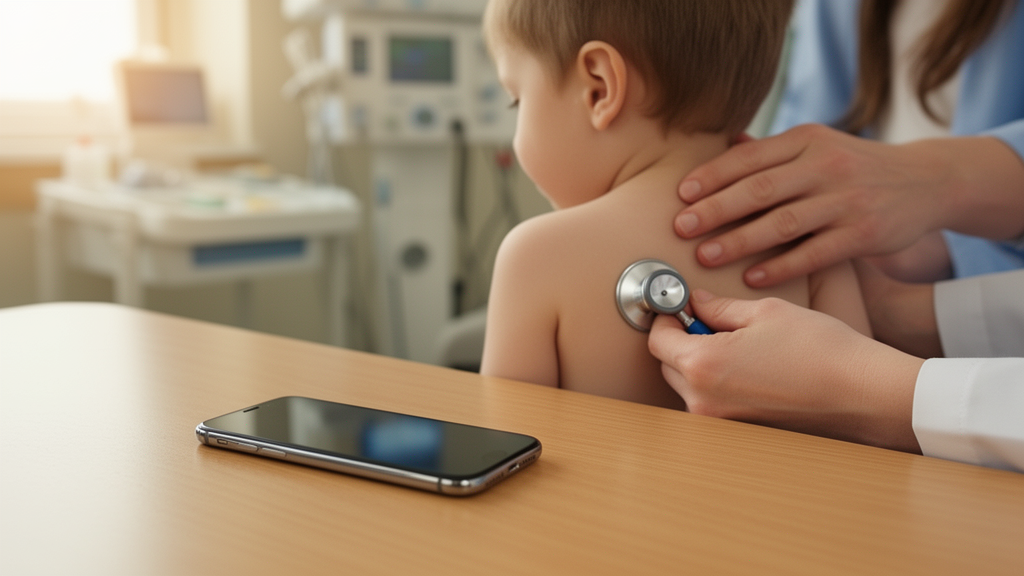
A pair of common devices sit on opposite ends of an unusual acoustic divide: the electronic stethoscope that clinicians press against a child’s chest, and the smartphone resting in a parent’s pocket. Researchers at Seoul National University of Science and Technology in South Korea have now shown how to bridge that divide using a domain-adaptive deep learning framework that allows artificial intelligence models trained on clinical stethoscope recordings to detect abnormal lung sounds from audio captured by ordinary smartphones. The work, published in the IEEE Journal of Biomedical and Health Informatics on July 30, 2026, offers a technical blueprint for turning one of the world’s most ubiquitous consumer devices into a screening tool for pediatric respiratory disease.
The clinical motivation behind the study is straightforward. Respiratory illness remains one of the leading health burdens facing children worldwide, and the traditional first step in diagnosis is auscultation, the practice of listening to sounds within the body with a stethoscope. But auscultation requires an in-person visit to a trained clinician, and for many families that visit is difficult to reach. Delays in identifying abnormal breath sounds, such as the wheezes and crackles that can signal conditions like pneumonia or asthma, can push diagnoses later and treatment further away. If a smartphone’s built-in microphone could reliably capture lung sounds at home, screening could begin between clinic visits rather than only inside them.
Smartphones would seem ideal for this purpose. They contain sensitive microphones, they are carried by billions of people, and they can run increasingly sophisticated software. Yet a fundamental problem stands in the way: the acoustic characteristics of lung sounds recorded through a smartphone differ substantially from those captured by an electronic stethoscope. The two devices sample audio at different rates, respond differently across frequencies, and sit at different distances and orientations relative to the chest. To a machine learning model trained on stethoscope data, smartphone recordings are essentially foreign. This mismatch, known in the field as domain shift, is one of the most stubborn obstacles to deploying medical AI outside the controlled conditions in which it was trained.
“To a neural network, the smartphone and electronic stethoscope effectively speak different languages,” explains Dr. Seong-Eun Kim, Associate Professor in the Department of Applied Artificial Intelligence at Seoul National University of Science and Technology, who led the research team. “Instead of simply pooling the data from the two devices, our approach offers reliable domain-adaption, where the model learns from reliable labelled-electronic stethoscope recordings while adapting to the smartphone domain.” First author Seunggyu Jeong, a Ph.D. student in the same department, together with Sungwoo Nam and Seongkwan Jung, built the framework around that principle.
The foundation of the study is a dataset that is rare in this field: paired recordings. For the primary dataset, the researchers acquired electronic stethoscope lung sound recordings from 611 children aged zero to six years, and 147 of those children also provided paired smartphone recordings. In every case, lung sounds were captured at the same four anatomical sites on the chest, allowing the team to compare how the two devices heard identical acoustic events. The team also collected an independent external dataset consisting of smartphone-only recordings from 48 children, held aside for validation on data the model had never seen in any form.
The framework applies two complementary strategies to close the gap between devices. The first operates at the signal level: smartphone audio, originally sampled at 48 kilohertz, was passed through a 1 kilohertz low-pass filter and downsampled to 4 kilohertz before analysis. “This brings the smartphone frequency profile closer to the stethoscope,” Dr. Kim notes, effectively trimming the smartphone’s wider acoustic bandwidth down to the range where the two devices overlap. The second strategy operates inside the network itself. A directional MixStyle module injects feature statistics drawn from the smartphone domain into the stethoscope domain during training, making the labeled stethoscope data appear more smartphone-like to the model. This module was integrated into an Audio Spectrogram Transformer, a deep learning architecture designed for audio classification that processes spectrograms, visual representations of sound, much as vision transformers process images.
The performance results illustrate both the difficulty of the problem and the value of the solution. When tested on smartphone recordings from the primary dataset, the proposed model achieved an F1 score of 0.802 and an area under the receiver operating characteristic curve, or AUROC, of 0.911 for detecting abnormal lung sounds. By comparison, a smartphone-only model reached an F1 score of 0.732, and naive pooling of stethoscope and smartphone recordings performed worst at 0.708. That last number carries an important lesson: simply mixing data from devices with different acoustic characteristics does not improve performance, and can actively degrade it, because the network spends its capacity distinguishing devices rather than distinguishing healthy from abnormal sounds.
The external validation set exposed the stakes even more starkly. A model trained only on electronic stethoscope recordings, applied to smartphone recordings from 48 children it had never encountered, achieved an F1 score of just 0.034 and an AUROC of 0.388, a result barely distinguishable from chance. This near-total collapse is a vivid demonstration of domain shift in medical audio, and a warning for any clinical AI system evaluated only on data from the same device used in training. The domain-adaptive model, by contrast, maintained its performance on the same external smartphone cohort, achieving an F1 score of 0.744 and an AUROC of 0.862, outperforming the other smartphone-domain approaches tested.
The researchers position the framework as an assistive tool rather than a replacement for clinical judgment. “Our framework provides a proof-of-concept for scalable and cost-effective pediatric respiratory screening,” Dr. Kim remarks. “It could help parents home screen children between visits while keeping clinicians in the loop. Moreover, such technology could improve remote clinic consultations and aid community healthcare workers in frontline triage in remote areas.” In this vision, a smartphone recording made at home would not deliver a diagnosis; it would flag concerning sounds early, prioritize which children need to be seen, and support triage by health workers in settings where electronic stethoscopes are scarce.
The team is candid about what remains before such a system could reach clinics or homes. Further validation with larger, multi-site cohorts, real-world home recordings made in uncontrolled acoustic environments, and multiple smartphone models will be needed to confirm that the performance holds outside the research setting. Even so, the study demonstrates a general principle with reach beyond lung sounds: signal-level alignment combined with feature-level domain adaptation can reduce acoustic discrepancies between medical devices and consumer hardware, providing a pathway for clinical AI tools to follow patients out of the hospital and into everyday life.
Subject of Research: Smartphone-based detection of abnormal pediatric lung sounds using domain-adaptive deep learning
Article Title: Seoul National University of Science and Technology researchers show how smartphones can help detect lung problems in children
Article References: Seoul National University of Science and Technology researchers show how smartphones can help detect lung problems in children. (n.d.). Original publication
Image Credits: AI Generated
DOI: Not provided
Keywords: smartphone, lung sounds, pediatric respiratory disease, deep learning, domain adaptation, electronic stethoscope, Audio Spectrogram Transformer, MixStyle, auscultation, machine learning, health screening, biomedical signal processing
Cite Scienmag News
Blake Davidson. (October 16, 2026). Smartphones Could Hear Signs of Child Lung Disease, Deep Learning Study Finds. Scienmag. https://scienmag.com/smartphones-could-hear-signs-of-child-lung-disease-deep-learning-study-finds/
Blake Davidson. "Smartphones Could Hear Signs of Child Lung Disease, Deep Learning Study Finds." Scienmag, 16 October 2026, https://scienmag.com/smartphones-could-hear-signs-of-child-lung-disease-deep-learning-study-finds/. Accessed 16 October 2026.
Blake Davidson. "Smartphones Could Hear Signs of Child Lung Disease, Deep Learning Study Finds." Scienmag. October 16, 2026. https://scienmag.com/smartphones-could-hear-signs-of-child-lung-disease-deep-learning-study-finds/


