


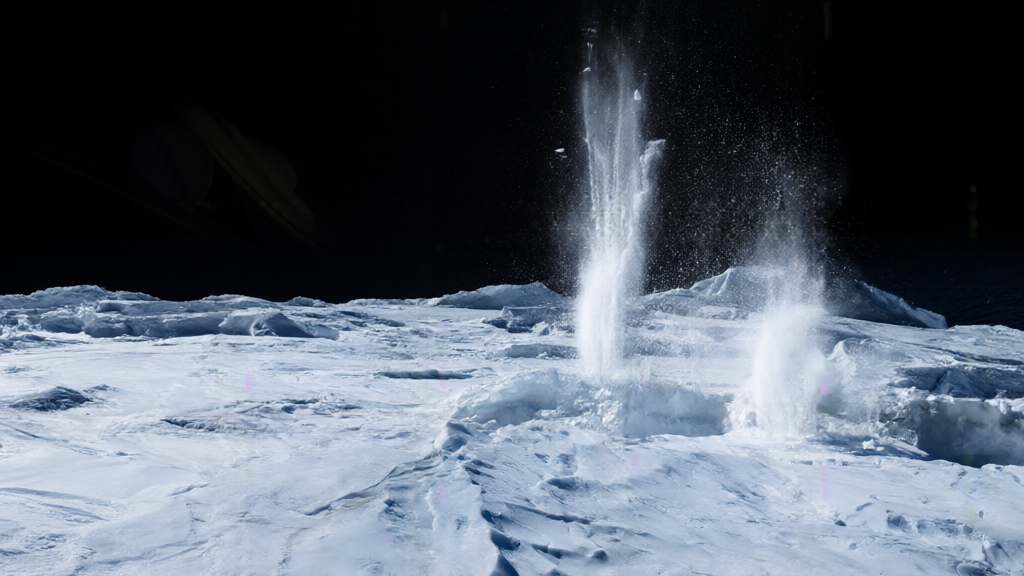
Saturn’s icy moon Enceladus harbors a global ocean beneath its frozen crust, a hidden reservoir that has long captivated astrobiologists and planetary scientists alike. From fractures near its south pole, material from this subsurface ocean is continuously ejected into space as a plume of water vapor and ice particles. These ejected grains offer a rare and invaluable opportunity to investigate an extraterrestrial ocean without the need to drill through kilometers of solid ice. By analyzing the composition of these particles, researchers can infer the chemical makeup of the ocean itself, providing critical clues about the moon’s potential habitability and the processes occurring within its interior.
An international research team, including scientists from the Earth-Life Science Institute (ELSI) at the Institute of Science Tokyo, has recently uncovered the mechanism by which ocean water is transformed during its journey from the subsurface ocean into the tiny ice grains observed in space. The study, published in Science Advances, combines data from NASA’s Cassini spacecraft with new laboratory experiments to explain a puzzling observation: the ice grains ejected from Enceladus are far more chemically diverse than expected. This diversity suggests that the particles do not simply represent a uniform sample of the ocean water, but rather the result of complex physical processes occurring within the moon’s icy vent system.
Between 2004 and 2017, the Cosmic Dust Analyser aboard the Cassini spacecraft measured the composition of individual ice grains in Saturn’s E-ring, which is supplied by material ejected from Enceladus. Researchers led by Prof Frank Postberg at Freie Universität Berlin analyzed 961 mass spectra of salt-rich grains, known as Type 3 particles. Instead of finding grains with broadly similar mixtures of ocean salts, they discovered striking chemical diversity. Different grains were enriched in different salts, including sodium chloride, carbonates, phosphates, and potassium chloride. Notably, chloride and carbonate were rarely found together in the same sodium-rich grain, raising the question of how particles originating from the same ocean could become so chemically distinct.
To investigate this phenomenon, Professor Yasuhito Sekine and colleagues at ELSI conducted laboratory experiments using droplets designed to reproduce the major salt components expected in Enceladus’ ocean. The team froze droplets of different sizes at various cooling rates and examined how their constituent elements were distributed after freezing. The experiments revealed that the cooling rate is a critical factor. In droplets around 200 micrometres across, salts became spatially separated when the droplets froze slowly, at approximately 10 Kelvin per minute or less. In contrast, faster freezing produced a much more uniform distribution of salts, suggesting that rapid cooling prevents the separation of different chemical components.
“What surprised us was that the diversity seen by Cassini could emerge from droplets originating from essentially the same ocean water,” said Sekine. “Our experiments show that when relatively large ocean droplets freeze slowly, different salts can separate within them. If those frozen droplets are later broken apart, they can produce much smaller ice grains, each with very different chemical compositions.” This finding provides a physical explanation for the compositional segregation observed by Cassini, linking the macro-scale dynamics of the plume to the micro-scale chemistry of individual ice grains.
The slow freezing process also provides clues to the conditions inside Enceladus’ icy crust. Previous research had generally assumed that seawater spray freezes rapidly, moving towards space fast after leaving the ocean. The new results instead suggest that droplets at the beginning of their journey travel more slowly through the subsurface vent system. This slower transit allows time for salts to separate as the droplets gradually freeze. The researchers propose a multi-stage journey where ocean spray initially forms droplets tens to hundreds of micrometres across. These droplets travel relatively slowly through deeper parts of the vents, allowing for chemical segregation before reaching the surface.
Closer to the surface, the gas flow accelerates, and the frozen droplets collide with the walls of narrower ice channels at high speeds, causing them to shatter. The resulting fragments can contain different salt-rich regions and are eventually carried into Saturn’s E-ring. “The Cassini data showed us that these salt-rich grains are far more chemically diverse than an average ocean composition would suggest,” said Postberg. “Combining those observations with the freezing experiments gives us a physical explanation: Cassini may have sampled fragments of larger frozen ocean droplets, each preserving different components that became separated during their journey towards the surface.” This fragmentation process effectively acts as a natural sorting mechanism, concentrating specific compounds into different grains.
The findings have significant implications for the future exploration of Enceladus. Freezing and fragmentation can concentrate particular compounds into different grains, separating salts not just from each other but also from organics. Previous analyses have shown that many organic species also appear separated from each other at elevated concentrations. Analyzing particles individually could therefore make it much easier for future spacecraft to detect compounds that are otherwise diluted in the ocean. On Earth, chemical laboratories go to great lengths to separate and concentrate the various components of a sample before analysis. Enceladus now conveniently performs both of these “sample preparation” steps for us, with chemical components separated from one another and appearing in elevated concentrations in a fraction of the ice particles.
Slow freezing may also create small pockets of liquid brine between growing ice crystals, where salts and organic compounds become concentrated. Such concentration could be relevant to prebiotic chemistry, where bringing dilute organic molecules together is an important challenge. Since much of Enceladus’ plume material falls back onto the moon, these processes could potentially occur repeatedly, creating a dynamic environment for chemical evolution. Understanding how these particles form provides both a picture of the hidden environment beneath Enceladus’ surface and a guide for interpreting material sampled by future missions searching for clues to the moon’s habitability and signs of life. This work underscores the importance of considering physical transport and phase-change processes when interpreting the chemical signatures of extraterrestrial oceans.
Subject of Research: Chemical segregation of ice grains in Enceladus plumes via slow freezing and fragmentation
Article Title: How Enceladus' ocean spray becomes chemically diverse ice grains
Article References: How Enceladus' ocean spray becomes chemically diverse ice grains. (n.d.). Original publication
Image Credits: AI Generated
DOI: Not provided
Keywords: Enceladus, Saturn, Astrobiology, Ice grains, Cassini mission, Subsurface ocean, Chemical diversity, Freezing dynamics, Planetary science, Habitability, Enceladus', ocean
Cite Scienmag News
Grant Pearson. (October 2, 2026). Slow Freezing Creates Chemical Diversity in Enceladus Ice. Scienmag. https://scienmag.com/slow-freezing-creates-chemical-diversity-in-enceladus-ice/
Grant Pearson. "Slow Freezing Creates Chemical Diversity in Enceladus Ice." Scienmag, 2 October 2026, https://scienmag.com/slow-freezing-creates-chemical-diversity-in-enceladus-ice/. Accessed 4 October 2026.
Grant Pearson. "Slow Freezing Creates Chemical Diversity in Enceladus Ice." Scienmag. October 2, 2026. https://scienmag.com/slow-freezing-creates-chemical-diversity-in-enceladus-ice/


