


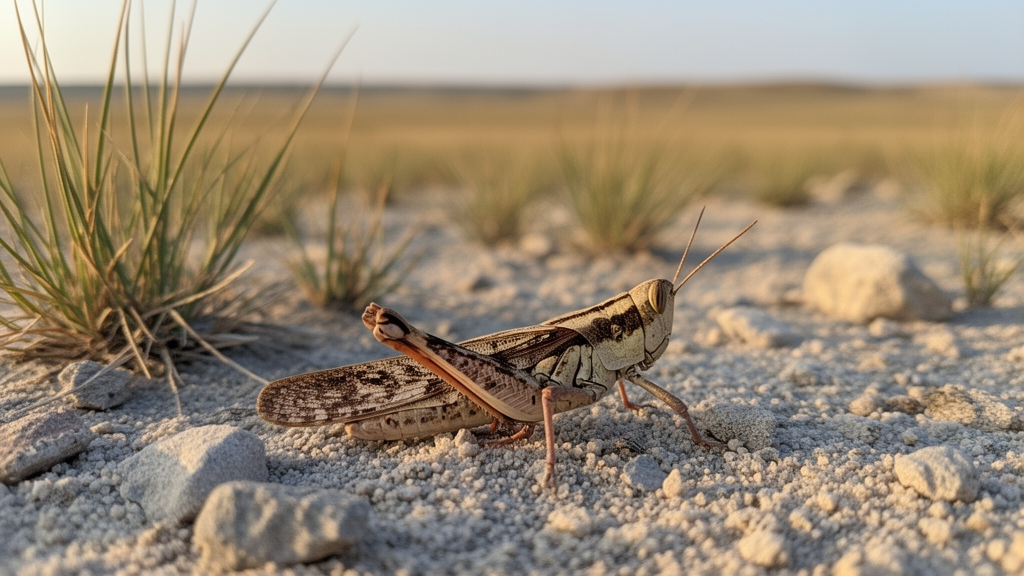
A field study in southern Slovakia found that the Common Digging Grasshopper, Acrotylus insubricus, and the Yellow-winged Digging Grasshopper, A. longipes, have returned to historically documented sites at the northern edge of their European ranges. The researchers mapped and monitored populations in 2023–2025 and reviewed historical records and orthopterological literature dating from the second half of the 19th century.
Records of A. insubricus in Slovakia date to the late 19th century, with observations from five sites in southeastern and southwestern Slovakia between 1890 and 1961. A. longipes was recorded once in 1961 near Kráľovský Chlmec in southeastern Slovakia, without sampling details. Orthoptera mapping data are missing for 1962–1994 because surveys during that period were irregular and insufficient. Researchers surveyed 53 historical or potential localities in southern Slovakia irregularly from 1997 through 2024, checking five to 28 localities per year from March to November as part of a national mapping programme that collected data from about 4,500 sites between 1994 and 2024.
A. insubricus was detected at two southeastern Slovak sites in 2019, after 22 years of mapping under the programme. It was subsequently found at seven sites in 2020–2022 and at nine of 16 monitored sites in 2023–2025. No populations were detected at 12 historical or potential sites in southwestern and central Slovakia. The polygon encompassing the most distant occupied Slovak sites covered 206 square kilometres. A. longipes was found in 2023 at two sites about 16.5 kilometres apart, and a third breeding occurrence was added in 2024. It had not been found at eight potential sandy sites in southwestern and central Slovakia. Its occupied polygon covered 26 square kilometres.
The study found no northward shift in the northern boundary of either breeding range. The northernmost edge of A. insubricus in Central Europe was 48.53° north, at elevations of 98–185 metres above sea level, while that of A. longipes was 48.40° north, at 98–125 metres. These limits remained effectively unchanged from the historical records of 1897 and 1961, respectively. The recent northernmost A. insubricus site at Beša was 13 kilometres north of historical sites, but the overall range boundary did not advance. The authors therefore interpreted the Slovak records as recolonization of previously known territory rather than a demonstrated expansion of the northern range.
Populations of both species were locally abundant from 2023 to 2025. A. insubricus exceeded 100 adults per hectare in August and September at two of nine sites, reached 50–100 adults per hectare at three sites, and remained below 10 adults per hectare at four. At the Biel and Somotor sites, densities reached 20–30 specimens per 100 square metres in August and September. A. longipes exceeded 100 adults per hectare at two of its three breeding sites, with local densities of 10–20 adults per 100 square metres, mainly in August and early September.
Habitat observations also distinguished the species. All three breeding populations of A. longipes occurred in blown sands with fine material and scattered, low-growing herbaceous vegetation; one site was classified as natural, one as seminatural and one as an abandoned sand quarry. A. insubricus occupied the same sandy habitats but also occurred rarely in xeric rocky steppes and forest-steppe locations. Of its nine Slovak sites, two were natural, five seminatural and two significantly disturbed by human interference during the preceding 60 years. The three sites supporting both species were sandy sites ranging from exploited or abandoned quarries to preserved dunes grazed by sheep, demonstrating that both grasshoppers can occupy seminatural and disturbed sandy substrates.
Seasonal monitoring showed that only A. insubricus was confirmed to overwinter as an adult in Slovakia. Its adults occurred from 16 February to 21 May and again until 20 November, while identifiable nymphs occurred from July through September. Identifiable A. longipes nymphs were first found in early June and adults from late June, with adult activity ending by 3 November. Because A. longipes had a shorter seasonal presence and generally fewer adults, the authors considered its climatic niche at the northern range edge to be narrower than that of A. insubricus.
At the nine A. insubricus sites, including the three shared with A. longipes, the team recorded 67 Orthoptera species—29 Ensifera and 38 Caelifera, about 51% of Slovakia’s orthopteran fauna—and the mantid Mantis religiosa. Sites contained 28–50 species each, averaging 39 ± 8, described by the authors as exceptionally high for Central Europe. Grasshoppers predominated in richness and abundance, alongside characteristic psammophilous and pseudo-psammophilous species and several rare European Orthoptera. Two isolated A. longipes females, found in atypical habitats in Hungary in 2021 and Slovakia in 2023, demonstrated mobility but were not followed by evidence of colonization. The long gaps in mapping and irregular survey effort limit firm conclusions about when recolonization occurred or how populations arrived.
Subject of Research: Distribution, abundance, habitat use and seasonal ecology of two Acrotylus grasshoppers at the northern edge of their range in Slovakia
Article Title: Expansion or recolonization: Distribution and ecology of the pontic-mediterranean species of genus Acrotylus ( Orthoptera ) at the northern border of their range
Article References: Krištín, A., & Balla, M. (2025). Expansion or recolonization: Distribution and ecology of the pontic-mediterranean species of genus Acrotylus (Orthoptera) at the northern border of their range. Journal of Orthoptera Research, 34(2), 265-272. https://doi.org/10.3897/jor.34.149244
Image Credits: AI Generated
Keywords: Acrotylus insubricus, Acrotylus longipes, grasshoppers, Orthoptera, Slovakia, recolonization, range edge, field ecology, habitat use, Expansion, Distribution, ecology
Cite Scienmag News
Gavin Prescott. (October 20, 2026). Slovak field study finds two digging grasshoppers recolonized historical range sites. Scienmag. https://scienmag.com/slovak-field-study-finds-two-digging-grasshoppers-recolonized-historical-range-sites/
Gavin Prescott. "Slovak field study finds two digging grasshoppers recolonized historical range sites." Scienmag, 20 October 2026, https://scienmag.com/slovak-field-study-finds-two-digging-grasshoppers-recolonized-historical-range-sites/. Accessed 20 October 2026.
Gavin Prescott. "Slovak field study finds two digging grasshoppers recolonized historical range sites." Scienmag. October 20, 2026. https://scienmag.com/slovak-field-study-finds-two-digging-grasshoppers-recolonized-historical-range-sites/


