


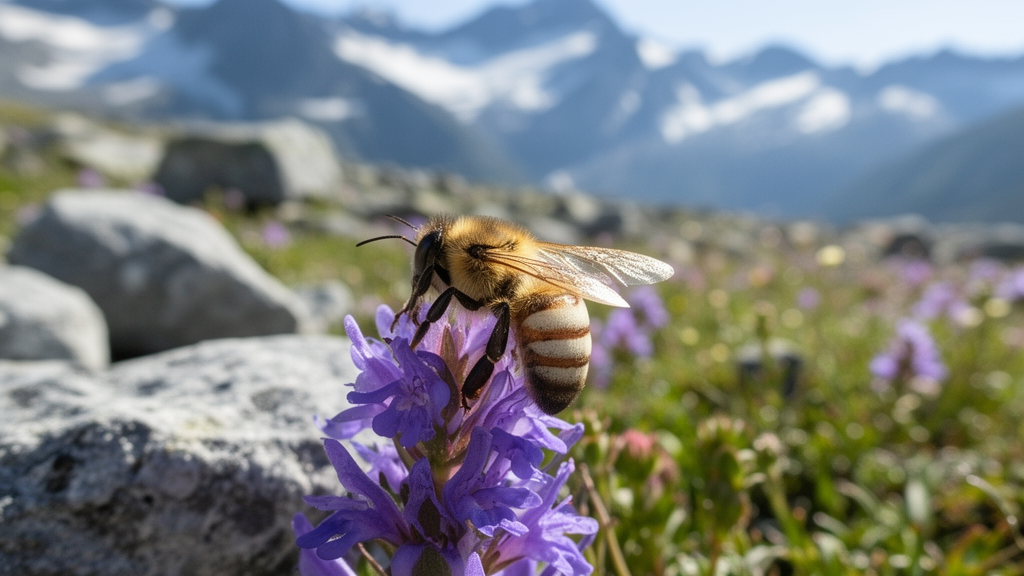
A new bee species, Hoplitis (Hoplitis) onosmaevae, has been described from the French Alps, Turkey and northern Iraq. The osmiine bee has a proboscis approximately as long as its body and is known from two sites in the Tinée Valley in southern France that are separated from eastern records by at least 2,000 km. The discovery combines morphological comparison, DNA sequencing, field observations and microscopic examination of pollen.
The species was first encountered during faunistic inventories in Mercantour National Park in 2018, when several specimens of the Hoplitis adunca species group were collected from flowers of Onosma tricerosperma subsp. fastigiata in the French southern Alps. Their exceptionally long mouthparts were unlike those of other known French or Central European species. Subsequent comparison showed that the French specimens matched an undescribed species represented in collections from Turkey.
The formal description was based on males and females from France, Turkey and northern Iraq. The authors examined external and terminal anatomy, including the head, antennae, legs and abdominal structures. The new species is distinguished by its long proboscis, strongly elevated vertex, and, in females, thickened lateral margins and a central apical spine on the sixth metasomal sternum. Yellowish-brown hind tibial spurs distinguish it from the similar H. adunca, which has black spurs.
Phylogenetic analyses included two French individuals and four gene fragments: the mitochondrial cytochrome oxidase I gene and the nuclear conserved ATPase domain, elongation factor 1-alpha and long-wavelength rhodopsin genes. Maximum-likelihood analysis placed the new species in a strongly supported clade containing H. adunca, H. benoisti and H. manicata. Its sister relationship to those three species received weaker support, with bootstrap values of 59–70 percent. The new species was not placed close to the other long-tongued species H. holmboei and H. homalocera; genetic data were unavailable for H. linguaria and H. semilinguaria. These results do not establish how many times the elongated proboscis evolved.
European and Asian specimens of both sexes were morphologically identical, including the shape of the male antennae and the membranous appendage on the sixth sternum. On that basis, the authors treated the disjunct populations as one species, although no genetic data were available for the eastern populations. Records came from the Mount Gara in northern Iraq, Mount Nemrut and several Taurus and Pontic mountain sites in Turkey, and the Tinée Valley in France.
Field observations in southern France showed females collecting nectar and pollen from Onosma. The bees entered flower heads, held the style, and vibrated the flowers by buzzing, usually sonicking each visited flower twice for a few seconds. Pollen in Onosma is shed into a cone formed by the five adjacent anthers. Microscopic analysis found that pollen from French female scopae and brood cells matched reference Onosma pollen, while Turkish samples could not be assigned unambiguously to that genus because several related Boraginaceae genera have similar pollen. Taken together, the limited pollen samples and observations strongly suggest, rather than conclusively demonstrate, narrow specialization on Onosma.
The authors also documented nesting at a site about 35–40 m from a French Onosma patch. Two nests occupied preexisting insect burrows in dead larch trunks, one lying and one standing. A plug of small pebbles and fine sand led to an empty chamber and then to linearly arranged brood cells separated by sand partitions; the two exposed cells contained solid provision masses. This behavior contrasts with the rock cavities or depressions used by most known members of the adunca group. The phylogenetic analysis is consistent with a single origin of wood-burrow nesting in H. adunca, H. manicata and H. onosmaevae, but the relationships among the four species were not fully resolved.
In France, the species appears exceptionally rare and localized. It has been found only at two sites less than 5 km apart, where the estimated numbers observed were three and 10–20 individuals. Searches at other southern Alpine sites with flowering Onosma were unsuccessful, although some surveys were affected by poor timing or low host-plant abundance and therefore could not exclude the bee’s presence. Its French records came from approximately 1,900–2,000 m, compared with 1,075–2,350 m in Turkey and Iraq. Large host-plant populations occur outside the known French range, so the bee’s rarity may also reflect a restricted climatic niche, limited availability of dead wood for nesting, or both.
These features lead the authors to consider the species potentially vulnerable to habitat change, including altered grazing pressure and climate-related effects on its host plants. They conclude that a conservation plan in the southwestern Alps should include further fieldwork, protection of known populations, maintenance of dead wood near Onosma stands and adaptation of pastoral management to preserve host-plant abundance. These are proposed measures rather than evidence of a measured population trend or a tested conservation outcome.
Subject of Research: Description and limited ecological study of the newly described Hoplitis onosmaevae bee
Article Title: A new osmiine bee with a spectacular geographic disjunction: Hoplitis ( Hoplitis ) onosmaevae sp. nov. ( Hymenoptera , Anthophila , Megachilidae )
Article References: Aubert, M., Müller, A., & Praz, C. (2024). A new osmiine bee with a spectacular geographic disjunction: Hoplitis (Hoplitis) onosmaevae sp. nov. (Hymenoptera, Anthophila, Megachilidae). Alpine Entomology, 8, 65-79. https://doi.org/10.3897/alpento.8.118039
Image Credits: AI Generated
Keywords: Hoplitis onosmaevae, new bee species, Megachilidae, Osmiini, French Alps, Turkey, Iraq, pollen analysis, phylogenetics, nesting biology, conservation, osmiine
Cite Scienmag News
Gavin Prescott. (October 20, 2026). New long-tongued bee species links French Alps with Turkey and Iraq. Scienmag. https://scienmag.com/new-long-tongued-bee-species-links-french-alps-with-turkey-and-iraq/
Gavin Prescott. "New long-tongued bee species links French Alps with Turkey and Iraq." Scienmag, 20 October 2026, https://scienmag.com/new-long-tongued-bee-species-links-french-alps-with-turkey-and-iraq/. Accessed 20 October 2026.
Gavin Prescott. "New long-tongued bee species links French Alps with Turkey and Iraq." Scienmag. October 20, 2026. https://scienmag.com/new-long-tongued-bee-species-links-french-alps-with-turkey-and-iraq/


