


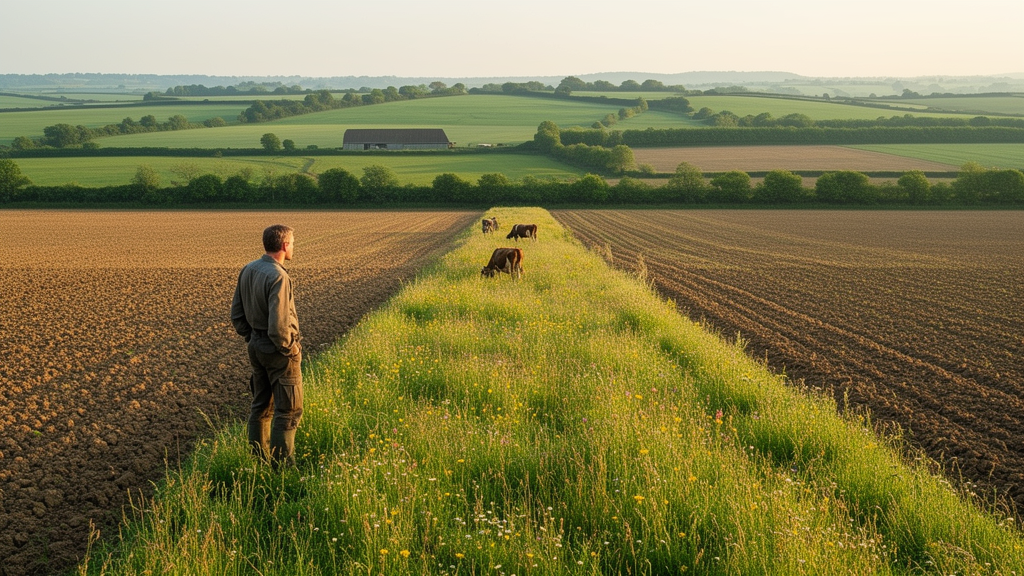
A mixed-methods study of 506 farmers in two Slovenian lowland agricultural regions found that extensively managed semi-natural meadows were most often retained where flooding, poor access or other physical constraints limited intensive production. Farmers valued the meadows’ ecological and aesthetic qualities, but survey responses and interviews showed that their declining role in livestock production and social expectations of regularly mown land weighed heavily on management decisions. Agri-environmental-climate payments helped some farms maintain marginal land, yet many respondents considered the payments too low to offset the opportunity costs of late mowing.
The study combined a face-to-face survey, mapped farm parcels and interview analysis. Researchers surveyed farmers between February and May 2022, representing 14% of the 3,525 farms in Ljubljansko barje and Dravsko-ptujsko polje. Of the 506 participants, 390 interviews were recorded, and 90 were selected for transcription and thematic coding. The sample was representative of the regional farm populations by age, farm size, organic-farming status and livestock units per hectare, although respondents included a higher proportion of men, livestock farms and farms enrolled in agri-environmental-climate measures than the full populations.
Ljubljansko barje covers 135.6 km² and includes 1,060 farms. Frequent flooding and high soil moisture have kept permanent meadows as its main land use, covering 39% of the area, while maize and cereals occupy the remaining arable land. The region has experienced drainage, earlier mowing, conversion of meadows to arable land and removal of hedgerows. Dravsko-ptujsko polje covers 414 km² and contains 2,450 farms; it is more intensively cultivated, with arable land occupying 53% of the region and permanent meadows covering 6%. Wet meadows have nearly disappeared there.
For this analysis, conservation experts defined extensively managed meadows as those without grazing or fertilisation and with mowing after 10 July in Ljubljansko barje. In Dravsko-ptujsko polje, the recommended mowing date was early July, reflecting local grass-seed ripening, although light grazing and fertilisation were described as compatible with local soil conditions. The definitions used in the two regions therefore differed in timing and in the treatment of grazing and fertilisation.
The researchers identified 317 extensively managed meadows among 2,484 mapped meadows in Ljubljansko barje. Only seven of the 321 mapped meadows in Dravsko-ptujsko polje met the extensive-management definition, so the quantitative model was limited to Ljubljansko barje. A boosted regression tree model using 450 trees explained 52.2% of deviance in the training data, with an area under the receiver operating characteristic curve of 0.947. Cross-validation produced 40% explained deviance and an AUC of 0.903. The residual-autocovariate term was the most influential variable at 60.91%, followed by plot size at 6.49%, road distance at 5.46%, rented land at 4.50%, farm meadow share at 3.59%, distance from water at 3.44% and attitudes toward the productive value of meadows at 3.24%.
Partial-dependence results associated larger plots with a logarithmically increasing probability that a meadow was extensively managed. Distance from roads was associated with a small increase in that probability. The probability was higher where water distance was up to 400 metres and showed no detected change beyond that distance. The share of rented land had little association over most of its range but was associated with a marked increase when rented land constituted 90–100% of a farm. Farmers’ positive attitudes toward the productive value of extensive meadows were consistently associated with their presence. These were model associations derived from one region and do not establish that the predictors caused farmers to retain the meadows.
Interviews revealed that many farmers recognised the ecological value of flower-rich meadows as habitat for birds, insects and other wildlife. Some also described aesthetic and experiential benefits, including the presence of blossoms and opportunities to observe wildlife. Survey respondents scored preserving extensive meadows for nature conservation relatively highly, with a mean of 3.8 on a five-point scale, while their score for agricultural production averaged 2.2. Despite this recognition, extensive management was frequently described as unsuitable for contemporary livestock production: early and frequent mowing was needed to secure nutritious fodder, while late-cut biomass was characterized as coarse, woody or of little market value.
Social expectations also discouraged delayed mowing. Farmers repeatedly associated regularly cut, visibly managed land with proper farming, while taller meadows could be viewed as abandoned. Some respondents reported anticipating criticism from neighbours, and farmers renting land said landowners could oppose delayed mowing. These interviews suggest that maintaining the appearance of productive farmland may constrain conservation practices even where farmers acknowledge the ecological value of extensive meadows.
Agri-environmental-climate measures were available in Ljubljansko barje during the 2014–2022 Common Agricultural Policy programming period. The “Hay meadows” scheme paid €329.79 per hectare per year, while the “Birds of wet grasslands” scheme paid €349.99–386.59 per hectare per year, with a possible additional payment where corncrakes were present nearby. A minority of farmers welcomed this support, especially for marginal, flood-prone, shaded or difficult-to-access land. Most considered the payments insufficient to compensate for lost production or the opportunity to grow more profitable crops. The findings apply to two lowland Slovenian regions and to the study’s agricultural definition of extensive meadows; the researchers did not model how views might differ among individual habitat types or predict which habitats would be least favored by farmers. The authors therefore caution that the results cannot be treated as a general account of all European semi-natural grasslands.
Subject of Research: Farmer decision-making and management of semi-natural meadows in two Slovenian lowland agricultural regions
Article Title: Semi-natural meadow conservation under pressure: Farmers’ decision‑making in intensifying lowland agricultural systems
Article References: Alif, Ž., Novak, A., & Šumrada, T. (2026). Semi-natural meadow conservation under pressure: Farmers’ decision‑making in intensifying lowland agricultural systems. Nature Conservation, 63, 153-171. https://doi.org/10.3897/natureconservation.63.186090
Image Credits: AI Generated
DOI: 10.3897/natureconservation.63.186090
Keywords: semi-natural meadows, Slovenian agriculture, farmer decision-making, grassland conservation, agri-environmental payments, livestock production, land intensification, mixed-methods study, farmland management, biodiversity conservation, Semi-natural, meadow
Cite Scienmag News
Margaret Porter. (October 20, 2026). Mixed-methods survey of 506 Slovenian farmers links meadow management to land constraints, attitudes and economic pressures. Scienmag. https://scienmag.com/mixed-methods-survey-of-506-slovenian-farmers-links-meadow-management-to-land-constraints-attitudes-and-economic-pressures/
Margaret Porter. "Mixed-methods survey of 506 Slovenian farmers links meadow management to land constraints, attitudes and economic pressures." Scienmag, 20 October 2026, https://scienmag.com/mixed-methods-survey-of-506-slovenian-farmers-links-meadow-management-to-land-constraints-attitudes-and-economic-pressures/. Accessed 20 October 2026.
Margaret Porter. "Mixed-methods survey of 506 Slovenian farmers links meadow management to land constraints, attitudes and economic pressures." Scienmag. October 20, 2026. https://scienmag.com/mixed-methods-survey-of-506-slovenian-farmers-links-meadow-management-to-land-constraints-attitudes-and-economic-pressures/


