


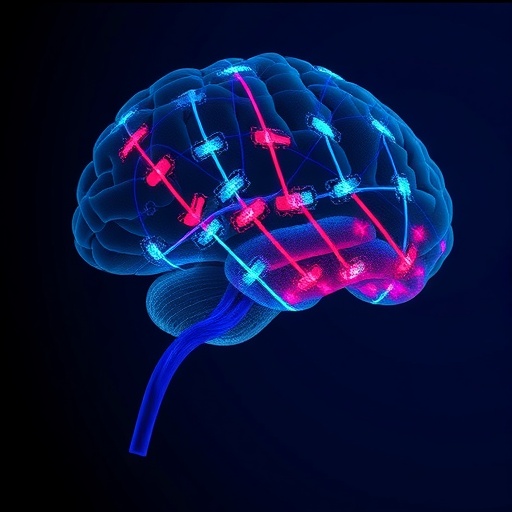
In a groundbreaking exploration of brain stimulation techniques during sleep, researchers Takahashi, Kuo, and Nitsche have unveiled compelling evidence linking phase-synchronized transcranial magnetic and electrical stimulation to enhanced delta frequency activity uniquely tailored to sleep stages. Published in Scientific Reports in 2026, this study pioneers the nuanced understanding of how external rhythmic interventions at 0.75 Hz can selectively modulate neural oscillations associated with slow-wave sleep, a critical phase for memory consolidation and synaptic homeostasis.
The intricate architecture of sleep has long fascinated neuroscientists, primarily due to its enigmatic relationship with neural plasticity and cognitive restoration. Central to slow-wave sleep are delta waves, low-frequency oscillations ranging approximately from 0.5 to 4 Hz, which reflect large-scale synchronized activity across cortical networks. The researchers leveraged two sophisticated neuromodulation modalities: repetitive transcranial magnetic stimulation (rTMS) and transcranial alternating current stimulation (tACS), locking their rhythmic output to the intra-sleep 0.75 Hz delta rhythm. This strategic frequency choice mimics the natural slow oscillations intrinsic to deep sleep, suggesting a physiologically congruent approach for external modulation.
Employing a carefully designed experimental protocol, the team administered phase-locked rTMS and tACS to human participants during monitored sleep sessions. Sleep stages were rigorously classified using polysomnography, enabling precise application of stimulation during distinct phases such as non-rapid eye movement (NREM) stages 2 and 3. What emerged was a sleep stage-specific modulation—stimulation synchronized at 0.75 Hz resulted in marked amplification of delta power during slow-wave sleep (NREM 3), while having negligible or subtly differential effects during lighter sleep stages. This specificity underscores the importance of timing and phase alignment in brain stimulation paradigms.
Technically, the rTMS employed in this study utilized magnetically induced currents to excite cortical neurons in a tightly controlled waveform. By synchronizing the pulses to the phase of endogenous delta oscillations, the stimulation likely capitalized on intrinsic network excitability windows, thereby reinforcing natural slow-wave activity. Conversely, the tACS method, which applies sinusoidal electrical currents transcranially, entrained brain rhythms by subtly biasing neuronal membrane potentials without overtly triggering action potentials. Both modalities, through distinct biophysical mechanisms, converged on the enhancement of physiologically significant oscillations.
The differential effects observed between rTMS and tACS provide critical insights into the mechanisms underpinning slow-wave modulation. rTMS’s capacity for direct cortical neuron activation may evoke more pronounced and immediate changes in synaptic activity and local field potentials, while tACS’s subtler membrane polarization effects might facilitate entrainment across distributed networks. Remarkably, both interventions exhibited phase-dependent amplification, revealing a potential avenue to optimize neuromodulation therapies by aligning stimulation with the brain’s endogenous rhythms.
From a neurophysiological perspective, slow-wave oscillations orchestrate a complex interplay between thalamocortical and corticocortical circuits. These oscillations facilitate synaptic downscaling, a process crucial for maintaining neural homeostasis and preventing saturation. The study’s findings that 0.75 Hz phase-synchronized stimulation can selectively bolster these slow oscillations hint at the prospect of modulating synaptic plasticity during sleep, potentially enhancing memory consolidation or restoring disrupted neural dynamics in pathological conditions such as insomnia or neurodegenerative diseases.
Furthermore, the researchers documented cortical topography changes induced by stimulation, noting that delta frequency enhancement was predominantly localized in frontal and prefrontal cortical areas, regions implicated in executive function and memory processing. This spatially selective modulation suggests that such targeted stimulation might influence cognitive processes dependent on slow-wave integrity, thereby hinting at rehabilitative applications beyond basic neuroscience.
The implications of these findings extend into the realm of clinical neuroscience, where non-invasive brain stimulation holds promise for addressing sleep disorders, cognitive impairment, and mood disorders. By demonstrating that carefully timed, phase-locked stimulation enhances delta activity during specific sleep stages, this study lays the groundwork for customized neuromodulatory interventions aimed at restoring or augmenting natural sleep physiology.
Importantly, the methodological rigor of the study ensures robust validity of the results. The use of sham controls, counterbalanced stimulation sessions, and comprehensive sleep staging minimized confounding variables. Advanced time-frequency analysis and phase-locking value computations substantiated the synchronization efficacy between the applied stimuli and endogenous oscillations, reinforcing the conclusion that phase alignment is critical for effective slow-wave modulation.
In the evolving landscape of sleep research and neuromodulation, this study represents a significant stride forward, bridging mechanistic understanding with translational potential. The ability to finely tune brain rhythms via phase-synchronized stimulation not only expands the toolkit for probing sleep neurobiology but also opens new horizons for therapeutic intervention tailored to the temporal dynamics of brain activity.
The researchers also highlighted potential limitations and future directions. While the immediate enhancement of delta power is promising, longitudinal studies are necessary to evaluate the persistence of these effects and their direct influence on cognitive and emotional outcomes. Additionally, integrating multimodal imaging techniques such as functional MRI with electrophysiological measures could elucidate network-wide changes beyond cortical surface oscillations.
Further refinement in electrode placement, stimulation intensity, and timing relative to sleep microarchitecture will optimize individualized protocols. The interplay between sleep architecture variability across individuals and responsiveness to neuromodulation remains a fertile domain for investigation, particularly in clinical populations with disrupted sleep patterns.
Overall, the convergence of repetitive transcranial magnetic stimulation and transcranial alternating current stimulation at frequencies that resonate with natural slow oscillations represents a powerful tool in neuroscience. This synergy enables unprecedented control over brain activity during sleep, presenting exciting possibilities for enhancing memory, cognitive function, and perhaps even emotional regulation.
Takahashi, Kuo, and Nitsche’s pioneering work invites a paradigm shift in how we conceptualize brain stimulation—not as a blunt instrument—but as a precision-timed dialogue with the brain’s intrinsic rhythms. As research progresses, the integration of such rhythmic neuromodulation techniques with wearable sleep monitoring technology could herald an era where effortless, at-home brain optimization becomes a reality.
In conclusion, the elucidation of sleep stage-specific effects of 0.75 Hz phase-synchronized rTMS and tACS on delta frequency activity underscores the transformative potential of phase-aligned neuromodulation. This approach delicately amplifies key neural oscillations that shape the restorative power of sleep, offering hope for innovative treatments that enhance cognitive resilience and mental health through the simple yet profound act of synchronized electrical entrainment.
Cite Scienmag News
Cassandra Pierce. (March 27, 2026). Sleep Stage-Specific Delta Boost: 0.75 Hz rTMS, tACS. Scienmag. https://scienmag.com/sleep-stage-specific-delta-boost-0-75-hz-rtms-tacs/
Cassandra Pierce. "Sleep Stage-Specific Delta Boost: 0.75 Hz rTMS, tACS." Scienmag, 27 March 2026, https://scienmag.com/sleep-stage-specific-delta-boost-0-75-hz-rtms-tacs/. Accessed 3 September 2026.
Cassandra Pierce. "Sleep Stage-Specific Delta Boost: 0.75 Hz rTMS, tACS." Scienmag. March 27, 2026. https://scienmag.com/sleep-stage-specific-delta-boost-0-75-hz-rtms-tacs/


