


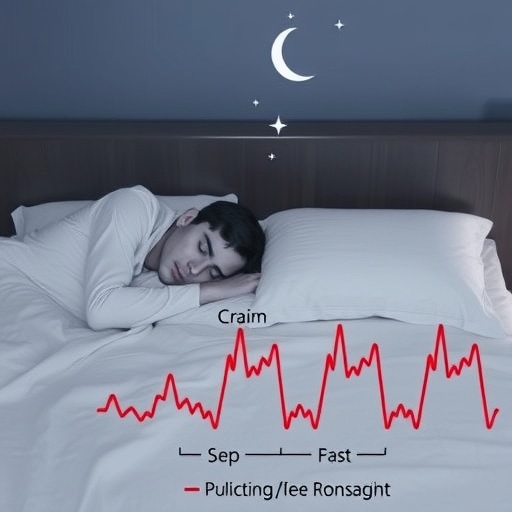
In a breakthrough study illuminating the intersection between sleep patterns and cardiovascular health, researchers from Kumamoto University and the National Cerebral and Cardiovascular Center have unveiled compelling evidence linking sleep duration to atrial fibrillation (AF) risk, particularly among working-age adults. This pioneering investigation utilized advanced technology to objectively measure sleep over one week, marking a significant departure from prior research heavily reliant on self-reported sleep data, which is often subject to bias and inaccuracy.
Atrial fibrillation, characterized by irregular and often rapid heart rhythm, is the most common cardiac arrhythmia globally, with profound implications including elevated stroke and heart failure risk. While the detrimental effects of insufficient sleep on general health are widely acknowledged, this study delves deeper by deploying a one-week Holter electrocardiogram device integrated with an accelerometer. This setup provided continuous, real-time monitoring of participants’ cardiac electrical activity alongside precise estimations of sleep duration in their natural environments, thus offering an unprecedented granularity in data collection rarely achieved in large-scale studies.
Analyzing data from over 36,000 individuals distributed between their 50s, representing peak professional years, and their 70s, an age typically associated with retirement, the research team uncovered a nuanced relationship between sleep length and AF incidence. Among the middle-aged cohort, results revealed a robust inverse correlation — shorter sleep durations were significantly associated with heightened AF risk. Remarkably, each incremental minute of additional sleep corresponded with a measurable decrement in the likelihood of developing atrial fibrillation, highlighting sleep duration as a potentially modifiable risk factor.
Interestingly, this sleep-AF linkage did not extend statistically to the older cohort aged 70 and above. This finding suggests age-related differences in cardiac physiology or possibly the influence of other confounding variables such as comorbidities and medication that may modulate AF risk independently of sleep duration in the elderly. Moreover, the data indicated a plateau effect wherein sleeping excessively long hours did not confer additional cardiovascular protection, underscoring the complexity of sleep’s role in cardiac electrophysiology and risk stratification.
The technology employed is a notable leap forward: by embedding accelerometry into Holter ECG devices, the study synthesized continuous heart rhythm data with active movement and rest cycles, effectively distinguishing true sleep time with objective precision. This methodology circumvents the inaccuracies common in questionnaire-based assessments, enhancing reliability and paving the way for future cardiology research to adopt similar integrative approaches.
These findings bear critical implications for occupational health policies and lifestyle interventions targeting working populations. Given that individuals in their 50s often face substantial occupational stress, irregular work hours, and lifestyle pressures that truncate sleep, the documented association stresses the importance of safeguarding sleep hygiene as a pragmatic approach to mitigating arrhythmia risk and associated cardiovascular morbidity.
Dr. Tadashi Hoshiyama, lead investigator from Kumamoto University, emphasized the actionable nature of these insights: “Our results furnish solid objective evidence that adequate sleep duration is intricately linked with heart rhythm stability, especially in the working demographic. Prioritizing sleep may emerge as an essential strategy in our multifaceted battle against atrial fibrillation.”
As contemporary lifestyles drive sleep deprivation to concerning levels through increased work demands, screen time, and social obligations, this research injects urgency into public health dialogues. The nuanced age-dependent findings encourage bespoke interventions that recognize differential cardiovascular risk profiles over a lifespan, advocating targeted sleep optimization as a cornerstone of heart health stewardship.
Furthermore, the study’s observational design, encompassing a vast and demographically nuanced sample, lends robustness to these conclusions while acknowledging the need for future investigations to elucidate the underlying pathophysiological mechanisms mediating the sleep-AF relationship. Potential pathways include autonomic nervous system modulation, inflammatory responses, and electrophysiological remodeling—all known to be influenced by sleep patterns.
In sum, this landmark study pioneers a deeper understanding of how the quantifiable paucity of sleep contributes to arrhythmogenesis in midlife adults, reinforcing sleep as an indispensable pillar of cardiovascular prevention strategies. It calls on clinicians, employers, and individuals alike to recognize the hidden cardiac costs of modern sleep curtailment, advancing a critical dialogue at the nexus of electrophysiology, lifestyle medicine, and occupational health.
News Publication Date: 24-Dec-2025
Web References: http://dx.doi.org/10.1253/circrep.CR-25-0310
References: Hoshiyama T, et al. From Working to Retirement-Age—How Sleep Duration Is Related to Atrial Fibrillation Using 1-Week Holter-Electrocardiogram With Accelerometry—. Circulation Reports. 2025; doi:10.1253/circrep.CR-25-0310.
Cite Scienmag News
Ophelia Keating. (February 20, 2026). Sleep Deprivation Associated with Increased Atrial Fibrillation Risk in Working-Age Adults. Scienmag. https://scienmag.com/sleep-deprivation-associated-with-increased-atrial-fibrillation-risk-in-working-age-adults/
Ophelia Keating. "Sleep Deprivation Associated with Increased Atrial Fibrillation Risk in Working-Age Adults." Scienmag, 20 February 2026, https://scienmag.com/sleep-deprivation-associated-with-increased-atrial-fibrillation-risk-in-working-age-adults/. Accessed 3 September 2026.
Ophelia Keating. "Sleep Deprivation Associated with Increased Atrial Fibrillation Risk in Working-Age Adults." Scienmag. February 20, 2026. https://scienmag.com/sleep-deprivation-associated-with-increased-atrial-fibrillation-risk-in-working-age-adults/


