


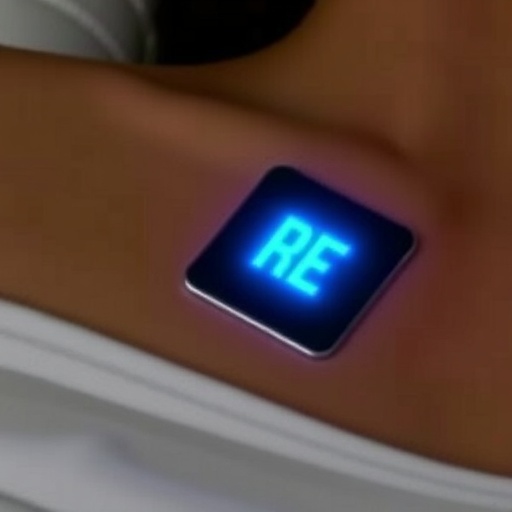
In a groundbreaking leap for neuroscience and wearable technology, researchers have unveiled an innovative skin-attached bioadhesive patch capable of delivering ultrasound deep brain stimulation (DBS) while simultaneously providing real-time electrophysiological monitoring aimed at enhancing REM sleep. This cutting-edge device, detailed in a recent publication in Nature Communications, represents a marriage of non-invasive therapeutic intervention and continuous neural activity tracking, promising transformative applications in sleep medicine and neurological research.
Deep brain stimulation traditionally involves invasive procedures wherein electrodes are surgically implanted into specific brain areas to modulate neural activity, most commonly used in the treatment of movement disorders such as Parkinson’s disease. However, the bioadhesive patch introduced by Tang, Baird, Moscoso-Barrera, and colleagues reimagines DBS by harnessing focused ultrasound waves transmitted through a flexible interface adhered to the skin. This approach eradicates the need for surgical implantation, drastically reducing risk, recovery time, and accessibility barriers.
The device leverages advances in bioadhesive materials engineered to maintain robust skin contact over extended periods without irritation or discomfort. These adhesives ensure stable acoustic coupling, which is critical for efficient transmission of ultrasound energy deep into the brain tissue. By precisely tuning ultrasound parameters—frequency, intensity, and pulse patterns—the team achieved targeted modulation of neuronal circuits implicated in REM sleep regulation.
Simultaneously, embedded electrophysiological sensors integrated into the patch capture local field potentials and cortical electrical activity with exceptional fidelity. This dual-functionality allows for concurrent stimulation and monitoring, enabling the device to operate in a closed-loop configuration. Such real-time feedback is essential for dynamically adjusting stimulation protocols in response to ongoing brain activity, thereby optimizing treatment efficacy and minimizing potential adverse effects.
The capacity to enhance REM sleep — a critical phase associated with memory consolidation, emotional processing, and overall brain health — offers exciting therapeutic prospects. REM sleep disturbances are linked to various neuropsychiatric disorders including depression, PTSD, and neurodegenerative diseases. Traditional pharmacological interventions often produce inconsistent results or undesirable side effects. The presented technology offers a non-pharmacological alternative, potentially revolutionizing the landscape of sleep disorder treatments.
Methodologically, the team validated the patch’s functionality through rigorous in vivo experiments employing rodent models. Ultrasound stimulation sites were carefully selected based on prior mapping of sleep-associated neural circuits. The researchers demonstrated significant increases in REM sleep duration and intensity, confirmed by electrophysiological signatures characteristic of the REM state. Importantly, these effects were achieved without collateral disruptions to other sleep stages or eliciting pain responses.
Moreover, the patch’s flexible form factor and lightweight design facilitate ease of use in both laboratory and clinical settings. The breathable adhesive substrate maintains skin integrity over prolonged wear, a critical consideration for overnight or extended therapeutic sessions. The entire system interfaces wirelessly with external processing units, enabling remote control and data acquisition, which could allow for home-based sleep therapy and longitudinal monitoring.
Beyond sleep enhancement, the versatility of ultrasound neuromodulation embodied in this device heralds broader applications. The ability to non-invasively target deep brain regions opens avenues for managing diverse neurological and psychiatric conditions. Disorders such as epilepsy, chronic pain, depression, and anxiety, where neural circuitry modulation is therapeutic, stand to benefit immensely from such technology.
The device’s real-time electrophysiological monitoring also provides an unprecedented window into brain dynamics. Researchers can dissect neural responses to stimulation at a fine temporal scale, unraveling complex mechanisms underlying sleep architecture and brain plasticity. This feedback loop facilitates personalized medicine approaches whereby therapies are tailored according to each individual’s neural signatures and treatment responses.
Crucially, this study underscores the promise of ultrasound-based neuromodulation as a safer alternative to electrical DBS, which carries risks of infection, hemorrhage, and hardware complications. Focused ultrasound has already gained FDA approval for conditions like essential tremor, lending regulatory momentum to this technology’s expansion. Incorporating it into a skin-conformal device further reduces invasiveness and operational complexity.
While the findings are compelling, challenges remain before widespread clinical adoption. Long-term safety and biocompatibility studies are essential to ensure chronic usage does not provoke adverse skin reactions or neural adaptations. Furthermore, scaling the device for human use involves overcoming anatomical and biophysical differences, such as skull thickness and acoustic window variability, which affect ultrasound propagation.
Future iterations may integrate advanced machine learning algorithms to better interpret electrophysiological data and refine stimulation patterns autonomously. Combining this patch with other sensing modalities like near-infrared spectroscopy or functional MRI could enrich monitoring capabilities. Additionally, exploring the device’s utility in other sleep stages or cognitive enhancement presents fertile grounds for research.
In summary, the skin-attached bioadhesive patch developed by Tang et al. epitomizes a paradigm shift in neuromodulation and sleep medicine. By enabling non-invasive, ultrasound-driven deep brain stimulation coupled with simultaneous electrophysiological monitoring, this technology promises safer, personalized, and more accessible interventions for sleep enhancement and beyond. As the field embraces wearable bioelectronics, such innovations pave the way toward seamless brain-machine interfaces that harmonize with natural physiology to improve human health and cognition.
The convergence of material science, bioengineering, neuroscience, and clinical medicine crystallizes into this elegant yet powerful device, illustrating the profound impact interdisciplinary collaboration can have in addressing some of humanity’s most challenging health issues. Its potential to enhance not only sleep quality but also brain function heralds a bright horizon for both patients and researchers alike.
As the technology advances toward human trials and eventual deployment, the implications extend beyond healthcare into realms such as augmented reality, learning enhancement, and even dream modulation research. The ability to actively and safely steer brain states may unlock novel frontiers that reconfigure how we understand consciousness and neural plasticity.
Ultimately, this skin-attached bioadhesive patch represents more than a medical device; it signifies an extraordinary step toward a future where wearable neurotechnology integrates effortlessly into daily life, empowering individuals to optimize their brain health with precision and minimal disruption. The ripple effects of such innovation will undoubtedly resonate across science, medicine, and society for years to come.
Cite Scienmag News
Cassandra Pierce. (June 4, 2026). Skin-Attached Patch Boosts REM Sleep via Ultrasound. Scienmag. https://scienmag.com/skin-attached-patch-boosts-rem-sleep-via-ultrasound/
Cassandra Pierce. "Skin-Attached Patch Boosts REM Sleep via Ultrasound." Scienmag, 4 June 2026, https://scienmag.com/skin-attached-patch-boosts-rem-sleep-via-ultrasound/. Accessed 4 September 2026.
Cassandra Pierce. "Skin-Attached Patch Boosts REM Sleep via Ultrasound." Scienmag. June 4, 2026. https://scienmag.com/skin-attached-patch-boosts-rem-sleep-via-ultrasound/


