


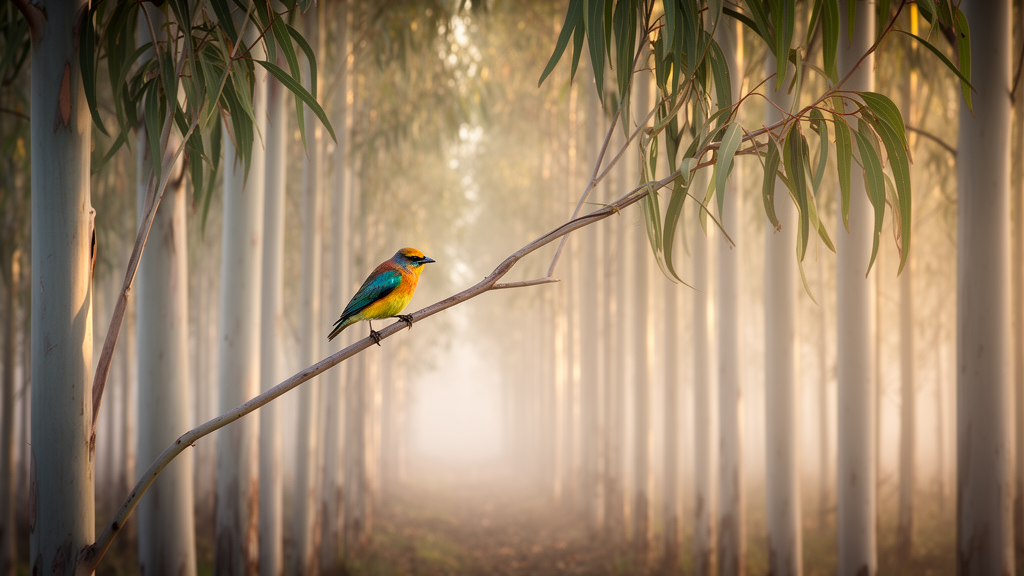
In the rolling grasslands of eastern Argentina, rows of Eucalyptus trees rise like green islands above a sea of pasture and farmland. To the birds trying to live among them, these plantations behave less like forests and more like archipelagos, and a new study suggests the rules governing those islands are not the ones ecologists expected. Research published in Frontiers of Biogeography finds that the size of a Eucalyptus plantation has almost nothing to do with how many forest bird species it holds, upending one of the oldest and most reliable patterns in ecology. What matters instead is distance: the farther a plantation sits from a natural riparian forest, the poorer and more monotonous its bird community becomes.
The species–area relationship, first formalized more than a century ago, holds that bigger patches of habitat almost always contain more species. It has been called a near-universal law of ecology, and it underpins conservation decisions worldwide, from the design of nature reserves to predictions of extinction following habitat loss. The team behind the new study, led by researchers affiliated with the Universidad de Buenos Aires and CONICET, set out to test whether that law extends to a strange new kind of island: intensively managed tree monocultures planted across the Río de la Plata grasslands, where commercial afforestation has been expanding since the 1970s and regional policy aims to grow plantation cover by half again by 2030.
The researchers surveyed birds at 17 mature Eucalyptus stands scattered between the towns of Gualeguaychú and Concordia in Entre Ríos province. The stands varied enormously in size, from roughly 14 hectares to more than 2,700, and in isolation, from just 400 meters to 9 kilometers from the nearest riparian forest, the narrow ribbons of native woodland that survive along the Uruguay River and its tributaries. Using the point-count technique, a trained observer recorded every bird seen or heard within a 50-meter radius at ten fixed points per plantation, each visit timed for five minutes during calm spring mornings. Digital recordings of vocalizations were later verified against published sound libraries to make sure no species slipped through unidentified.
In total, the surveys detected 48 bird species, of which 40 were classified as forest species for analysis, representing 737 individual birds. The most widespread residents were familiar generalists: the Rufous-collared sparrow, the Picazuro pigeon, the Sayaca tanager, and the House wren, which together dominated the counts. On average, a plantation held about 12 forest species, though the range was wide, from as few as 4 to as many as 21. Those numbers alone hinted that something unusual was happening in these man-made woods.
When the team ran the numbers through generalized linear models, controlling for differences in vegetation structure such as leaf litter cover, shrub height, and canopy openness, the results were striking. Plantation area showed no statistically significant relationship with species richness. A plantation of 2,700 hectares was, on average, no richer in forest birds than one a hundred times smaller. Distance, by contrast, told a clear and consistent story: species richness declined significantly as the gap to the nearest riparian forest widened, with isolation explaining roughly 35 percent of the variation in species counts, far more than any other variable in the model.
But the study did not stop at counting species. The researchers also measured functional diversity, which captures the variety of ecological roles birds play, from diet and body size to nesting habitat and sensitivity to disturbance. They compiled 11 functional traits for each species and calculated two indices: functional richness, which measures the volume of trait space a community occupies, and functional originality, which reflects how distinct each species is from its closest ecological neighbor. A community with low functional originality is functionally redundant, meaning multiple species are doing essentially the same jobs, a configuration that can leave ecosystems vulnerable if those roles are lost.
The functional results mirrored the taxonomic ones. Functional richness was unrelated to plantation area but fell significantly with distance from riparian forest. Functional originality showed the strongest effect of all, declining sharply with isolation, which means the most remote plantations were packed with functionally interchangeable species. Isolation alone explained more than 41 percent of the variation in functional originality. In plain terms, a far-flung Eucalyptus stand is not just emptier than a well-connected one; it is also filled with birds that are ecological clones of one another, while the specialists with unique traits have been filtered out entirely.
Why does size fail where it usually succeeds? The authors point to the habitat diversity hypothesis, one of the classic explanations for the species–area relationship: bigger areas tend to contain more kinds of habitats, and more habitats support more species. Eucalyptus plantations break that link. Because they are managed for uniformity, with standardized spacing, pruning, and harvest cycles, a large plantation offers essentially the same simplified environment as a small one, just more of it. Without a gradient of habitat diversity to exploit, additional area gives forest birds nothing new, and the strong environmental filter of a monoculture narrows the candidate species list regardless of how many hectares are on offer.
Isolation works differently. In the framework of island biogeography developed by Robert MacArthur and E. O. Wilson in the 1960s, species richness on an island reflects a balance between immigration, which falls with distance from a mainland source, and extinction, which falls with island size. The new findings suggest that in this agricultural landscape, the immigration side of the equation dominates. Riparian forests act as source populations, continually sending colonists into nearby plantations and reinforcing struggling ones through what ecologists call the rescue effect. The surrounding grassland matrix offers little shelter, and other plantations scattered across the landscape appear too poor in habitat quality to serve as stepping stones, so distance to true native forest becomes the decisive variable for which birds can arrive, persist, and recolonize after local losses.
The practical implications reach well beyond Argentina. As commercial tree plantations expand across grasslands and former farmland on every continent, the study offers a concrete lever for conservation: keep native forest within reach. Plantations near riparian woodland supported richer, more distinctive bird communities, while isolated stands converged on depauperate, redundant assemblages dominated by a handful of tough generalists. For land managers, foresters, and certification schemes, the message is that connectivity to natural habitat, not the sheer size of the production block, is what sustains biodiversity in these anthropogenic islands. The researchers also caution that the quality and permeability of the surrounding matrix deserve closer attention in future work, since a hostile landscape can turn even a modest gap into an effective barrier. In a world where managed monocultures increasingly double as habitat, knowing which rules of island ecology apply, and which quietly break down, may determine how much life these green archipelagos can hold.
Subject of Research: Island biogeography effects of patch area and isolation on bird diversity in Eucalyptus plantations
Article Title: Area and isolation influence on bird diversity in Eucalyptus plantations: An island biogeography perspective
Article References: Oddi, J. A., Ariza, A. M., & Filloy, J. (2025). Area and isolation influence on bird diversity in Eucalyptus plantations: An island biogeography perspective. Frontiers of Biogeography, 18, Article e148419. https://doi.org/10.21425/fob.18.148419
Image Credits: AI Generated
Keywords: island biogeography, Eucalyptus plantations, bird diversity, species-area relationship, functional diversity, habitat fragmentation, riparian forest, Argentina, Entre Ríos, monoculture, functional redundancy, conservation
Cite Scienmag News
Margaret Porter. (October 18, 2026). Size Doesn’t Matter: Isolation Drives Bird Diversity in Eucalyptus Plantations. Scienmag. https://scienmag.com/size-doesnt-matter-isolation-drives-bird-diversity-in-eucalyptus-plantations/
Margaret Porter. "Size Doesn’t Matter: Isolation Drives Bird Diversity in Eucalyptus Plantations." Scienmag, 18 October 2026, https://scienmag.com/size-doesnt-matter-isolation-drives-bird-diversity-in-eucalyptus-plantations/. Accessed 18 October 2026.
Margaret Porter. "Size Doesn’t Matter: Isolation Drives Bird Diversity in Eucalyptus Plantations." Scienmag. October 18, 2026. https://scienmag.com/size-doesnt-matter-isolation-drives-bird-diversity-in-eucalyptus-plantations/


