


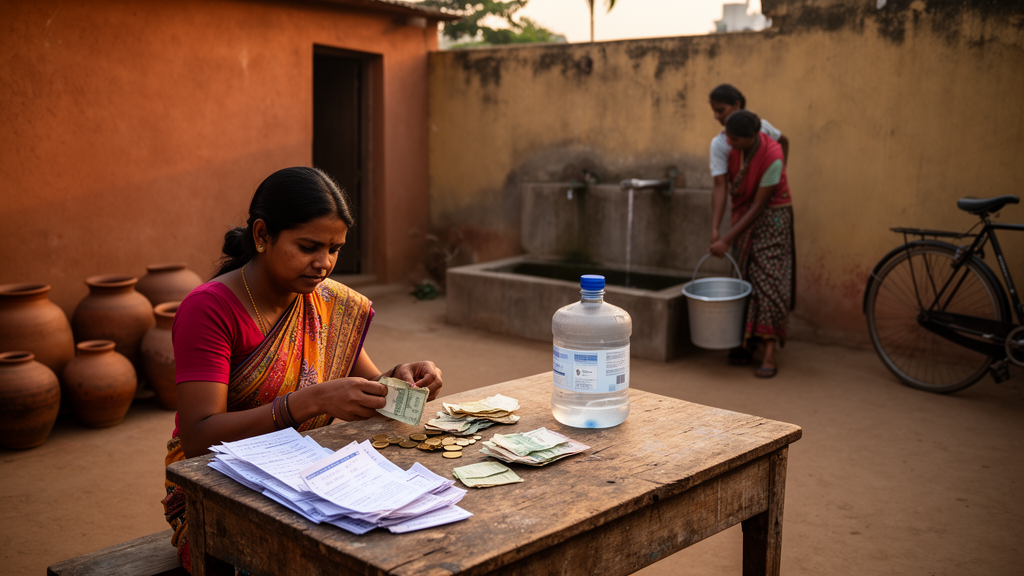
Cholera is usually described in the language of epidemiology: an estimated 4 million cases and roughly 143,000 deaths every year, concentrated in the world’s most resource-limited settings. But a new prospective cost-of-illness study, published in BMC Public Health, shifts the lens from case counts to cash flows, asking a deceptively simple question with profound policy implications: what does a single episode of cholera actually cost, and who ends up paying for it? The answer, drawn from hundreds of consecutively enrolled patients in Nepal and Mozambique, reveals two countries where the same disease imposes strikingly different economic burdens, shaped less by biology than by the architecture of healthcare financing and service delivery.
The research was embedded within the Enhanced Cholera Control projects, known as ECHO-N in Nepal and ECHO-M in Mozambique, and led by the International Vaccine Institute with support from the Korea International Cooperation Agency. Rather than reconstructing costs retrospectively from records, the team designed a prospective cost-of-illness study, the gold standard for capturing the full economic footprint of a disease as it unfolds. In Nepal, data were collected from 38 health facilities in the Kathmandu Valley and Kailali District between 2021 and 2024. In Mozambique, the team worked in cholera treatment centers across five provinces during the epidemic period and in Nampula province during the endemic period, spanning 2023 to 2025. All eligible cholera cases meeting country-specific case definitions were consecutively enrolled, a design choice that minimizes selection bias and yields a sample representative of the true patient population presenting for care.
The analytical framework distinguished three cost categories that together define the economic burden of an illness episode. Direct medical costs cover consultations, medications, laboratory tests and hospital stays. Direct non-medical costs capture the often-overlooked expenses of simply getting treated: transportation to facilities, food for patients and caregivers, and accommodation during hospitalization. Indirect costs, the third pillar, quantify lost productivity, the wages forfeited when a patient or caregiver cannot work. Patient interviews captured all three categories, while healthcare provider costs were estimated from facility records in both countries. In Nepal, the researchers applied a hospital-specific revenue-to-cost ratio adjustment, a technical refinement that corrects for the mismatch between what facilities earn through revenue and what their services actually cost to deliver, ensuring provider-side estimates reflect true resource consumption rather than accounting artifacts.
The headline numbers tell a story of two very different epidemics. During epidemic periods, the mean cost per cholera episode was higher in Nepal, at US$113.5 with a 95 percent bootstrapped confidence interval of 93.3 to 133.7, than in Mozambique, where the mean was US$54.1 with a confidence interval of 50.8 to 57.0. Yet the pattern inverted during endemic periods: the mean cost per episode rose to US$72.5 in Mozambique, with a confidence interval of 65.0 to 80.5, while Nepal’s endemic-period mean fell to US$63.6, with a confidence interval of 48.4 to 78.7. The study analyzed 273 cases in Nepal and 252 in Mozambique, and all costs were reported in 2023 US dollars with 95 percent bootstrapped confidence intervals, a non-parametric resampling technique that avoids assumptions about the underlying cost distribution, which is typically right-skewed in cost-of-illness data.
Raw dollar comparisons, however, can mislead when the two economies differ so dramatically in what money can buy. To correct for this, the researchers adjusted the figures for purchasing power parity, converting local costs into international dollars that reflect equivalent purchasing power across countries. After this adjustment, the mean cost per episode was I$346.9 in Nepal and I$155.3 in Mozambique, meaning that once the local cost of goods and services is accounted for, a cholera episode in Nepal consumes more than twice the real resources of one in Mozambique. This PPP adjustment is critical for cross-country comparisons in health economics, because a US$113 episode in a low-income economy can represent a far heavier real burden than the same nominal sum in a wealthier one.
The most consequential finding concerns who bears the financial weight. In Mozambique, every single enrolled patient received government subsidies for cholera treatment, meaning the state absorbed the direct medical costs rather than the households. In Nepal, the picture was radically different: 89.5 percent of enrolled participants reported making out-of-pocket payments for cholera treatment during the endemic period, and out-of-pocket payments accounted for 92.6 to 96.6 percent of total direct medical costs. In practical terms, nearly every rupee spent on cholera care in Nepal came directly from the pockets of already vulnerable families, a financing pattern that health economists associate with catastrophic health expenditure and impoverishment when illness strikes households with limited savings.
The burden relative to income tells the final chapter of this economic story. The proportion of household income represented by cholera-related costs was higher in Mozambique than in Nepal and varied across income groups, meaning that for the poorest families, a single episode of watery diarrhea could consume a meaningful slice of annual earnings. This income-relative framing is essential for understanding the true distributional impact of cholera: the same absolute cost weighs far more heavily on a household living at subsistence level than on one with disposable income, and the variation across income groups signals that cholera functions as a regressive economic shock, punishing the poorest most severely.
The divergence in cost patterns between the two settings reflects differences in healthcare utilization, financing mechanisms and service delivery models rather than differences in the disease itself. Nepal’s higher epidemic-period costs likely mirror longer care pathways, more intensive facility-based treatment and the absence of subsidies, while Mozambique’s government-financed model shields patients from direct medical charges even as indirect and non-medical costs accumulate. These findings argue for context-specific financing strategies: in Nepal, expanding subsidy coverage or risk-pooling mechanisms could prevent cholera from becoming a household financial catastrophe, while in Mozambique, protecting government financing for cholera treatment remains essential to preserve the existing safety net.
Beyond financing, the economics of cholera strengthen the case for prevention. The authors emphasize that these cost estimates support consideration of preventive investments, from oral cholera vaccines to water, sanitation and hygiene infrastructure, as a means of reducing the economic burden before episodes occur. When a single episode costs I$346.9 in purchasing-power-adjusted terms in Nepal, and when cholera generates millions of cases annually worldwide, the aggregate economic toll rivals the clinical one. Cost-of-illness evidence of this kind provides ministries of health and finance with the quantitative ammunition to weigh prevention against treatment, transforming cholera control from a purely public health argument into an economic one that resonates across government departments.
For a disease long measured in cases and deaths, this study adds a third metric that may prove just as persuasive to policymakers: money. By rigorously quantifying the economic burden of cholera from both patient and provider perspectives in two endemic countries, the research demonstrates that the financial footprint of cholera is substantial, unevenly distributed and deeply shaped by national financing choices. As climate change expands the geographic range of cholera and urbanization concentrates vulnerable populations, understanding what each episode costs, and who pays, will become an increasingly urgent question for global health. The answer from Nepal and Mozambique is clear: cholera is not only a clinical emergency but an economic one, and the solutions, whether subsidies in Kathmandu or sustained financing in Maputo, must be tailored to the financing architecture of each setting.
Subject of Research: Health Economics
Article Title: Estimating the economic burden of cholera: evidence from Nepal and Mozambique
Article References: Parajulee, P., Karki, K., Capitine, I. U., Manjate, N. J., Amatya, R., Sitoe, S. M., Chaudhary, R., Jang, G. H., Jeon, Y., Lee, Y., Lee, J.-W., Dengo-Baloi, L., Bajracharya, D. C., Mishra, P., Kimathi, D., Poudyal, N., Langa, J. P. M., Paudel, K. P., Park, S. E., … Lee, J.-S. (2026). Estimating the economic burden of cholera: evidence from Nepal and Mozambique. BMC Public Health. https://doi.org/10.1186/s12889-026-29818-4
Image Credits: AI Generated
DOI: 10.1186/s12889-026-29818-4
Keywords: cholera, cost of illness, Nepal, Mozambique, health economics, out-of-pocket payments, public health, LMICs, Estimating, economic, burden, evidence
Cite Scienmag News
Ophelia Keating. (October 18, 2026). Cholera’s hidden price tag: households in Nepal and Mozambique pay a heavy economic toll. Scienmag. https://scienmag.com/choleras-hidden-price-tag-households-in-nepal-and-mozambique-pay-a-heavy-economic-toll/
Ophelia Keating. "Cholera’s hidden price tag: households in Nepal and Mozambique pay a heavy economic toll." Scienmag, 18 October 2026, https://scienmag.com/choleras-hidden-price-tag-households-in-nepal-and-mozambique-pay-a-heavy-economic-toll/. Accessed 18 October 2026.
Ophelia Keating. "Cholera’s hidden price tag: households in Nepal and Mozambique pay a heavy economic toll." Scienmag. October 18, 2026. https://scienmag.com/choleras-hidden-price-tag-households-in-nepal-and-mozambique-pay-a-heavy-economic-toll/


