More than a decade and a half after Wisconsin’s grasshopper atlas went quiet, the state’s short-horned grasshoppers are getting a long-overdue census update. A new study published in the Journal of Orthoptera Research documents 99 new county-level distribution records for the state’s short-horned grasshoppers, the insects of the families Acrididae and Romaleidae, and adds one species entirely new to Wisconsin. The update, the first comprehensive revision since the Guide to the Grasshoppers of Wisconsin appeared in 2005, reveals that a surprising share of the state’s grasshopper diversity has been hiding in plain sight, particularly in the woodlands and forest edges that conventional survey work has historically neglected.
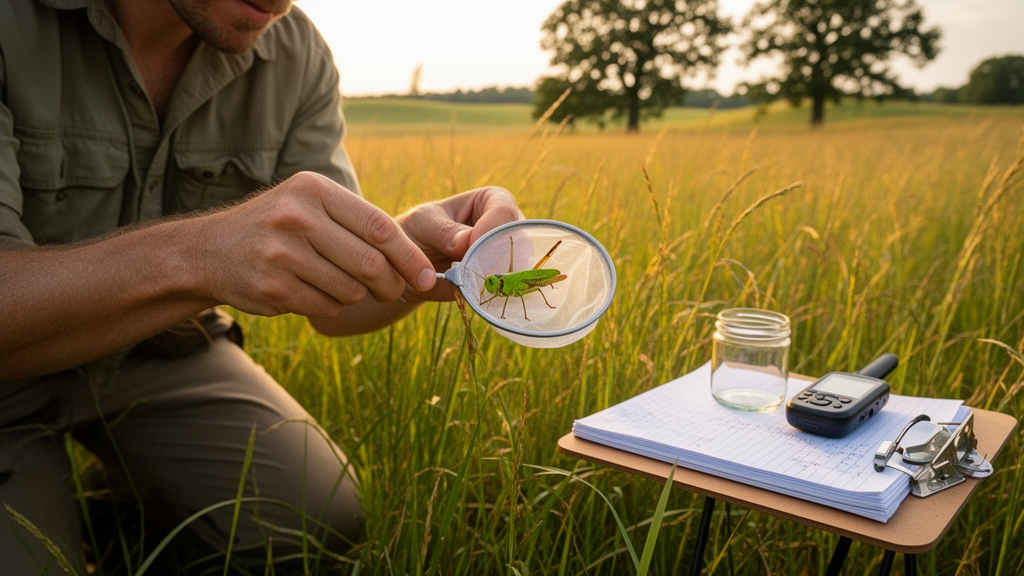
The effort was driven in large part by periodic summer collecting trips by the study’s first and third authors, who visited Wisconsin for one to three weeks each year between 2005 and 2023, sweeping specimens with aerial nets and photographing others in the field. But the researchers also leaned heavily on a resource that simply did not exist when the 2005 guide was compiled: online citizen science platforms. BugGuide and iNaturalist, where volunteers upload geotagged photographs of insects with dates and locations, supplied a substantial portion of the new records and, in one remarkable case, revealed an entire species breeding in the state that no one had formally documented before.
The scale of the update is striking for several species. Melanoplus punctulatus, an arboreal grasshopper that spends much of its life in trees and shrubs, jumped from 10 recorded counties to 30, an increase of more than 50 percent. Dichromorpha viridis rose from 14 counties to 23, Melanoplus viridipes from 23 to 33, and Melanoplus walshii from 20 to 27. Dendrotettix quercus, Melanoplus fasciatus, Melanoplus scudderi, and the wetland-dwelling Stethophyma lineata each gained at least 20 percent more county records. In total, 28 of Wisconsin’s 72 previously recorded short-horned grasshopper species gained new county records during the study period.
The most dramatic discovery, however, was Melanoplus gracilis, a species never before recorded in Wisconsin. Nine photographs of the grasshopper were found on iNaturalist, three showing nymphs and six showing adults, from three southeastern counties: Ozaukee, Walworth, and Waukesha. The earliest records date to August 31, 2020, in Ozaukee County. Because Melanoplus gracilis is flightless and nymphs were documented, the evidence indicates the species is actively breeding in southeastern Wisconsin rather than merely straying across the border, and the authors suggest it likely occupies additional counties in the region.
A separate state record, Trimerotropis pallidipennis, was collected in Price County in June 2022 and reported previously, so it is not counted as new here. Still, its significance is worth noting: the male specimen was found roughly 6.5 kilometers east of Fifield, more than 600 kilometers from the nearest previously known occurrence. The species is native to the southwestern United States and regularly disperses across Texas, Oklahoma, and the western Great Plains, and the researchers believe the Wisconsin individual most likely arrived on a significant weather front, a reminder that insect distributions can shift dramatically in a single storm event.
Why did so many species go unrecorded for so long? The answer, the authors argue, lies largely in habitat specialization and the historical biases of grasshopper survey work. Of the eight species whose county records increased by at least 20 percent, seven are associated with woodlands or woodland edges, and two of those are arboreal, spending most of their time in the forest canopy. Grasshopper research has traditionally focused on species of agricultural and economic importance, which means the insects of rangelands and crop fields are well cataloged while woodland dwellers, wetland specialists, and small cryptic species are frequently overlooked. The pattern is not unique to Wisconsin: a comparable effort in Nebraska yielded eight new state records in just three years simply by sampling beyond grasslands and across a broader seasonal window.
Some of the state’s smallest and most inconspicuous grasshoppers are probably far more widespread than current records indicate. Melanoplus islandicus and Melanoplus dawsoni, both very small and mostly flightless, likely occur across most of the northern half of Wisconsin, the former in small woodland openings and the latter in meadows and along woodland edges. At the other extreme, several habitat generalists probably live in every one of Wisconsin’s 72 counties even though the records do not show it. Species such as Arphia sulphurea, Chloealtis conspersa, Chortophaga viridifasciata, Dissosteira carolina, Melanoplus bivittatus, Melanoplus femurrubrum, Melanoplus sanguinipes, and Pseudochorthippus curtipennis thrive in roadsides, gardens, disturbed ground, and field edges, and their broad host-plant tolerance makes them easy to find once someone looks.
Citizen science proved powerful but demanded careful vetting. On BugGuide, where only site editors can move images between taxa and insect taxonomists frequently review submissions, species identifications are generally dependable. iNaturalist is more of a mixed bag: identification accuracy varies widely and misidentified specimens are abundant, so the first author personally examined each candidate record and accepted only those where the species identification was conclusive based on visible anatomical structures. The approach paid off, and the authors note that several additional county records were added to iNaturalist in 2024 and will need to be incorporated in future updates. The usefulness of these platforms is particularly evident for arboreal species like Melanoplus punctulatus, which collectors rarely notice but photographers frequently capture.
The update also raises taxonomic questions that may reshape Wisconsin’s grasshopper list in the coming years. The status of Melanoplus foedus fluviatilis, currently treated as a subspecies, is actively debated: differences in habitat preference, flight behavior, plant associations, coloration, and body measurements, together with the apparent absence of hybrids where the two forms co-occur, suggest it may warrant full species status. Similarly, Hesperotettix viridis pratensis, the form found in Wisconsin’s western counties, may prove to be a distinct species from Hesperotettix viridis viridis, with genetic differences that track host-plant associations. Ongoing research on the genus is expected to clarify these boundaries.
Not all the news is about additions. Pardalophora haldemanii, a grassland species of the Great Plains, has not been seen in Wisconsin in more than 50 years, and the authors suspect it may have been extirpated. The species requires large, connected grassland tracts, and most of Wisconsin’s grasslands have become small, isolated, or heavily invaded by nonnative grasses, a combination that makes long-term persistence unlikely. Several other historical records are questionable: the flightless southeastern species Romalea microptera was probably recorded from escaped captive specimens, a 1976 record of Paratylotropidia brunneri sits more than 400 kilometers north of its nearest known population and may represent a rare native remnant, and single old records of Encoptolophus costalis, Pardalophora phoenicoptera, and Schistocerca damnifica are considered doubtful, possibly the result of mislabeled specimens. The authors also flag two host-plant specialists, Hypochlora alba and Campylacantha olivacea, as species to watch for, since both have been photographed within striking distance of the state’s borders and their favored food plants grow widely across Wisconsin. Targeted searches on those host plants, the researchers suggest, are the logical next step in a survey that is clearly far from finished.
Subject of Research: Updated county-level distribution records for Wisconsin short-horned grasshoppers based on field surveys and citizen science data
Article Title: Updated county-level distribution records for Wisconsin short-horned grasshoppers ( Orthoptera , Acrididae and Romaleidae )
Article References: Brust, M. L., Bomar, C., & Harman, A. J. (2025). Updated county-level distribution records for Wisconsin short-horned grasshoppers (Orthoptera, Acrididae and Romaleidae). Journal of Orthoptera Research, 34(1), 143-149. https://doi.org/10.3897/jor.34.124604
Image Credits: AI Generated
Keywords: grasshoppers, Orthoptera, Acrididae, Wisconsin, citizen science, iNaturalist, BugGuide, species distribution, Melanoplus, woodland insects, biodiversity survey, new state record
Cite Scienmag News
Gavin Prescott. (October 18, 2026). Wisconsin Grasshopper Map Redrawn as Citizen Scientists and Field Surveys Add 99 New County Records. Scienmag. https://scienmag.com/wisconsin-grasshopper-map-redrawn-as-citizen-scientists-and-field-surveys-add-99-new-county-records/
Gavin Prescott. "Wisconsin Grasshopper Map Redrawn as Citizen Scientists and Field Surveys Add 99 New County Records." Scienmag, 18 October 2026, https://scienmag.com/wisconsin-grasshopper-map-redrawn-as-citizen-scientists-and-field-surveys-add-99-new-county-records/. Accessed 18 October 2026.
Gavin Prescott. "Wisconsin Grasshopper Map Redrawn as Citizen Scientists and Field Surveys Add 99 New County Records." Scienmag. October 18, 2026. https://scienmag.com/wisconsin-grasshopper-map-redrawn-as-citizen-scientists-and-field-surveys-add-99-new-county-records/