


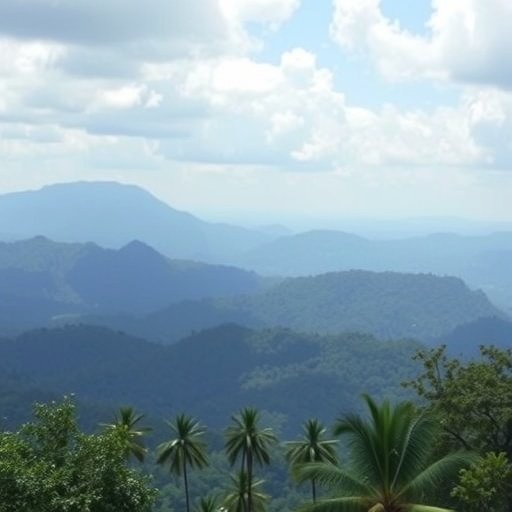
In the realm of tropical forestry, the delicate interplay between environmental variables and tree development dictates both ecosystem stability and commercial viability. A groundbreaking study conducted by experts from the University of Eastern Finland in collaboration with Colombia’s AGROSAVIA has illuminated the nuanced effects of climate and light conditions on the early growth stages of Cariniana pyriformis, commonly known as the abarco tree. This research offers pivotal insights for reforestation initiatives and sustainable forest management strategies, particularly in the face of accelerating climate change across tropical regions.
Cariniana pyriformis holds a distinguished position among native South American timber species, prized not only for its superior wood qualities but also for its ecological roles within forest systems. Despite its commercial value, abarco plantations remain relatively limited in scale within Colombia. Recently, Colombian authorities have recognized the species’ potential, adding it to the government-backed 2025 financial incentive program for commercial reforestation, aiming to stimulate the propagation of native species that can sustainably support local economies and enhance biodiversity.
Over the course of six years, researchers meticulously monitored young abarco saplings in permanent plots subjected to contrasting light regimes: full sunlight exposure and partial canopy shade. The longitudinal nature of this study allowed for an unprecedented examination of growth dynamics through repeated annual measurements of key morphological parameters such as diameter at breast height, total height, and crown expansion. In addition, qualitative assessments determined tree health, including pest infestation and disease symptomatology, providing a comprehensive understanding of biotic and abiotic impacts on early development.
Crucially, the study integrated detailed climate data encompassing variables like rainfall patterns, ambient temperature fluctuations, relative humidity levels, and light intensity metrics. This multidimensional approach enabled the disentanglement of the relative contributions of each environmental factor to growth performance and survival probabilities, emphasizing the critical balance between moisture availability and solar radiation in shaping the young trees’ physiological responses.
Findings revealed robust early growth in abarco seedlings under both examined light conditions, with a marked enhancement in diameter growth rates observed in full sun environments. This suggests that the species exhibits photophilic tendencies during juvenile stages, leveraging higher light availability to maximize photosynthetic productivity and biomass accumulation. However, survival rates remained high across both light treatments, underlining the species’ inherent adaptability and resilience within its native range.
The influence of relative humidity emerged as a particularly significant determinant of growth vigor, underscoring the sensitivity of early development to atmospheric moisture gradients. These results bear critical implications amid global climate models predicting altered humidity regimes, signaling potential vulnerabilities and adaptation needs for reforestation programs relying on abarco.
Interestingly, pest and disease incidence was predominantly associated with shaded conditions during the initial phases of growth, hinting at complex interactions between microclimate, plant vigor, and biotic stressors. This finding challenges preconceived notions that shade inherently confers protection, instead revealing that lower light levels may favor certain pathogen or pest pressures, which can undermine seedling establishment success.
Lead author Dr. Alexander Pulgarín Díaz emphasized the applied value of this research: “By elucidating how climate and light intricately influence the early stages of Cariniana pyriformis growth, forest managers are equipped to identify optimal planting sites and strategies that harness natural conditions, thereby promoting robust establishment and long-term forest sustainability.” The study provides a strategic framework for evidence-based decision-making in tropical forest restoration, where ecological knowledge remains patchy yet urgently required.
This investigation stands as the first extensive longitudinal analysis employing permanent plots to quantify early growth trajectories, survival rates, and climatic sensitivities of abarco seedlings in their native northern South American habitats. The innovative combination of repeated biometric measurements with climate monitoring delivers a granular perspective on how foundational environmental factors modulate forest regeneration processes for this economically and ecologically significant species.
Given the pressing global challenges posed by climate change and deforestation, advancing understanding of native tropical timber species such as Cariniana pyriformis is imperative. This study not only charts ecological baselines but also catalyzes the development of adaptive silvicultural practices tailored to dynamic environmental contexts, enhancing both conservation outcomes and timber production sustainability.
Bolstered by funding from the Corporación Colombiana de Investigación Agropecuaria-AGROSAVIA, the LUMETO Doctoral Programme, and the School of Forest Sciences at the University of Eastern Finland, this research exemplifies successful international collaboration aimed at addressing pressing environmental challenges through rigorous scientific inquiry.
The identification of light intensity and humidity as key drivers of early growth underscores the importance of integrating climatic forecasts into reforestation planning. As native tropical species face mounting pressure from environmental perturbations, studies like this pave the way toward resilient forest landscapes that can sustain ecosystem services and local livelihoods alike.
By focusing on a species that bridges commercial demand and ecological function, this work inspires confidence in the potential for native species to fulfill multiple societal needs under changing climatic scenarios, challenging reliance on exotic or less sustainable alternatives. The legacy of this research will likely influence tropical forestry policy and practice for years to come.
News Publication Date: 5-Feb-2026
Web References: http://dx.doi.org/10.1093/forestry/cpaf089
Cite Scienmag News
Russell Cooper. (March 4, 2026). Six Years of Field Data Reveal How Climate and Light Influence Early Abarco Growth, Guiding Reforestation Efforts in Colombia. Scienmag. https://scienmag.com/six-years-of-field-data-reveal-how-climate-and-light-influence-early-abarco-growth-guiding-reforestation-efforts-in-colombia/
Russell Cooper. "Six Years of Field Data Reveal How Climate and Light Influence Early Abarco Growth, Guiding Reforestation Efforts in Colombia." Scienmag, 4 March 2026, https://scienmag.com/six-years-of-field-data-reveal-how-climate-and-light-influence-early-abarco-growth-guiding-reforestation-efforts-in-colombia/. Accessed 3 September 2026.
Russell Cooper. "Six Years of Field Data Reveal How Climate and Light Influence Early Abarco Growth, Guiding Reforestation Efforts in Colombia." Scienmag. March 4, 2026. https://scienmag.com/six-years-of-field-data-reveal-how-climate-and-light-influence-early-abarco-growth-guiding-reforestation-efforts-in-colombia/


