


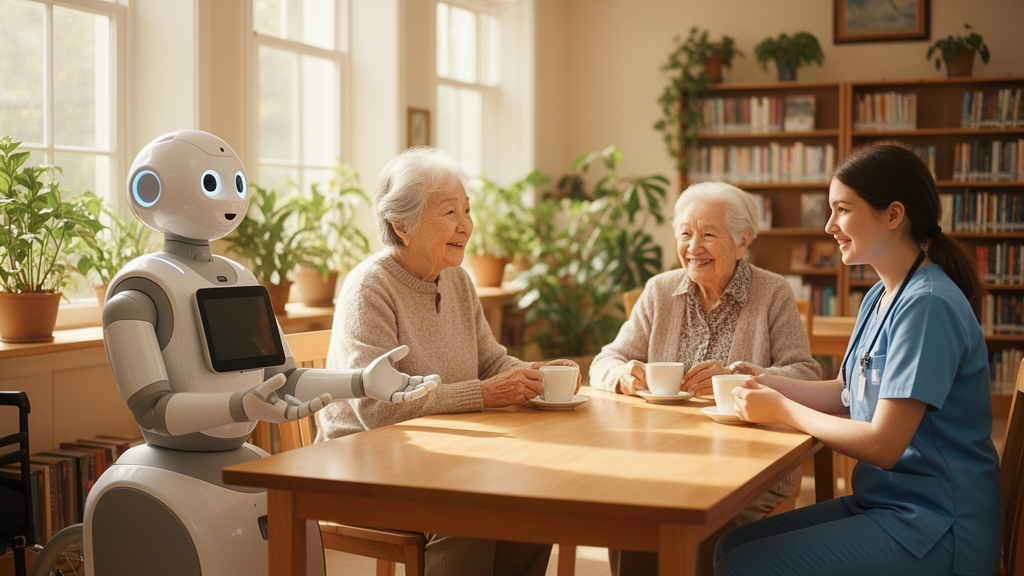
Can a small humanoid robot with glowing yellow eyes comfort an older adult as effectively as a human being? A new six-week study from Waseda University suggests that the answer is more nuanced than a simple yes or no, and the details may reshape how we think about emotional support in aging societies. Researchers Lingxuan Xiang and Hideaki Kikuchi found that verbal encouragement delivered by both a human partner and a conversational robot was associated with improvements in older Japanese adults’ subjective well-being, but the two types of partners appeared to work through distinctly different psychological pathways.
The study, published in Frontiers in Robotics and AI, tackled a growing social challenge. By 2050, the global population aged 65 and older is projected to reach 1.6 billion, and Japan already stands among the most aged nations, with older adults comprising 29.3 percent of its population. Aging brings daily hassles rather than clinical disorders: chronic pain, sleep difficulties, domestic friction, and a quiet loneliness amplified by shrinking social networks. Providing low-threshold emotional support for these everyday worries has become a pressing need, and chatbots and social robots capable of natural conversation are increasingly proposed as part of the solution. Whether they can genuinely deliver, however, has remained unclear.
The research unfolded in two phases. First, an online survey of 55 older Japanese adults aged 65 to 74 evaluated five types of encouraging utterances: reassurance and affirmation, expressing concern, encouragement to take action, offering specific actions, and distraction. Participants imagined confiding a worry to either a close human or a robot and rated how encouraged they would feel. Offering specific actions, exemplified by phrases like “I’ll look that up for you and let you know,” emerged as the high-efficacy strategy, while distraction, such as suggesting a warm bath or a delicious dessert, ranked lowest and was classified as low-efficacy. The difference was statistically significant.
Phase two recruited 18 older adults aged 62 to 90 for an exploratory six-week longitudinal experiment at a community center in Tokorozawa, Japan. Participants were randomly assigned to one of four conditions: a human partner or a small humanoid social robot called RoBoHoN, crossed with either the high-efficacy or low-efficacy encouragement strategy. Each week, they engaged in a structured conversation lasting five to ten minutes. Weeks one and two built rapport through casual chat and reminiscence, inviting participants to share memories of childhood games and school life. From weeks three through six, participants raised one everyday worry per session, which the partner or robot explored through empathic questioning before delivering the assigned encouragement in a single pivotal turn.
The robot’s dialogue system blended modern artificial intelligence with careful acoustic engineering. RoBoHoN’s microphone captured participants’ speech, which was transcribed by Google Speech-to-Text, processed by the GPT-4o language model to generate contextually appropriate responses in polite Japanese, and synthesized back into speech with pitch and speech rate adjusted to approximate the human partner’s voice. Robot body movements were disabled to isolate the effect of verbal encouragement, leaving only the illuminated eye display as a social signal. In the human condition, trained female partners followed identical dialogue scripts, ensuring that the comparison between flesh and machine rested on strategy content rather than conversation structure.
The quantitative results revealed a striking crossover-like pattern. Affective well-being, measured with the WHO-5 Well-Being Index, showed its largest mean increase in the robot condition paired with the high-efficacy strategy, rising 4.2 points, compared with only a 1.4-point gain for the robot paired with distraction. The advantage of high over low-efficacy encouragement was thus far more pronounced with the robot, a gap of 2.8 points, than with the human partner, where the gap was just 0.5 points. Cognitive well-being, measured with the Satisfaction With Life Scale, told the opposite story: the human condition showed a 2.0-point gap between strategies, while the robot condition showed almost none at 0.2 points. Encouragement from a robot seemed to operate on daily emotional balance, while encouragement from a human appeared to influence life evaluation.
The researchers offer a theoretically rich explanation rooted in how people attribute support. A human promising concrete help does not merely supply coping information; the offer signals genuine willingness to engage with the worry, fostering a sense of being valued and socially connected that reshapes how manageable a problem seems. When a robot makes the same offer, some participants questioned its plausibility, with one remarking that “the robot is not actually going to cook for me.” Conversely, the robot’s embodied presence may lower social evaluation pressure, creating a judgment-free space for emotional disclosure that is hard to find in human relationships. In Japan, where cultural norms around not burdening others discourage everyday sharing, this low-pressure environment may carry independent value.
The qualitative data brought the numbers to life. Many participants said the worries they disclosed during sessions had rarely or never been shared with anyone else, precisely because they feared burdening listeners or considered their concerns too trivial. Fifteen of the eighteen participants identified the conversations themselves as a source of perceived well-being change. Several reported that simply verbalizing vague feelings helped organize their thoughts, and multiple robot-condition participants said the robot’s illuminated eyes made it feel like it was truly listening. Some participants spontaneously distinguished the partners’ roles, suggesting that emotionally sensitive matters belong with humans while more objective concerns suit a robot.
Perceived encouragement effectiveness also evolved in revealing ways. In the human condition, the two strategies remained clearly separated, with high-efficacy encouragement rated 26.2 points higher by week six. In the robot condition, the strategies converged to nearly identical ratings as receptiveness to the robot’s action-oriented offers climbed steadily from 70.0 to 89.0, suggesting that trust in machine-delivered encouragement may develop gradually through sustained interaction. The authors caution that these findings remain preliminary: the sample was small, the analysis was descriptive rather than inferential, no no-encouragement control group was included, and diary entries documented external life events, including bereavements, that coincided with some score fluctuations.
Even with those caveats, the implications are compelling. The study is, to the researchers’ knowledge, the first to longitudinally compare identical encouragement strategies delivered by a human versus an embodied social robot in older adults. Its central message is that social robots should not be seen as substitutes for human supporters but as complementary resources, offering a low-threshold, sustainable outlet for everyday disclosure while human relationships remain essential for deeper concerns. Future support systems might even route everyday worries to a robot and guide serious issues to family members or professionals. As populations age worldwide, the humble glowing-eyed robot in a Tokorozawa community center may have offered an early glimpse of how machines and humans could share the work of caring.
Subject of Research: Long-term effects of human- versus robot-delivered verbal encouragement on older adults' subjective well-being
Article Title: The impact of encouraging utterances by a human partner and a conversational robot on older adults’ subjective well-being: a 6-week sustained interaction
Article References: Xiang, L., & Kikuchi, H. (2026). The impact of encouraging utterances by a human partner and a conversational robot on older adults’ subjective well-being: a 6-week sustained interaction. Frontiers in Robotics and AI, 13, Article 1866995. https://doi.org/10.3389/frobt.2026.1866995
Image Credits: AI Generated
DOI: 10.3389/frobt.2026.1866995
Keywords: social robots, subjective well-being, human-robot interaction, older adults, encouragement, emotional support, RoBoHoN, longitudinal study, aging society, affective well-being, cognitive well-being, Japan
Cite Scienmag News
Denise Maddox. (October 15, 2026). Six Weeks of Encouragement: Robots and Humans Uplift Older Adults in Different Ways. Scienmag. https://scienmag.com/six-weeks-of-encouragement-robots-and-humans-uplift-older-adults-in-different-ways/
Denise Maddox. "Six Weeks of Encouragement: Robots and Humans Uplift Older Adults in Different Ways." Scienmag, 15 October 2026, https://scienmag.com/six-weeks-of-encouragement-robots-and-humans-uplift-older-adults-in-different-ways/. Accessed 15 October 2026.
Denise Maddox. "Six Weeks of Encouragement: Robots and Humans Uplift Older Adults in Different Ways." Scienmag. October 15, 2026. https://scienmag.com/six-weeks-of-encouragement-robots-and-humans-uplift-older-adults-in-different-ways/


