


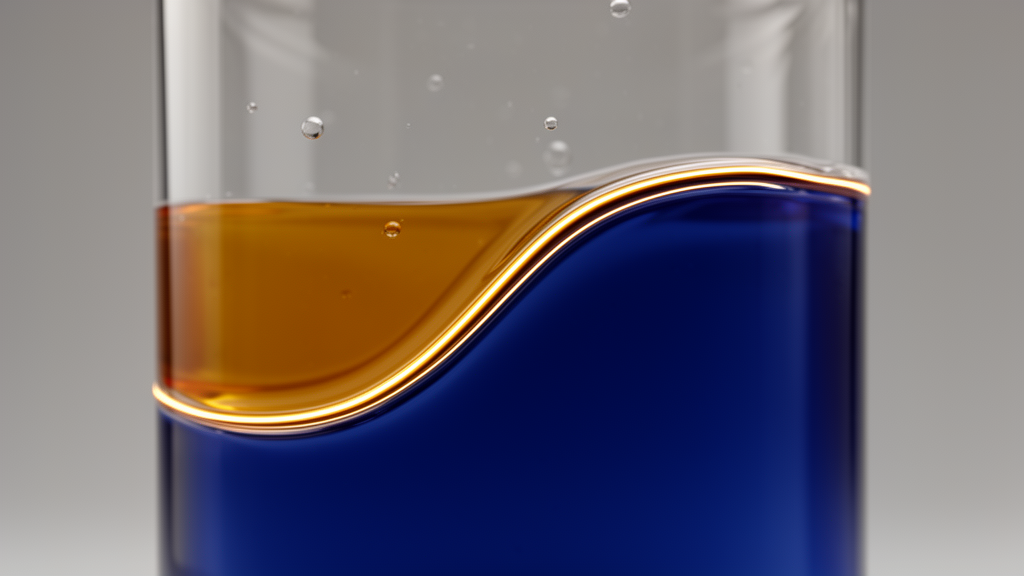
Simulating two fluids sliding past each other—a bubble rising through water, a droplet falling through air, or two drops merging into one—is one of the deceptively hard problems in computational physics. The boundary between the fluids, the interface, must be tracked with surgical precision, and any sloppiness quickly shows up as fluid that mysteriously vanishes or appears from nowhere. A team of researchers at the Norwegian University of Science and Technology (NTNU), working with Luca Brandt of NTNU and the Politecnico di Torino, has now unveiled a numerical scheme that tackles this long-standing nuisance head-on, reporting sharper mass conservation and faster runtimes without sacrificing accuracy in high-density-ratio two-phase flow simulations.
The new work, published in Frontiers in Thermal Engineering, builds on the level set method, one of the most popular interface-capturing techniques in computational fluid dynamics. In a level set formulation, the interface is not drawn explicitly; instead, it hides inside a smooth function as the set of points where that function equals zero. Typically this function is a signed distance function, meaning its value tells you how far you are from the interface and on which side. Moving the interface is then simply a matter of transporting this function along with the flow. The elegance of the approach explains its enduring popularity, but it comes with a well-known Achilles heel: mass loss.
The trouble arises because the interface must periodically be re-regularized. As the flow deforms the distance function, its defining property—that its gradient has unit magnitude everywhere—degrades, so a reinitialization equation must be solved to restore it. Every round of reinitialization nudges the zero contour slightly, and those tiny nudges accumulate. Over long simulations, droplets can shrink and bubbles can evaporate numerically, not because of any physics but because of the bookkeeping itself. Previous fixes have ranged from coupling level sets with volume-of-fluid methods to seeding the interface with Lagrangian particles, or from adding source terms to solving extra correction equations. Each works to some degree, but all add computational steps, implementation complexity, or both.
The NTNU-led team took a different route, borrowing an idea from a parallel line of research on phase field methods. Recent formulations—the conservative phase field (CPF) method of Chiu and Lin, refined by Jain, and the conservative diffuse interface (CDI) method proposed by Mirjalili and colleagues—advect a hyperbolic tangent profile across the interface instead of a signed distance function. This profile is carried by a compressive-diffusive equation with a regularization term that keeps the interface sharp, and crucially, it can preserve the interface function within strict bounds between zero and one using nothing more exotic than central-difference discretization. No separate reinitialization equation is needed at all.
The researchers realized this conservative advection machinery could be grafted onto their existing sharp interface level set solver designed for co-located grids, a solver they call SI-LSMcol. The result is the new sharp interface conservative level set method on a co-located grid, or SI-CLSMcol. Where the old method solved a pseudo-time reinitialization equation after every advection step, the new method advects the bounded hyperbolic tangent profile in a single step and then recovers the signed distance function through a simple algebraic relation. That substitution removes the most expensive and mass-eroding step in the pipeline while leaving everything else—momentum solving, pressure projection, jump conditions at the interface—untouched.
The co-located grid part of the story matters just as much. Many production codes store velocity and pressure at the same grid points rather than on staggered meshes, which is memory-friendly and simpler to parallelize, but it introduces a risk of pressure–interfacial force imbalance: when surface tension is not discretized in perfect balance with the pressure gradient, unphysical spurious currents ripple through the flow. The team’s approach sidesteps this by treating surface tension not as a volumetric source term but as a jump condition—an interfacial boundary condition—imposed directly at the interface. The new study extends this jump-condition framework, previously demonstrated only in two dimensions, to full three-dimensional Cartesian simulations with high density ratios, showing it remains robust under those demanding conditions.
Validation proceeded through a gauntlet of canonical benchmarks. First came the Young–Laplace law: a static droplet suspended in equilibrium, where the pressure jump across the curved interface must exactly match the surface tension times curvature. Across density ratios of 1, 10, and 100, the new method matched the old one’s accuracy almost exactly, with comparable magnitudes of spurious currents—confirming that swapping the advection equation did not disturb the delicate pressure–surface tension balance. A grid refinement study then revealed the headline result: the conservative method achieved two to three orders of magnitude less mass loss than its predecessor, while converging at a rate between first and second order as the mesh was refined.
The dynamic test cases told a consistent story. For a buoyancy-driven bubble rising in three dimensions, the simulated rise velocities agreed with previously published benchmark results, and the new method cut computational time by a factor of about two while improving mass conservation by a factor of roughly 45. For a falling droplet, validation against level set and coupled level set–volume of fluid results showed excellent agreement in the droplet’s trajectory, with improvements of about 3.25 times in speed and a several-fold gain in mass conservation. The droplet coalescence case—a droplet merging into a quiescent liquid pool, a surface-tension-dominated problem with severe interface deformation—matched experimental data within a few percent, with a 1.66-fold speedup and a 4.28-fold reduction in mass loss.
What makes the advance practical rather than merely academic is its plug-and-play character. Because the jump-condition source terms and the overall solution algorithm remain unchanged, the conservative advection equation can be dropped into an existing sharp interface solver with minimal re-engineering. The authors recommend choosing the regularization parameters so the interface function stays strictly bounded between zero and one, keeping the transition layer as thin as stability allows—a choice that sharpens the estimates of interface normals and curvature on which the whole sharp interface framework depends. The interface advection itself is discretized with a fifth-order WENO scheme in space and a third-order Runge–Kutta scheme in time, while the flow equations use a semi-explicit pressure-projection algorithm with a third-order TVD scheme for momentum advection.
For engineers simulating boiling, atomization, droplet dynamics, or any application where two immiscible fluids interact over long times, the implications are straightforward: simulations that keep their mass, run faster, and behave identically to trusted methods when checked against known physics. The work was supported by the Research Council of Norway and computed on the IDUN cluster at NTNU. As multiphase flow simulation pushes into ever more complex regimes—phase change, turbulent sprays, dense suspensions—methods that quietly eliminate accumulated numerical error while saving computation are exactly the kind of unglamorous but essential progress on which the field depends. This one, its authors show, can be adopted almost as easily as it was conceived.
Subject of Research: A mass-conservative sharp interface level set method for two-phase flow simulation on co-located grids
Article Title: A fast and improved mass-conservative approach for a sharp interface-level set method on co-located grid
Article References: Chirammel, S. S., Mukherjee, A., Brandt, L., & Solsvik, J. (2026). A fast and improved mass-conservative approach for a sharp interface-level set method on co-located grid. Frontiers in Thermal Engineering, 6, Article 1916556. https://doi.org/10.3389/fther.2026.1916556
Image Credits: AI Generated
DOI: 10.3389/fther.2026.1916556
Keywords: level set method, multiphase flow, mass conservation, co-located grid, sharp interface, computational fluid dynamics, surface tension, phase field method, two-phase flow, numerical simulation, jump conditions, reinitialization
Cite Scienmag News
Audrey Campbell. (October 15, 2026). Sharper Interfaces, Faster Simulations: New Level Set Method Curbs Mass Loss in Multiphase Flow Codes. Scienmag. https://scienmag.com/sharper-interfaces-faster-simulations-new-level-set-method-curbs-mass-loss-in-multiphase-flow-codes/
Audrey Campbell. "Sharper Interfaces, Faster Simulations: New Level Set Method Curbs Mass Loss in Multiphase Flow Codes." Scienmag, 15 October 2026, https://scienmag.com/sharper-interfaces-faster-simulations-new-level-set-method-curbs-mass-loss-in-multiphase-flow-codes/. Accessed 15 October 2026.
Audrey Campbell. "Sharper Interfaces, Faster Simulations: New Level Set Method Curbs Mass Loss in Multiphase Flow Codes." Scienmag. October 15, 2026. https://scienmag.com/sharper-interfaces-faster-simulations-new-level-set-method-curbs-mass-loss-in-multiphase-flow-codes/


