


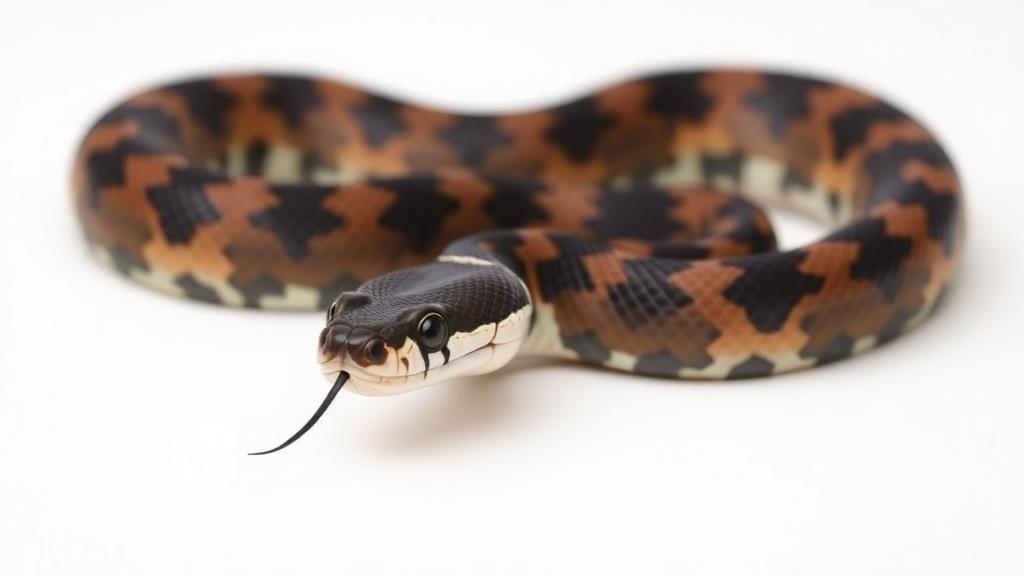
A single adult female snake collected during a forest survey in Guangdong Province, China, has been identified as a new species, Plagiopholis maculosa , after detailed morphological examination and comparison with mitochondrial DNA sequences. The researchers named the animal the Nanling mountain snake and proposed the formal Chinese name “南岭颈斑蛇.” The description, published in Zoosystematics and Evolution , raises the recognized number of Plagiopholis species to seven, with six recorded in China, although the new species is currently known from only the type specimen. The holotype was collected on June 23, 2025, by Rui-Jian Fang and Jun-Rong Su in Tianjingshan National Forest Park, within Nanling National Nature Reserve in Ruyuan County, Shaoguan City.
It was found at approximately 9:00 a.m. in a roadside ditch within evergreen broad-leaved forest at about 680 metres above sea level. The site has a dense canopy, abundant leaf litter and a moist microenvironment associated with the Nanling Mountains. After liver and muscle samples were taken, the specimen was fixed in 10% buffered formalin and transferred to 70% ethanol for permanent preservation.
It is an adult female deposited in the Museum of Biology at Sun Yat-sen University as SYS r002979. Snakes in the genus Plagiopholis are small, semi-fossorial and nonvenomous, and are commonly called mountain snakes. The genus occurs in southern China, Myanmar, Laos, Vietnam and parts of Thailand, but its members are rarely collected because of their cryptic habits.
Consequently, taxonomic work on the genus relied largely on morphology until molecular sequences became available. Recent molecular studies have uncovered additional cryptic lineages, and two recent taxonomic studies described two new species from China and revised the known distribution of P. styani . Before the description of P. maculosa , six species were recognized, five of them occurring in China.
Records of Plagiopholis from Guangdong had been sparse. A formal record reported in 2003 identified a specimen from Nanling National Nature Reserve as P. styani . A few sighting records were documented during the following two decades, but no additional specimens were obtained.
The new discovery was made during recent herpetological surveys, and the authors assessed whether it belonged to a recognized species by combining measurements and scale counts with molecular analysis. The resulting combination of diagnostic morphology, phylogenetic placement and genetic differentiation led them to describe the specimen as a separately evolving lineage and a new species. The researchers measured the holotype with digital calipers and examined its head scalation, body scales, ventral scales, subcaudals and maxillary teeth.
They then extracted genomic DNA from liver tissue and amplified two mitochondrial gene fragments: 605 base pairs of partial cytochrome c oxidase subunit 1, or CO1, and 1,027 base pairs of partial cytochrome b. For the phylogenetic analyses, the aligned and concatenated dataset comprised 1,632 base pairs from 26 samples representing five recognized Plagiopholis species, the new Guangdong specimen and the outgroup Pseudoxenodon bambusicola . Bayesian inference and maximum-likelihood analyses were used to reconstruct relationships and assess support for the branches.
Both analytical approaches produced the same topology. All sampled Plagiopholis formed a strongly supported monophyletic group with a Bayesian posterior probability of 1.00. Within the genus, the analyses resolved six well-supported clades corresponding to the five sampled recognized species and the newly proposed species.
The Guangdong specimen formed a separate lineage, with a posterior probability of 0.95, an ultrafast bootstrap value of 82 and an SH-aLRT value of 96.2. It was sister to a clade containing P. pluvialis , P. acuta and P. styani , placing it apart from every recognized congener in the sampled material. Genetic-distance estimates provided additional support for the taxonomic decision.
Under the Kimura two-parameter model, the Guangdong animal differed from all recognized congeners by 12.73% to 15.88% in CO1 and by 16.17% to 17.54% in cytochrome b. Across the known species, the corresponding interspecific ranges were 4.87% to 19.02% for CO1 and 6.50% to 20.57% for cytochrome b. The authors regarded the phylogenetic separation, marked genetic differentiation and morphological distinctiveness as sufficient evidence to recognize the specimen as P. maculosa , rather than assign it to an existing species.
The new species is compact and small, with total length of 295.9 millimetres, comprising a snout-vent length of 261.4 millimetres and a tail length of 34.5 millimetres. Its head measures 13.3 millimetres long and 8.4 millimetres wide, and its dorsal scales are smooth, without apical pits, in 15–15–15 rows. Diagnostic characters include the absence of a loreal scale, two anterior and two posterior temporal scales on each side, 17 maxillary teeth, 104 ventral scales excluding two preventrals, and 24 pairs of subcaudals excluding the tail tip.
The precloacal plate is entire. These features form the basis of the formal diagnosis, which relies on the one available female specimen. The specific epithet maculosa is the feminine form of the Latin adjective maculosus , meaning “spotted” or “blotched,” and refers to the irregular series of blotches along the dorsum.
The head is reddish-brown with scattered small black spots and brown blotches, while the upper and lower lip scales are creamy white with black and brown edges. A large black-brown inverted V-shaped mark crosses the neck and reaches its widest point across eight scales. Large black-brown spots occur along the sides of the reddish-brown body; scales between them have white margins, and darker adjacent scales combine into irregular dorsal blotches.
In preservation, the dorsum fades toward grayish brown, the blotches become more distinct and the underside changes to yellowish white. The authors compared the new species with all recognized congeners using a combination of anatomical and color-pattern characters. The inverted V-shaped nuchal blotch separates it from P. acuta and P. styani , which have neck markings described as pentagonal, sub-annular or sagittate, while the irregular dorsal blotches contrast with the reticulated pattern reported for other congeners.
The absence of a loreal scale distinguishes it from P. nuchalis . The single-specimen basis remains the principal limitation. Additional individuals are needed to establish variation in scale counts, coloration and body size, as well as to determine abundance and geographic range.
The authors suggest that the genus’s rarity in field collections may be related to secretive habits, narrow habitat preferences and low population density, but the current record cannot quantify population size or confirm those explanations. A 2003 account of a Guangdong snake attributed to P. styani described a black transverse neck band rather than the inverted V-shaped mark of the new species, but its remaining characteristics corresponded to P. acuta and P. styani . Pending further specimens, the authors retained the earlier Guangdong record for P. styani .
The discovery also exposes broader gaps in the study of Plagiopholis . Nearly all available molecular data have come from Chinese populations, while no genetic data were available in the study from Myanmar, Laos, Vietnam or Thailand. The taxonomic status of P. delacouri in Vietnam and Laos therefore remains uncertain, and the authors state that cryptic lineages within populations in Myanmar and Thailand cannot be ruled out.
The Nanling Mountains lie at the junction of several major biogeographic regions of southern China and serve as both a refugium and a dispersal corridor. Identification of P. maculosa adds evidence of the region’s distinctive amphibian and reptile diversity, but sampling across the genus’s full distribution will be necessary to clarify its species diversity and evolutionary history.
Subject of Research: Taxonomic and molecular description of a new Plagiopholis species from Guangdong, China
Article Title: A new species of Plagiopholis Boulenger, 1893 ( Serpentes , Pseudoxenodontidae ) from Guangdong, China
Article References: Qi, S., Song, H.-M., Yang, H.-C., Xu, Y.-H., Fang, R.-J., Su, J.-R., Liu, Z.-F., Gong, Y.-N., Li, F.-H., Lyu, C.-H., Wang, B.-Y., & Wang, Y.-Y. (2025). A new species of Plagiopholis Boulenger, 1893 (Serpentes, Pseudoxenodontidae) from Guangdong, China. Zoosystematics and Evolution, 101(4), 2171-2180. https://doi.org/10.3897/zse.101.172706
Image Credits: AI Generated
Keywords: new snake species, Plagiopholis maculosa, Nanling mountain snake, Guangdong, China, snake taxonomy, mitochondrial DNA, molecular phylogeny, morphological analysis, reptile diversity, species, Plagiopholis
Cite Scienmag News
Margaret Porter. (October 19, 2026). Single-specimen study identifies new spotted mountain snake in Guangdong. Scienmag. https://scienmag.com/single-specimen-study-identifies-new-spotted-mountain-snake-in-guangdong/
Margaret Porter. "Single-specimen study identifies new spotted mountain snake in Guangdong." Scienmag, 19 October 2026, https://scienmag.com/single-specimen-study-identifies-new-spotted-mountain-snake-in-guangdong/. Accessed 19 October 2026.
Margaret Porter. "Single-specimen study identifies new spotted mountain snake in Guangdong." Scienmag. October 19, 2026. https://scienmag.com/single-specimen-study-identifies-new-spotted-mountain-snake-in-guangdong/


