


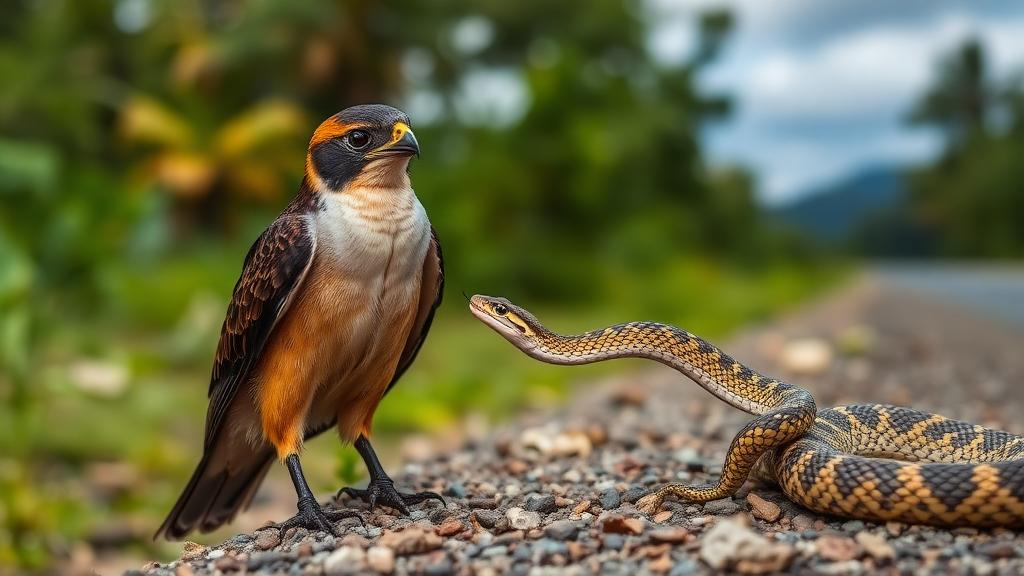
A laughing falcon was observed eating a venomous Amazonian pit viper beside a road in Ecuador’s Sucumbíos province, providing a detailed record of how the raptor handled and consumed a roughly 1-metre-long Bothrops atrox. The event was recorded on 13 November 2017 near Lumbaqui–La Bonita and Puerto Libre, in the buffer zone of the Cofán Bermejo Ecological Reserve. The observation adds a previously unreported prey record for Herpetotheres cachinnans and documents a six-minute sequence in which the falcon removed the viper’s head before feeding on its body.
The observation formed part of a seven-day wildlife-monitoring expedition conducted from 8 to 14 November 2017. The team worked with native guides and staff from Ecuador’s Ministry of Environment in a project supported by Paisajes Vida Silvestre. During the expedition, the researchers searched the buffer zone for direct and indirect signs of wildlife and recorded the location of each finding with a Garmin GPSMAP 64S global positioning system receiver. The predation event was observed beside secondary forest, where the falcon held the snake in a tree 10–15 metres above the ground.
At 15:48, the falcon was holding the viper by the head with one foot. No visible damage had been recorded on the snake’s body at that point. Between 15:49 and 15:50, the falcon occasionally picked at the viper’s head while the snake continued to move. At 15:51, the bird attempted to draw the head off and began to eat it. The falcon completed the decapitation at 15:54, after which the severed head fell from its beak as the bird continued feeding on the body. The observed feeding process lasted about 23 minutes from the beginning of the encounter.
The report notes that the laughing falcon has a broad distribution from Mexico to Argentina and occupies forest edges and open areas containing isolated trees. Its diet includes arthropods, frogs, lizards, birds, rabbits, rodents, bats and fish, but snakes are a major component. A review of literature and author records by Costa and colleagues in 2014 found that snakes represented 73% of the prey records for H. cachinnans. Despite this specialization, information about identified venomous snake species taken by the falcon has remained limited, with earlier reports documenting predation on several species of rattlesnakes, pit vipers and coral snakes.
Bothrops atrox had not previously been recorded as prey of the laughing falcon. The new observation is also distinct from an earlier report of a laughing falcon eating Bothrops asper. The 2017 Ecuadorian event provides direct evidence that H. cachinnans can prey on B. atrox and records the bird’s handling of the animal at short intervals. Because the account concerns one observed event, however, it does not establish how frequently the species attacks Amazonian pit vipers or whether the same sequence occurs during other encounters.
The authors place the event in the context of the falcon’s possible use of roads as a source of prey. Snakes are ectothermic animals that may be attracted to the heat retained by asphalt and lie on roads on sunny days. On the same day as the observation, five frogs and three snakes were found dead along the road. The closest road-killed animal was a Rhinella marina frog located 60 metres from the predation site, while the farthest was an unidentified snake found 3.6 kilometres away. These findings indicate that herpetofauna used the road during the monitoring period, but they do not by themselves measure the abundance or movement of living snakes there.
Earlier records offer additional context for the roadside association. The laughing falcon has been listed among birds killed on roads in Brazil and Paraguay, and Sasa and colleagues reported an encounter with a large female Bothrops asper along a roadside. Henderson also recorded the bird along highways in the Caribbean lowlands of Costa Rica. These observations are consistent with the report’s interpretation that roads may sometimes provide the laughing falcon with access to snake prey. They do not, however, demonstrate a general hunting preference or establish the contribution of roads to the falcon’s overall diet.
Descriptions of how birds consume venomous snakes are scarce, making the visible stages of this event relevant to understanding the variety of approaches used by different predators. The Ecuadorian account records the laughing falcon grasping the viper’s head with a foot, pecking at it and removing the head before consuming the body. By contrast, earlier observations cited in the report describe secretary birds kicking a snake’s head to incapacitate or kill it and black-breasted snake eagles gripping cobras in their talons while pecking the vertebral column. The contrasting cases show that techniques for handling venomous prey can differ among predatory bird species, while the single laughing falcon observation does not establish a universal strategy.
Overall, the study reports a field observation rather than a controlled experiment or a long-term assessment of roadside hunting. Its strongest conclusion is that, on 13 November 2017, a laughing falcon killed and ate a venomous B. atrox beside a road in Ecuadorian Sucumbíos. The event supplies a new prey record and a minute-by-minute description of the feeding behavior. The authors’ proposal that roads may serve as a prey source is biologically plausible in light of the other herpetofauna found along the route and previous roadside records, but additional observations would be required to determine how general that pattern is.
Subject of Research: A field observation of laughing falcon predation on a venomous Amazonian pit viper beside a road in Ecuador
Article Title: Predating behavior of the Laughing falcon ( Herpetotheres cachinnans ) on the venomous Amazonian pit viper Bothrops atrox (the use of roads as a prey source)
Article References: Medrano-Vizcaíno, P. (2019). Predating behavior of the Laughing falcon (Herpetotheres cachinnans) on the venomous Amazonian pit viper Bothrops atrox (the use of roads as a prey source). BioRisk, 14, 25-30. https://doi.org/10.3897/biorisk.14.35953
Image Credits: AI Generated
Keywords: laughing falcon, Amazonian pit viper, Bothrops atrox, raptor predation, venomous snake, roadside ecology, Ecuador, Sucumbíos, wildlife monitoring, Predating, behavior, Laughing
Cite Scienmag News
Margaret Porter. (October 19, 2026). Field observation documents laughing falcon eating Amazonian pit viper beside Ecuador road. Scienmag. https://scienmag.com/field-observation-documents-laughing-falcon-eating-amazonian-pit-viper-beside-ecuador-road/
Margaret Porter. "Field observation documents laughing falcon eating Amazonian pit viper beside Ecuador road." Scienmag, 19 October 2026, https://scienmag.com/field-observation-documents-laughing-falcon-eating-amazonian-pit-viper-beside-ecuador-road/. Accessed 19 October 2026.
Margaret Porter. "Field observation documents laughing falcon eating Amazonian pit viper beside Ecuador road." Scienmag. October 19, 2026. https://scienmag.com/field-observation-documents-laughing-falcon-eating-amazonian-pit-viper-beside-ecuador-road/


