


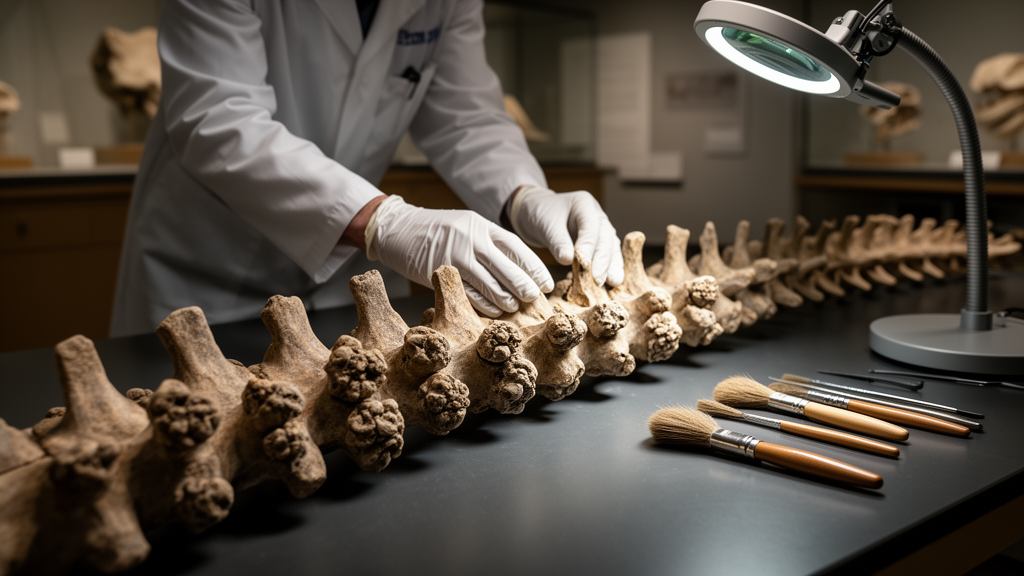
A single-specimen paleopathology study identified paired, symmetrically positioned bulks on the articular facets of four posterior dorsal vertebral centra in the holotype of the Triassic sauropterygian Paludidraco multidentatus. The investigators interpreted the lesions as pathological, while concluding that long-term biomechanical stress or a congenital malformation were the most likely explanations.
The affected bones, catalogued as MUPA-ATZ0101-21, MUPA-ATZ0101-22, MUPA-ATZ0101-25 and MUPA-ATZ0101-23, came from a relatively complete skeleton discovered at the El Atance fossil site in Guadalajara, central Spain. The locality and individual date to the Carnian, or Late Triassic. This is the first reported pathology within Simosauridae and the first documented non-infectious vertebral pathology among Triassic sauropterygians.
The analysis focused on the four anomalous, disarticulated centra, which lay close together near the sacral region but were no longer in their original anatomical positions. Their precise positions within the vertebral series, their order relative to one another, and the identification of their anterior and posterior articular facets could not be established reliably. The authors provisionally regarded the individual as an adult or sub-adult based on its size, skeletal measurements and degree of ossification.
Researchers conducted external and internal macroscopic comparisons using the four affected centra and a non-anomalous posterior dorsal centrum, MUPA-ATZ0101-13. They measured centrum height, length and width, along with the maximum height and width of the structures, which were designated “bulks” and numbered from 1 to 11. ImageJ was used to calculate the proportion of each articular facet occupied by one or more bulks as a percentage of the facet’s total surface area. These occupation percentages referred to combined bulks on a facet rather than to each individual structure.
High-resolution CT scans were performed on three specimens at the Servicio de Técnicas no Destructivas of the Museo Nacional de Ciencias Naturales in Madrid: two anomalous centra, MUPA-ATZ0101-25 and MUPA-ATZ0101-23, and the non-anomalous comparison centrum MUPA-ATZ0101-13. The scanner operated at 160 kV, with 3,015 projections per specimen, 1,533–1,536 images per specimen and voxel sizes of 27–31 micrometres. DICOM data were processed in Avizo 7.1 to generate three-dimensional models and bone sections.
Externally, the bulks were rounded or ovoid, sharply delimited and rugose, resembling the texture of the surrounding articular surfaces. MUPA-ATZ0101-21 had two bulks on one facet and one visible bulk on the opposite facet, where the expected second structure was affected by crushing and poor preservation. MUPA-ATZ0101-22 had a symmetrical pair on one facet, while preservation did not permit confirmation of the opposite facet. MUPA-ATZ0101-25 had paired bulks on one facet, and MUPA-ATZ0101-23 carried pairs on both facets.
The combined bulk occupation was approximately 12.3% for the pair and visible bulk on the first facet of MUPA-ATZ0101-21, while the deformed bulk on its opposite facet accounted for about 3.1%. The pair on MUPA-ATZ0101-22 occupied approximately 5.4%, and that on MUPA-ATZ0101-25 occupied 9.9%. On MUPA-ATZ0101-23, the smaller pair occupied about 5.1% of its facet, whereas the more protruding pair occupied approximately 12.7%. Overall, the anomalous pattern was confined to the most posterior dorsal region and was not found in other examined centra of the holotype or in similarly positioned vertebrae from other known P. multidentatus individuals.
CT sections showed that the internal tissue of the bulks was continuous with the surrounding bone and was not clearly differentiated from it. The periosteum covering the bulks was likewise continuous with non-anomalous periosteum, without a distinct reaction. No reactive new bone formation, necrosis, lytic inner lesions, sinuses, sequestra, disproportionate overgrowth, osteophytes or clear osteoporotic or traumatic fractures were identified. One affected centrum had a locally more porous region beneath its bulk-bearing facet, whereas comparable areas in the other affected centrum did not show the same restricted pattern. Diagonal and linear microfractures occurred in both pathological and non-pathological centra, but their timing could not be determined because no associated bone reaction or malunion was present.
The authors used differential diagnosis informed by medical and veterinary pathology literature, especially work on extinct and living reptiles. The observations did not support a tumoral origin because the bulks lacked distinct pathological internal bone and disproportionate overgrowth. Infection was not supported by the absence of necrotic tissue, reactive new bone, sinuses or sequestra. Metabolic deposition disorders were inconsistent with the absence of deposits having separate internal margins and a different internal structure. A single traumatic event was also unsupported, and the restricted, symmetrical, multifocal distribution was considered incompatible with a luxation or subluxation pattern. Osteoporosis and intervertebral-disc degeneration were likewise not supported by the absence of fractures, necrosis, osteophytes, Schmorl nodes, surface pitting or evident vertebral arthritis.
The diagnosis therefore remained uncertain. Comparable paired or button-like vertebral bulks have rarely been documented in dinosaurs, but their causes have also been debated, and many occur alongside other surface lesions. Paired symmetrical bulks had not previously been reported in this form in marine reptiles. Based on the differential diagnosis and comparisons with dinosaur vertebrae, the investigators concluded that the P. multidentatus bulks most likely reflected either long-term biomechanical stress or a congenital disorder, without assigning a definitive cause.
Subject of Research: Paleopathology of vertebral centra in the Triassic sauropterygian Paludidraco multidentatus
Article Title: Pathological vertebrae in the holotype of Paludidraco multidentatus ( Sauropterygia , Simosauridae ) from the Upper Triassic of El Atance (Central Spain)
Article References: Cabezuelo-Hernández, A., de Miguel Chaves, C., Ortega, F., & Pérez-García, A. (2025). Pathological vertebrae in the holotype of Paludidraco multidentatus (Sauropterygia, Simosauridae) from the Upper Triassic of El Atance (Central Spain). Fossil Record, 28(1), 133-145. https://doi.org/10.3897/fr.28.148714
Image Credits: AI Generated
DOI: 10.3897/fr.28.148714
Keywords: paleopathology, Paludidraco multidentatus, sauropterygia, Simosauridae, vertebral pathology, Triassic reptiles, CT scanning, biomechanical stress, congenital malformation, Pathological, vertebrae, holotype
Cite Scienmag News
Paul Hunter. (October 20, 2026). Single-specimen study documents paired vertebral bulks in Triassic Paludidraco multidentatus. Scienmag. https://scienmag.com/single-specimen-study-documents-paired-vertebral-bulks-in-triassic-paludidraco-multidentatus/
Paul Hunter. "Single-specimen study documents paired vertebral bulks in Triassic Paludidraco multidentatus." Scienmag, 20 October 2026, https://scienmag.com/single-specimen-study-documents-paired-vertebral-bulks-in-triassic-paludidraco-multidentatus/. Accessed 20 October 2026.
Paul Hunter. "Single-specimen study documents paired vertebral bulks in Triassic Paludidraco multidentatus." Scienmag. October 20, 2026. https://scienmag.com/single-specimen-study-documents-paired-vertebral-bulks-in-triassic-paludidraco-multidentatus/


