


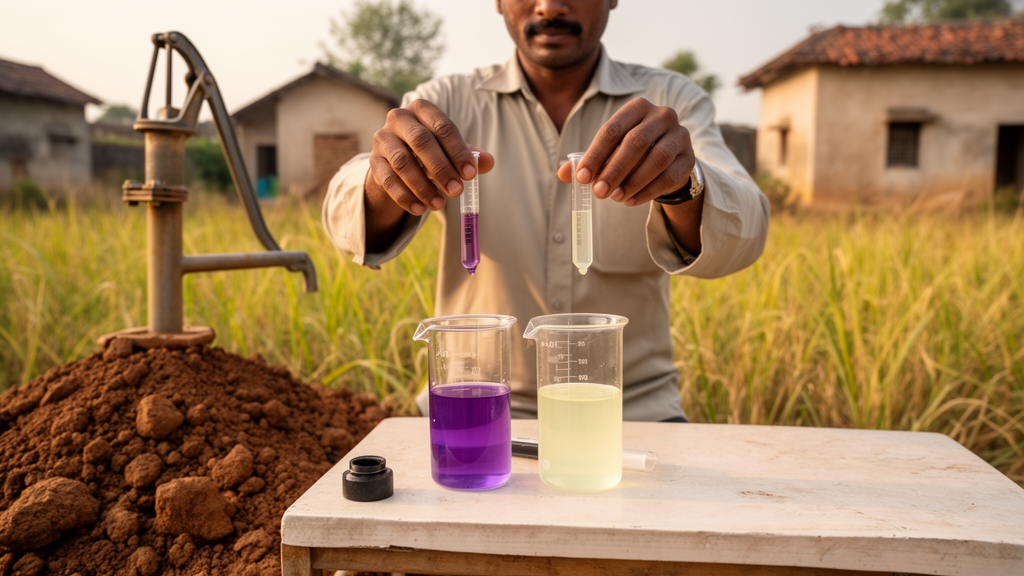
A single-reagent colorimetric method developed for groundwater in Chhattisgarh, central India, distinguished two arsenic species through visibly different precipitates: green for arsenite, As(III), and blue for arsenate, As(V). Applied to collected groundwater samples, the method reached a detection limit of 5.5 micrograms per liter and required neither pretreatment nor post-treatment. The researchers also found that the color response could support semi-quantitative estimates of the relative proportions of As(III) and As(V) in a sample.
The study focused on a practical analytical problem: determining which arsenic species are present in contaminated groundwater. Rather than relying on a multi-step procedure, the method uses cupric acetate monohydrate as its only reagent. Its primary output is the color of the resulting precipitate, allowing As(III) to be identified by green coloration and As(V) by blue coloration.
The reported detection limit of 5.5 micrograms per liter was established in collected groundwater samples. Beyond identifying the two species, the method provides an indication of their relative abundance within a sample. No pretreatment or post-treatment is needed, and the procedure has potential for rapid, low-cost, field-deployable screening and monitoring, particularly in resource-limited regions where the researchers say such a method may be useful.
The reported application was limited to contaminated groundwater from the Dongargarh–Kotri region, and the available evidence does not establish performance in other groundwater types or water matrices. The study therefore demonstrates a simple colorimetric approach within its regional application rather than providing broad validation across diverse environmental samples. The result is a compact analytical method: one reagent, two diagnostic precipitate colors, a reported detection limit of 5.5 micrograms per liter, and semi-quantitative information on the relative shares of arsenite and arsenate in the tested groundwater.
Subject of Research: Colorimetric arsenic speciation in contaminated groundwater
Article Title: A simple single-reagent colorimetric method for arsenic speciation analysis: application to the Dongargarh–Kotri region, Central India
Article References: Ganveer, S., & Pruseth, K. L. (2026). A simple single-reagent colorimetric method for arsenic speciation analysis: application to the Dongargarh–Kotri region, Central India. Environmental Monitoring and Assessment, 198(11), Article 1234. https://doi.org/10.1007/s10661-026-16050-1
Image Credits: AI Generated
DOI: 10.1007/s10661-026-16050-1
Keywords: arsenic speciation, groundwater contamination, colorimetric analysis, arsenite, arsenate, Chhattisgarh, cupric acetate, field screening, simple, single-reagent, colorimetric, method
Cite Scienmag News
Violet Maxwell. (October 21, 2026). Single-Reagent Colorimetry Distinguishes Arsenic Species in Central India. Scienmag. https://scienmag.com/single-reagent-colorimetry-distinguishes-arsenic-species-in-central-india/
Violet Maxwell. "Single-Reagent Colorimetry Distinguishes Arsenic Species in Central India." Scienmag, 21 October 2026, https://scienmag.com/single-reagent-colorimetry-distinguishes-arsenic-species-in-central-india/. Accessed 21 October 2026.
Violet Maxwell. "Single-Reagent Colorimetry Distinguishes Arsenic Species in Central India." Scienmag. October 21, 2026. https://scienmag.com/single-reagent-colorimetry-distinguishes-arsenic-species-in-central-india/


