


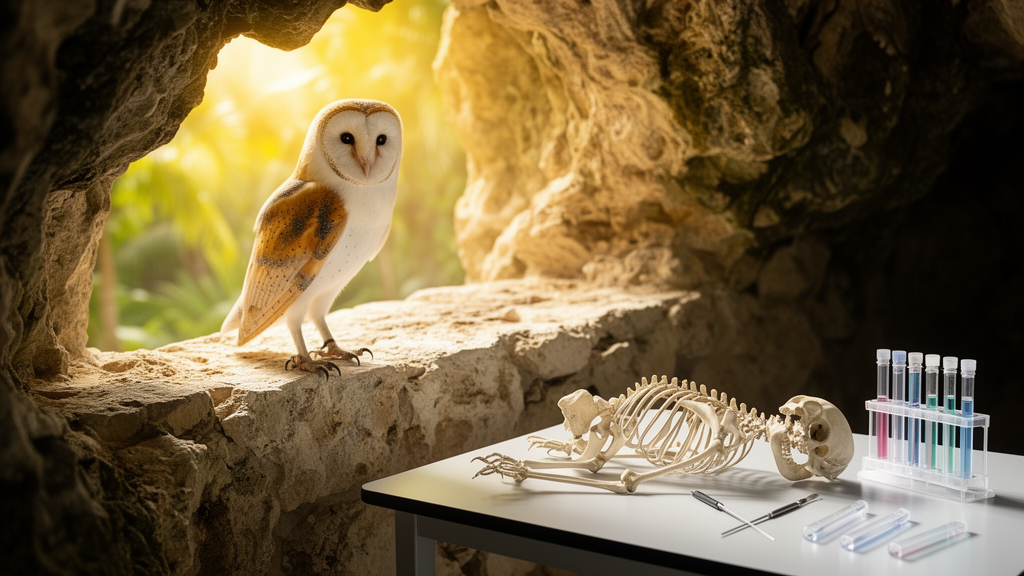
A genetic analysis of museum specimens and fossils indicates that barn owls reached the Caribbean from Eurasia before colonizing the Americas, overturning a long-standing model in which mainland populations spread outward to the islands. The study found that the American barn owl, Tyto furcata, originated in the Caribbean less than 2 million years ago, after which Caribbean lineages dispersed to the Galápagos and later to North and South America. The Caribbean once supported at least nine barn owl species, including several giant forms that are now extinct, making the region a former center of owl diversity rather than simply an isolated endpoint of a mainland migration.
Lead author Min Zhao, a postdoctoral associate at the Florida Museum of Natural History when the research was conducted, and his colleagues used DNA from dozens of barn owl specimens collected as early as 1876 and housed in 11 museums, including the Florida Museum, the American Museum, the Field Museum and Louisiana State University. The analysis combined genetic sequences with radiocarbon dates from fossils published in earlier studies to reconstruct approximate movements among regions. The evidence indicates that the lineage later named the American barn owl diversified in the Caribbean and then reached the mainland.
The Galápagos lineage apparently reached the islands directly from the Caribbean, skipping the Americas, before another, more recent barn owl colonization from South America established a population on San Cristóbal. The chronology points to an initial trans-Atlantic arrival from Europe or Asia during or shortly before the Pleistocene ice ages. The study rejected the earlier idea that barn owls crossed the ancient North Atlantic land bridge or traveled through Beringia before spreading through continental America and colonizing the Caribbean.
Steadman said these northern routes appeared unrealistic because barn owls are tropical and temperate and cannot readily handle high latitudes where snow obscures the meadow voles they hunt. The researchers therefore favored an oceanic crossing, although the evidence does not establish the precise route or circumstances of that journey. The reconstructed movements are approximate chronologies rather than observations of individual migrations.
Ocean crossings of this scale are unusual for barn owls, but long-distance dispersal is not without precedent. The authors noted that the Mediterranean plant genus Limonium, commonly called sea lavender, dispersed from its region of origin to Macaronesia and then on to the Caribbean. They also cited an account by English naturalist Mark Catesby, who saw an owl accompany his ship in 1722 while crossing the Atlantic at about 26 degrees north.
In an interview, study co-author David Steadman said that owls are good dispersers and that barn owls may be the best among them. The historical observation indicates that an owl can remain aloft far from land, but it does not demonstrate the route taken by the ancestors of the populations examined in the study. The fossil record suggests that the Caribbean was especially important in the owls’ early history.
Tyto pollens, a roughly meter-tall species that lived in Cuba and the Bahamas, may have inspired the Bahamian legend of the chickcharney, a giant elfin creature associated with luck and the disappearance of people who encounter it. Another exceptionally large form, the Hispaniolan giant barn owl, Tyto ostologa, lived on Hispaniola. Evidence from an archaeological site in the Lesser Antilles indicates that people encountered a giant owl there.
Both giant species probably disappeared within the past 1 million years, during the late Pleistocene or Holocene, although the precise dates of their extinction are not known. Steadman noted that many large Caribbean prey animals survived until people arrived in the region during the middle to late Holocene, raising the possibility that the giant owls also persisted until relatively late in prehistory. Their prey included hutias, a diverse group of large rodents, as well as monkeys, insectivores and other animals too large for an ordinary barn owl to manage.
The two or three largest forms may have been capable of taking a young Caribbean ground sloth. The disappearance of these prey communities, rather than deliberate hunting of elusive owls, was considered a plausible explanation for the owls’ subsequent losses. At least nine species that once inhabited the Caribbean are now extinct, leaving only a small fraction of its former barn owl diversity.
The Caribbean ground sloth was the last of the giant ground sloths to become extinct following the arrival of humans in the Americas, although it was smaller than its massive continental relatives. Most hutia species that lived on Caribbean islands were important prey for giant barn owls, and a fossil skull of an extinct hutia was found serving as a home for bees. Although the fossil record cannot provide a complete account of each owl population, the available evidence indicates that the region once supported an unusually diverse assemblage of barn owls.
The modern American barn owl is widespread across continental America, yet the most genetically divergent lineages are found in the Caribbean. The study also raises the possibility that some surviving island populations deserve greater taxonomic and conservation attention. The Caribbean-derived Galápagos population, now treated as a subspecies of the American barn owl, is genetically distinct and may warrant recognition as a species, according to the authors.
A little-known Caribbean barn owl subspecies in the Lesser Antilles may similarly be distinct, but it has received limited scientific attention because it was not previously considered endemic. In the Galápagos, the Caribbean lineage is now endemic to Isabela and Santa Cruz after being extirpated from Floreana. The proposed taxonomic changes are grounded in the study’s genetic evidence and have not been completed formal reclassifications.
Modern barn owls appear to be filling some of the ecological gaps left by extinct giants. In Hispaniola, the smaller American barn owl was first recorded in the mid-1900s, long after the giant T. ostologa disappeared. The surviving owl takes smaller prey that may include invasive rats, whereas the extinct giant depended on animals such as the island’s hutias, many of which were driven extinct by people.
A similar sequence may be unfolding in the Galápagos, where the ancient Caribbean-derived lineage coexists with a newer population that probably flew from South America and established itself on the populous island of San Cristóbal. The findings reverse the expected direction of colonization and connect the modern distribution of barn owls with the recent extinction of island lineages. Earlier paleontological work had produced no pre-Pleistocene barn owl fossils in the Western Hemisphere, leading some researchers to suspect that the birds arrived during the Pleistocene or, at the earliest, the Pliocene.
The new phylogeographic analysis instead identifies the most divergent lineages in the Caribbean, uses fossil timing to support a Caribbean origin for T. furcata, and indicates separate movements from the Caribbean to the Galápagos and the Americas. Genetic relationships and radiocarbon dates provide approximate dispersal windows rather than exact migration dates, but together they support a Caribbean chapter in barn owl evolution that had previously been overlooked. The peer-reviewed study was published in Proceedings of the Royal Society B.
Subject of Research: Genetic reconstruction of the Caribbean origin and subsequent dispersal of Western Hemisphere barn owls
Article Title: Caribbean islands were once the center of diversity for barn owls
Article References: Caribbean islands were once the center of diversity for barn owls. Original publication (Bibliographic details unavailable.)
Image Credits: AI Generated
DOI: Not provided
Keywords: barn owls, Caribbean, Galápagos, genetic analysis, fossil record, island biogeography, species extinction, taxonomy, phylogeography, American barn owl, islands, were
Cite Scienmag News
Juliet Wilcox. (October 20, 2026). Genetic and fossil study traces Caribbean origin of Western Hemisphere barn owls. Scienmag. https://scienmag.com/genetic-and-fossil-study-traces-caribbean-origin-of-western-hemisphere-barn-owls/
Juliet Wilcox. "Genetic and fossil study traces Caribbean origin of Western Hemisphere barn owls." Scienmag, 20 October 2026, https://scienmag.com/genetic-and-fossil-study-traces-caribbean-origin-of-western-hemisphere-barn-owls/. Accessed 20 October 2026.
Juliet Wilcox. "Genetic and fossil study traces Caribbean origin of Western Hemisphere barn owls." Scienmag. October 20, 2026. https://scienmag.com/genetic-and-fossil-study-traces-caribbean-origin-of-western-hemisphere-barn-owls/


