


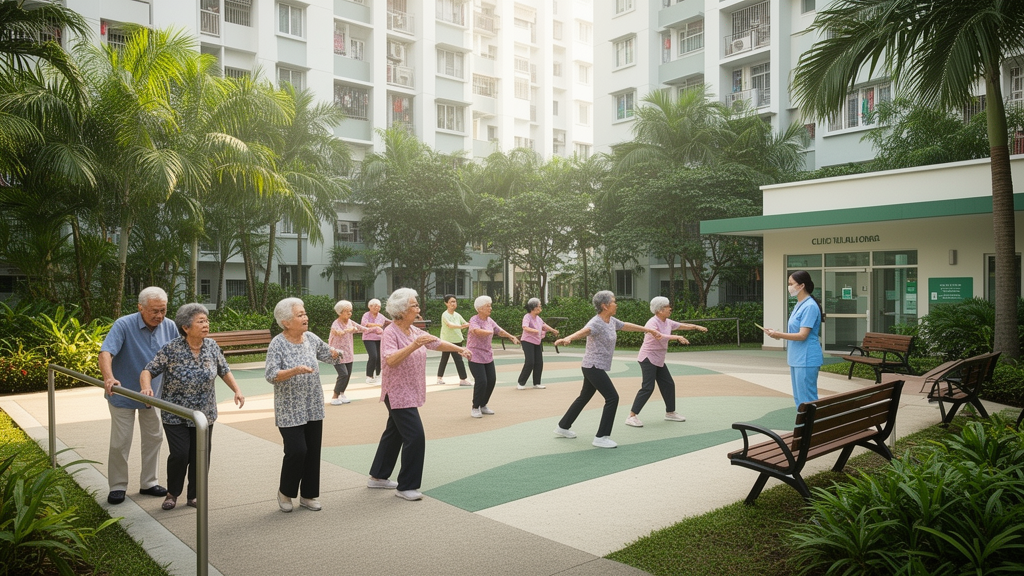
Singapore Management University’s Centre for Research on Successful Ageing has received a five-year Ministry of Education grant to investigate how social settings and urban infrastructure can encourage older adults in Singapore to move more, participate in community life and adopt healthier behaviours. The programme, titled “Societal Nudges to Promote Well-being of a Super-aged Population,” is led by Paulin Straughan, a professor of sociology and the centre’s director. It is a research programme rather than a clinical trial, and the announcement reports neither intervention results nor measured health benefits.
The award comes as Singapore becomes what the announcement describes as a “super-aged” society, with people aged 65 and older accounting for one-fifth of the population. This proportion is estimated to expand to one-quarter by 2030. Against this demographic shift, Straughan and her team will examine how neighbourhoods, public spaces and patterns of informal interaction may help residents sustain social connections and health-promoting routines as they age.
The work will focus on the combined influence of the built environment, community interaction and behavioural “nudges,” rather than relying only on restrictions such as bans on sugary drinks. One central concept is the sociological “Third Place,” defined in the announcement as a physical setting that encourages informal social interaction outside the home and workplace, such as a café. Straughan said infrastructure can serve purposes beyond aesthetics by creating places intentionally designed to bring people together.
Hawker centres, for example, could become community kitchens, with programmes and social events designed to attract people and embed messages about health and well-being in everyday settings. The research team also plans to work with relevant government agencies on a project involving such spaces, although the release does not identify a selected site or policy. The team will analyse how social settings and the built environment can “nudge” people toward willingly adopting behaviours that support physical activity, mobility and social participation.
She described the aim as developing spaces alive with programmes, events and relationships, where health messaging could be embedded naturally. Because many people would encounter those messages collectively, she said, such settings could begin to change community norms. These are the programme’s proposed mechanisms; the announcement does not yet establish that they will improve health outcomes.
Straughan offered an everyday illustration of the idea from a morning visit to a condominium gym. A neighbour had brought in an enthusiastic personal trainer, turning the normally quiet room into a loud, motivational space. The sociologist initially found the noise irritating but chose to respond with friendship and serenity, reasoning that neighbours could not complain about one another.
The episode illustrates her argument that social ties can break down barriers, lessen hostility and encourage healthier lifestyles. It was an anecdote used to motivate the research, not evidence that the proposed programme works, and no controlled comparison was described. A major analytical resource for the programme is the Singapore Life Panel, a longitudinal survey maintained by ROSA since 2015.
The announcement calls it the world’s largest high-frequency longitudinal survey on ageing and reports that it produces about 7,500 responses each month from Singapore residents aged 50 to 80. Its responses are self-reported, meaning that the data reflect participants’ own assessments and are subjective rather than direct clinical measurements. To enhance the panel’s analytical potential, ROSA plans to link Singapore Life Panel data with the Ministry of Health’s TRUST platform.
TRUST collates anonymised health-related research and objective real-world data and is accessible only to vetted researchers. The proposal describes the combined dataset as nationally significant and suitable for holistic, cross-cohort and policy-relevant research on ageing. Data linkage is presented as a core component of the programme, but the announcement provides no results from the linked dataset and does not specify which measures, records or participant groups will be included in the analysis.
The new Academic Research Fund Tier 3 award represents a second round of funding for ROSA over the next five years. Straughan nevertheless emphasised that maintaining the Singapore Life Panel depends on continuing university support, particularly for personnel. She said the core team is responsible for maintaining the panel and cultivating the contacts on which its longitudinal work depends.
The funding announcement did not disclose the monetary value of the award or explain how much university staffing support would accompany it, leaving the operating resources for the five-year programme unspecified. The project also reflects Straughan’s view that ageing should be treated as a productive stage of life rather than a period in which people are “just waiting to die.” She said community participation can help seniors retain talent and transform their experience into social assets for the wider community. This social dimension matters, she argued, because household sizes are shrinking and elder care can no longer be the sole responsibility of immediate family.
Rather than confining mutual support to formal family relationships, she wants to explore how lively neighbourhoods and high social capital may broaden the networks through which residents look after one another, while the State remains responsible for those who are extremely poor and require direct intervention. Taken together, the five-year programme will test whether the places in which people live, move and meet can be deliberately shaped to support well-being during ageing. Its proposed pathway links urban design and Third Places with community participation, social norms and health-related behaviour, while the Singapore Life Panel and linked health data provide the empirical foundation.
Whether environmental and social nudges improve mobility, physical activity or other health outcomes remains to be established. For now, the award funds a research effort to measure and evaluate relationships between neighbourhood conditions, social participation and successful ageing in Singapore.
Subject of Research: Research on urban design and social environments supporting older adults’ well-being in Singapore
Article Title: Nudging Super-aged SG towards fruitful longevity
Article References: Nudging Super-aged SG towards fruitful longevity. Original publication (Bibliographic details unavailable.)
Image Credits: AI Generated
DOI: Not provided
Keywords: healthy ageing, older adults, urban design, social environments, community participation, behavioural nudges, Singapore, longitudinal survey, health data linkage, social connection, Nudging, Super-aged
Cite Scienmag News
Beatrice Stafford. (October 21, 2026). Singapore programme to test how neighbourhoods can support healthier ageing. Scienmag. https://scienmag.com/singapore-programme-to-test-how-neighbourhoods-can-support-healthier-ageing/
Beatrice Stafford. "Singapore programme to test how neighbourhoods can support healthier ageing." Scienmag, 21 October 2026, https://scienmag.com/singapore-programme-to-test-how-neighbourhoods-can-support-healthier-ageing/. Accessed 21 October 2026.
Beatrice Stafford. "Singapore programme to test how neighbourhoods can support healthier ageing." Scienmag. October 21, 2026. https://scienmag.com/singapore-programme-to-test-how-neighbourhoods-can-support-healthier-ageing/


