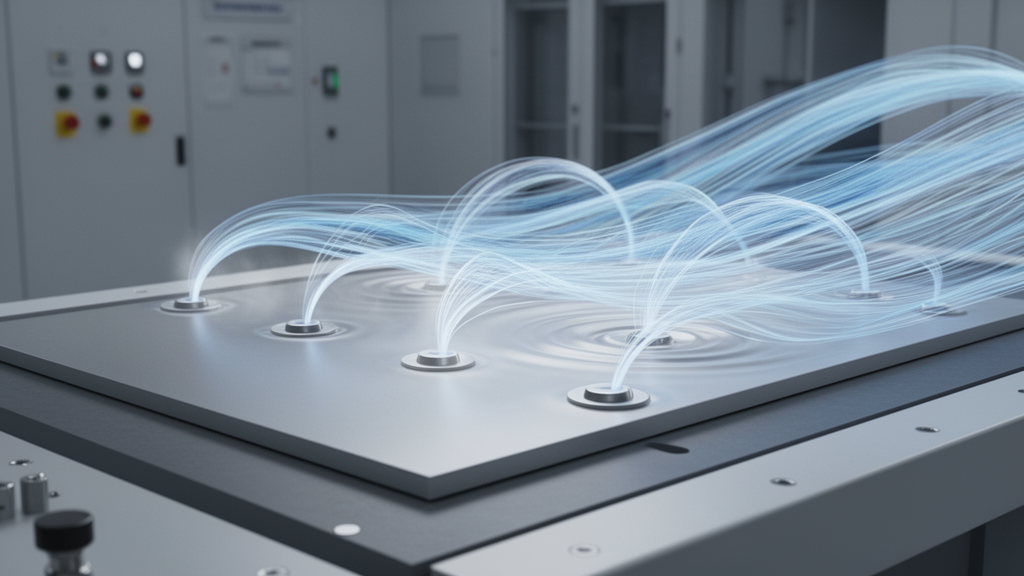
A vortex ring fired sideways into an oncoming airstream can do something remarkable: it can push fresh, fast-moving momentum down toward a surface, thickening the cushion of energetic fluid that keeps a wing or turbine blade attached to the flow. A new computational study published in Discover Fluid Mechanics maps out precisely how the settings of one such device, the synthetic jet actuator, determine whether that momentum boost is broad and long-lasting or narrow and fleeting.
Synthetic jet actuators are zero-net-mass-flux devices: a vibrating diaphragm inside a small cavity alternately sucks in and expels the surrounding fluid through a tiny nozzle, so no external air supply or plumbing is needed. Because each expulsion sheds a vortex ring that injects linear momentum into the external flow, these compact, energy-efficient actuators have attracted attention for separation control, mixing enhancement, and turbulence manipulation, with proposed applications ranging from small drones and wind turbines to compact heat exchangers. When the expelled vortex ring meets a crossflow, the outcome depends delicately on operating conditions: the jet can evolve into a stretched hairpin vortex hugging the wall, or a tilted vortex ring accompanied by a trailing vortex pair and smaller near-wall tertiary vortices that drive downwash toward the surface.
Previous studies have covered low to moderate blowing ratios, but the authors identified a gap: few investigations had explored higher-momentum configurations with blowing ratios above one combined with extended stroke ratios, and most kept the ratio of boundary-layer thickness to nozzle diameter fixed, leaving the independent influence of that height ratio poorly characterized. The new simulations address this by running three-dimensional unsteady Reynolds-averaged Navier-Stokes calculations in OpenFOAM, using the Launder-Sharma low-Reynolds-number k-epsilon turbulence model with damping functions rather than wall functions. The team chose URANS over large-eddy simulation because the computational cost of a multi-variable test matrix with full turbulence resolution was prohibitive, citing prior validation showing that URANS satisfactorily reproduces the mean and phase-averaged velocity profiles needed to characterize jet trajectory and shear-layer evolution.
The test matrix held the free-stream velocity constant and independently varied the average jet velocity, the actuation frequency between 200 and 400 hertz, and the inlet boundary-layer momentum thickness Reynolds number between 170 and 740. Blowing ratios ranged from 0.85 to 1.7, stroke ratios from 10.6 to 21.3, and boundary-layer height ratios from 2.1 to 8.0, all applied to a circular nozzle two millimeters in diameter. Rather than modeling the actuator cavity directly, the researchers prescribed an analytical Womersley solution for pulsating laminar pipe flow at the neck inlet, an approach previously validated against whole-actuator dynamic-mesh simulations when sufficient modeled neck volume is included. A neck height ratio of fifteen nozzle diameters satisfied that requirement, and the authors note that this boundary condition does not resolve cavity-specific details such as diaphragm motion or waveform distortions from the internal actuation mechanism.
The simulations revealed a clear taxonomy of vortex structures. At low actuation frequency, the expelled jet formed tilted vortex rings with trailing vortex pairs extending toward the wall. At higher frequency, the expelled structures packed closely together in the streamwise direction, and in the thickest boundary layer, with a height ratio of 8.0, consecutive vortex rings interfered with one another and broke into hairpin-like structures farther from the wall, a transition not seen in the thinner layers where the jet experienced a more uniform crossflow. Raising the frequency from 200 to 400 hertz clustered the vortex rings and reduced jet penetration depth by 15 to 25 percent in that thickest layer, with transverse-velocity peaks decaying to less than 10 percent of their near-field magnitude within about ten nozzle diameters downstream.
The boundary-layer height ratio proved to be the decisive factor for near-wall coherence. At the lowest height ratio of about 2.1, near-wall tertiary vortices persisted beyond twenty nozzle diameters downstream and spanned more than four nozzle diameters in the spanwise direction, maintaining increased near-wall momentum over extended streamwise distances. These tertiary vortices promote downwash and increase wall shear stress, making them directly relevant to separation control. At moderate to high height ratios of 4.1 and above, the same structures dissipated by roughly twelve to fifteen nozzle diameters, and the near-wall velocity profiles recovered to baseline conditions by about thirty nozzle diameters. The authors also caution that changing the boundary-layer family alters other descriptors such as the momentum-thickness Reynolds number and shape factor, so the height ratio characterizes the primary variation across the tested conditions rather than being strictly isolated in a causal sense.
Wall-shear responses exposed a trade-off between strength and coverage. Increasing the blowing ratio from 0.85 to 1.7 boosted the mid-span skin-friction coefficient by up to 120 percent immediately downstream of the jet exit, within five nozzle diameters. However, the spanwise footprint of that benefit narrowed, with off-center deficit regions emerging beyond three nozzle diameters from the centerline. For the two thicker boundary layers at low momentum, skin friction increased only within about ten nozzle diameters before dropping below baseline, while higher momentum extended the region of increase but introduced spanwise deficits. Higher frequency yielded only a modest additional mid-span increase that decayed rapidly, with skin friction falling below baseline beyond roughly twenty-five nozzle diameters, a pattern the authors flag as a potential adverse far-field impact in both spanwise and streamwise directions.
One incidental finding stands out for its physical intrigue. In the thinnest boundary layer at low frequency, the simulations showed two additional high-skin-friction regions flanking the jet at plus and minus five nozzle diameters in the spanwise direction. The authors hypothesize this pattern is consistent with the excitation of Tollmien-Schlichting waves, since the baseline for that series had a displacement-thickness Reynolds number near 500, close to the critical Blasius value of about 520, and the reduced frequency of the actuation was approximately 1.06. They are careful to emphasize that this interpretation is speculative, because URANS does not generally resolve boundary-layer instabilities accurately, and that wall-resolved large-eddy simulation or direct numerical simulation with spectral analysis would be needed to confirm disturbance growth in future work.
The study is not without acknowledged limitations. The authors note that eddy-viscosity models often introduce excessive diffusivity, which could cause premature dissipation of tertiary vortices and earlier breakdown of hairpin structures, so the reported vortex coherence should be treated as a lower bound of actual persistence. High-momentum and high-frequency cases were omitted from the trajectory analysis because of complex symmetry-plane vorticity, which the authors acknowledge somewhat restricts the generality of conclusions about penetration. Grid-resolution and time-step sensitivity studies on a representative case supported the numerical setup, which used a medium mesh with forty inflation layers, a first cell height of 75 micrometers, and a dimensionless wall distance below five across all nine cases, with an average of 4200 time steps per actuation cycle.
For engineers contemplating synthetic jets as flow-control devices, the practical guidance is concrete. Within the attached-flow configurations tested, a low-to-moderate boundary-layer height ratio of four or below, combined with the lower end of the tested frequency range near 200 hertz, showed the greatest potential for sustained, spanwise-broad increases in near-wall momentum, the condition most favorable for delaying separation. When the boundary layer is thick relative to the nozzle, raising the blowing ratio does increase local mid-span skin friction, but it delivers reduced spanwise coverage and more rapid downstream decay. The authors also note a design tension: a small height ratio requires a larger array of actuators to achieve the same spanwise control authority, while a large height ratio can significantly alter the surface geometry itself. The simulations, the authors conclude, show that actuators with low to moderate height ratios hold the greatest potential for separation control, maintaining increased near-wall momentum over extended streamwise distances.
Subject of Research: Numerical simulation of how synthetic jet actuator parameters and boundary-layer height affect vortex structures and flow control in crossflow
Article Title: Actuation parameters and boundary layer height effects on a circular synthetic jet in crossflow
Article References: Ho, H. H., Essel, E. E., & Sullivan, P. E. (2026). Actuation parameters and boundary layer height effects on a circular synthetic jet in crossflow. Discover Fluid Mechanics, 2(1), Article 7. https://doi.org/10.1007/s44369-026-00011-9
Image Credits: AI Generated
DOI: 10.1007/s44369-026-00011-9
Keywords: synthetic jet actuator, flow control, boundary layer, URANS simulation, vortex rings, crossflow, skin friction, separation control, blowing ratio, actuation frequency, fluid mechanics, wall shear stress
Cite Scienmag News
Denise Maddox. (October 29, 2026). Simulations reveal how synthetic jets tune boundary layers for flow control. Scienmag. https://scienmag.com/simulations-reveal-how-synthetic-jets-tune-boundary-layers-for-flow-control/
Denise Maddox. "Simulations reveal how synthetic jets tune boundary layers for flow control." Scienmag, 29 October 2026, https://scienmag.com/simulations-reveal-how-synthetic-jets-tune-boundary-layers-for-flow-control/. Accessed 29 October 2026.
Denise Maddox. "Simulations reveal how synthetic jets tune boundary layers for flow control." Scienmag. October 29, 2026. https://scienmag.com/simulations-reveal-how-synthetic-jets-tune-boundary-layers-for-flow-control/