


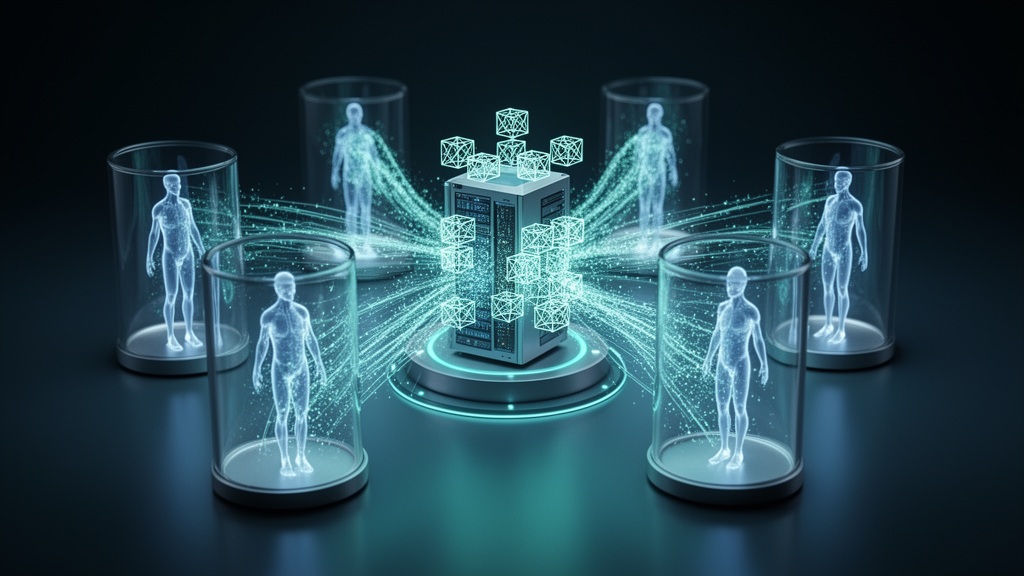
A new framework for privacy-preserving healthcare analytics, published in Discover Artificial Intelligence, reports measurable gains in accuracy, latency, and communication efficiency by combining tensor-network model compression with adaptive privacy control across distributed medical edge devices. The system, called Quantum-Inspired Context-Aware Adaptive Federated Edge Intelligence (QI-CAF-EI), was evaluated on five benchmark healthcare datasets and, according to the authors, improved predictive accuracy by 3.7 to 4.5 percentage points over standard differentially private federated learning while reducing inference latency by 25 to 36 percent compared with edge-only baselines.
The core problem the framework addresses is a familiar tension in modern medicine. Hospitals and Internet of Medical Things devices, from bedside ICU monitors to wearable sensors, generate enormous volumes of sensitive patient data. Regulations such as HIPAA and GDPR restrict how that data can be shared, so federated learning has emerged as a way for institutions to train a shared predictive model without moving raw patient records. But the authors argue that existing federated frameworks rely on static privacy budgets and rigid communication schedules, leaving them poorly matched to fluctuating network bandwidth, varied device capabilities, and rapidly changing patient conditions.
QI-CAF-EI integrates five functional modules: data acquisition and edge preprocessing, quantum-inspired edge intelligence, context-aware adaptive control, privacy-preserving federated learning using differential privacy and homomorphic encryption, and a governance and explainability layer. The quantum-inspired component is the conceptual centerpiece, and the authors are careful to define what it is not. The term refers to tensor-network mathematics, such as matrix product state decompositions, originally developed in quantum many-body physics but executed entirely on classical hardware. No quantum processors, quantum communication, or demonstrated quantum speed-up are involved.
The practical value of this compression lies in how it interacts with privacy mechanisms. Standard differentially private federated learning injects Gaussian noise into high-dimensional parameter spaces, which severely degrades accuracy. By compressing parameter vectors from a dimensionality on the order of d down to roughly r² log d before noise injection and encryption, the framework reduces the noise energy relative to signal strength and shrinks ciphertext sizes by more than 90 percent. The authors describe this as using tensor factorization as an upfront mathematical filter for privacy and security, rather than a post-hoc bandwidth-saving step.
The context-aware controller is the second distinguishing element. Each edge node maintains a state vector capturing data sensitivity, device capacity, latency, bandwidth, and clinical urgency, with urgency derived from the National Early Warning Score. When urgency rises above a defined threshold, the system forces immediate model synchronization; when bandwidth or computing power is constrained, it extends local update intervals. Privacy budgets, training frequencies, and communication schedules are adjusted dynamically, with the controller formulated as a constrained optimization problem solved through convex analysis rather than heuristic rules.
On the security side, the framework pairs differential privacy with additive homomorphic encryption and threshold key management. Local gradients are clipped, perturbed with calibrated Gaussian noise, compressed into low-rank tensor cores, and encrypted before transmission. The aggregation server computes weighted averages directly in the encrypted domain, and no single entity holds the full decryption key. Individual client updates are never decrypted, and the authors report that simulated membership inference attacks achieved success rates of at most 8 percent against QI-CAF-EI, compared with at least 21 percent against standard differentially private federated learning.
The empirical evaluation spanned MIMIC-III intensive care records, PhysioNet 2012 physiological time series, NIH ChestX-ray14 radiographs, UCI Heart Disease tabular records, and WISDM wearable sensor streams. The experiments simulated federated networks of 20 edge nodes under extreme non-IID label skew, with results averaged over five random seeds. Accuracy ranged from 84.2 percent on the UCI Heart Disease dataset to 91.6 percent on WISDM, with paired t-tests yielding p-values well below 0.05 and Cohen’s d effect sizes between 0.71 and 1.23. Confidence intervals for the accuracy gains over baselines did not cross zero on any dataset.
Latency and communication results were benchmarked on physical hardware, including Raspberry Pi 4 single-board computers and NVIDIA Jetson Orin Nano kits connected to a central aggregator over 50 Mbps channels. Tensor compression reduced raw parameter update sizes by over 92 percent, and even after accounting for a threefold ciphertext expansion from homomorphic encryption, encrypted updates remained roughly 79 percent smaller than uncompressed equivalents. For a 20-client network, communication overhead fell from 21.4 megabytes per round under FedAvg to 12.7 megabytes, and the framework scaled linearly to 100 clients. Convergence was reached in 30 to 35 rounds, compared with 45 to 50 for the differentially private baseline.
The framework also incorporates federated SHAP explainability with a consistency loss that aligns feature attributions across institutions. Adding this regularization raised explanation fidelity, measured by insertion area under the curve, from a baseline mean of 0.75 to 0.89, and feature ranking stability from 0.65 to 0.86.
The authors note several limitations and future directions. The evaluation relied on simulated federated networks rather than live hospital deployments, and the theoretical convergence guarantees assume convex loss functions. Planned work includes pilot testing in real hospital networks, adding Byzantine-robust aggregation, and optimizing tensor contraction for ultra-low-power microcontrollers. The team also emphasizes that the reported gains reflect classical-hardware efficiency from structured tensor representation combined with adaptive control, not any quantum computational advantage, positioning the framework as a practical step toward deployable, privacy-conscious clinical AI.
Subject of Research: A quantum-inspired, context-aware federated learning framework for privacy-preserving healthcare analytics on edge devices.
Article Title: Quantum-inspired context-aware adaptive federated edge intelligence for privacy-preserving healthcare analytics
Article References: Kumar, G. S., Yogarayan, S., Kannan, S., & Karthiga, M. (2026). Quantum-inspired context-aware adaptive federated edge intelligence for privacy-preserving healthcare analytics. Discover Artificial Intelligence, 6(1), Article 1643. https://doi.org/10.1007/s44163-026-02582-5
Image Credits: AI Generated
DOI: 10.1007/s44163-026-02582-5
Keywords: federated learning, differential privacy, homomorphic encryption, edge computing, Internet of Medical Things, tensor networks, quantum-inspired computing, healthcare analytics, explainability, SHAP, data privacy, machine learning
Cite Scienmag News
Veronica Carney. (October 29, 2026). Tensor-Compressed Federated Learning Keeps Patient Data Private While Cutting Edge Latency. Scienmag. https://scienmag.com/tensor-compressed-federated-learning-keeps-patient-data-private-while-cutting-edge-latency/
Veronica Carney. "Tensor-Compressed Federated Learning Keeps Patient Data Private While Cutting Edge Latency." Scienmag, 29 October 2026, https://scienmag.com/tensor-compressed-federated-learning-keeps-patient-data-private-while-cutting-edge-latency/. Accessed 30 October 2026.
Veronica Carney. "Tensor-Compressed Federated Learning Keeps Patient Data Private While Cutting Edge Latency." Scienmag. October 29, 2026. https://scienmag.com/tensor-compressed-federated-learning-keeps-patient-data-private-while-cutting-edge-latency/









