


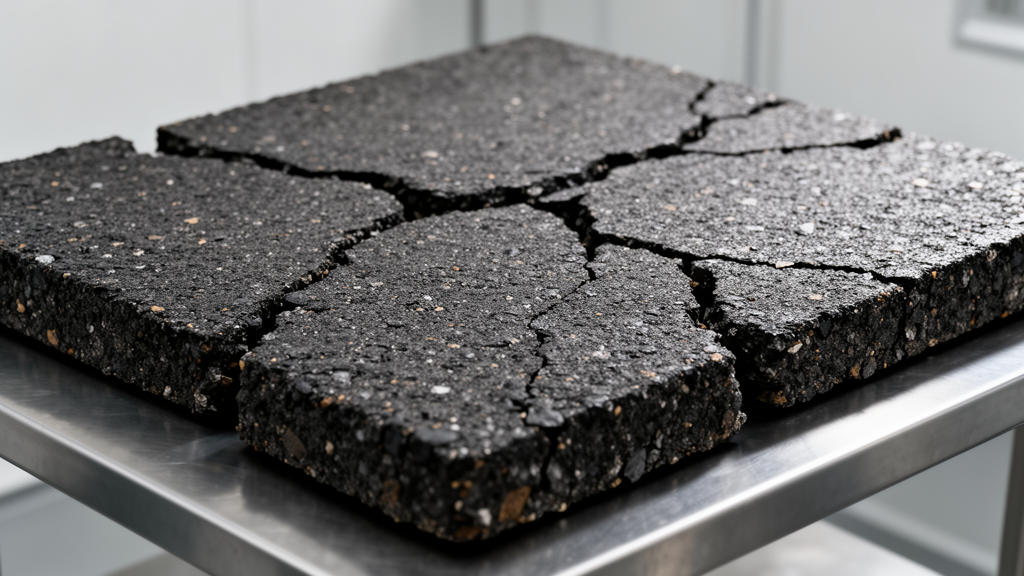
As governments worldwide push to reuse old road materials, a new study from China offers a strikingly detailed view of what actually happens inside recycled asphalt when it cracks. Using the discrete element method, researchers from Guangdong built two-dimensional simulations of splitting tests on recycled asphalt mixtures containing 15, 30, 45, and 60 percent reclaimed asphalt pavement, known as RAP. Their models distinguish every mesoscopic component, including virgin aggregates, RAP particles, aged asphalt coatings, and new asphalt binder, and even account for aggregate breakage during loading. The work, published in Frontiers in Materials, traces how microscopic damage accumulates and ultimately undermines the cracking resistance of recycled pavements.
The environmental case for RAP is compelling. Reclaimed asphalt pavement is generated in enormous quantities as infrastructure is built and renewed, and recycling it into new pavement alleviates waste pressure and supports green, low-carbon development. Yet the mechanical behavior of recycled mixtures is complicated by long-term service factors such as aggregate damage from loading and increased brittleness of aged asphalt. Cracking resistance deteriorates as RAP content rises, which has restricted high-content applications. Prior studies have shown that when RAP content exceeds 30 percent, fatigue performance decreases due to binder hardening, but the underlying influence mechanism has remained incompletely understood.
Laboratory tests alone cannot fully track the evolution from microcrack initiation to specimen failure. Techniques such as CT scanning and image analysis have limitations in following crack development in real time and in quantifying how much each mesoscopic component contributes to cracking. The discrete element method fills this gap by enabling investigation of stress characteristics, damage initiation, and crack propagation throughout the entire loading process at the mesoscopic scale. Over the past decade, researchers have applied DEM to recycled asphalt mixtures, analyzing meso-mechanical responses through indirect tensile tests and confirming that bonding parameters and RAP morphology significantly influence virtual splitting results. However, existing models have not adequately characterized the aged asphalt on RAP surfaces and its non-uniform distribution, which limits the fidelity of mesostructure simulation.
To address this, the team constructed DEM models of splitting specimens with a diameter of 101.6 millimeters using PFC5.0 2D software. Eight different aggregate contours obtained from scanning real aggregates served as the basis for generating coarse aggregate Clump models, since aggregate morphology critically influences mechanical properties. Fine aggregates smaller than 2.36 millimeters were represented by circular particles of 0.2 to 0.3 millimeters treated as asphalt mortar filler to improve computational efficiency. The modeling proceeded through six steps, from particle filling and specimen space definition, through servo compaction forming a three-phase structure of coarse aggregate, asphalt mastic, and voids, to locking aggregate contours into crushable Clumps grouped with the parallel bond model.
A distinctive feature of the models is their treatment of aged asphalt. Particles in direct contact with the RAP surface were identified through a traversal search and classified as the aged asphalt component. Because different aggregate contours can produce offset overlapping contact, the aged asphalt thickness ranged from 0.2 to 0.6 millimeters. Coating particle layers were generated on RAP surfaces, identified in yellow, and assigned mesoscopic parameters different from those of new asphalt, with reduced bond toughness and increased brittleness. The bond strength of the interfacial transition zone was set lower than that of the asphalt binder itself. Mesoscopic parameters were calibrated against indoor splitting test results, with the criterion that errors in maximum load and splitting strength remain below 10 percent, which the final models achieved.
The laboratory splitting tests were conducted on standard Marshall-compacted specimens 101.6 millimeters in diameter and 63.5 millimeters high, at 15 degrees Celsius and a loading rate of 50 millimeters per minute, with three replicate tests per RAP content. Both splitting strength and maximum load decreased progressively with increasing RAP content in a nonlinear pattern. When RAP rose from 15 to 30 percent, the maximum load declined only slightly, but at 45 percent the rate of decline accelerated markedly. At 60 percent RAP, the maximum load was reduced by 46.4 percent compared with the 15 percent mixture, and splitting strength followed a similar trend, indicating particularly pronounced deterioration in tensile performance beyond 45 percent RAP.
To monitor stress evolution, the researchers divided the DEM model into eight equal-area regions and placed measurement circles of 12.5 millimeter radius at their centers. Taking the 30 percent RAP mixture as a representative case, all measurement points exhibited negative stress responses, confirming the specimen was in overall compression. Measurement circles #1 through #4, directly subjected to loading along the vertical axis, showed sharp stress drops with peak values between −0.5 and −3.5 megapascals, where weak interfacial bonds between RAP and aggregates produced stress concentration and microcrack initiation. Circles #5 through #8 on both sides experienced lower stress levels and acted as buffer zones. By the later stage, microcrack development in the loading-axis region caused severe damage while the lateral curves stabilized, showing that the deep negative stress zone preferentially becomes the site of microcrack propagation and local failure. Shear stress peaked near 1.1 megapascals before declining toward zero at failure.
Crack morphology changed dramatically with RAP content. At 15 percent, cracks were dominated by a single primary crack with a concentrated, straight path along the loading direction, mainly near interfaces between aged and new materials. At 30 percent, the primary crack remained dominant but locally detoured around coarse aggregates before returning to the main path. At 45 percent, the primary crack was accompanied by multiple secondary cracks with obvious deflection and bifurcation, and the interface became the main failure path. At 60 percent, the primary crack branched into multiple crack bands with repeated deflections and convergences forming a network-like pattern. Tensile microcracks accounted for more than 97 percent of the total at all RAP contents, demonstrating that splitting failure is essentially tensile failure induced when transverse tensile stress exceeds the material limit, while shear contributes little to damage evolution. The total number of microcracks increased by 16 percent when RAP content rose beyond 30 percent to 45 and 60 percent.
Aggregate breakage also displayed concentration and directionality. Breakage was mainly distributed in the two end regions along the loading direction, accounting for 70 percent of the total, with the highest degree in measurement circles #1 and #4. Breakage in the lateral circles depended on whether crack paths traversed them. The total breakage index ranged from 4 to 10 percent and exhibited an exponential positive correlation with RAP content. RAP aggregates may have already developed microcracks during their service life, reducing inherent strength, so sustained principal tensile stress concentration at the loading-axis ends promoted initiation, propagation, and coalescence of microcracks in weak interfacial bonding zones, eventually forming primary cracks.
Correlating mesoscopic damage indicators with macroscopic mechanical responses revealed clear negative relationships. As RAP content increased, the total number of microcracks grew while maximum load and splitting strength declined, because continuous microcrack propagation reduced the effective load-bearing cross-section. The total breakage index likewise correlated negatively with splitting strength, since aggregate breakage restructures the force chain network and weakens the skeleton’s load transfer capacity. Together, the microcrack count characterizes damage to bonding performance while the breakage index characterizes skeleton degradation, and mesoscopic damage ultimately degrades macroscopic performance through two pathways: microcrack coalescence and skeleton weakening. The authors note limitations, including reliance on a specific gradation and a 2D approach, and plan future work with multiple gradations, various rock types, 3D DEM models, and measurement circles analyzing contact force variation in RAP-concentrated and virgin aggregate zones. The findings provide a theoretical basis for design optimization of recycled asphalt mixtures.
Subject of Research: Mesoscopic crack evolution and cracking resistance of recycled asphalt mixtures with different RAP contents simulated using the discrete element method
Article Title: Mesoscopic crack evolution and cracking resistance of recycled asphalt mixtures with different RAP contents using discrete element method
Article References: Li, H., Zhang, H., Huang, Y., Liu, Q., Zhan, J., & Lin, Y. (2026). Mesoscopic crack evolution and cracking resistance of recycled asphalt mixtures with different RAP contents using discrete element method. Frontiers in Materials, 13, Article 1967974. https://doi.org/10.3389/fmats.2026.1967974
Image Credits: AI Generated
DOI: 10.3389/fmats.2026.1967974
Keywords: recycled asphalt pavement, RAP content, discrete element method, cracking resistance, microcrack evolution, splitting test, aged asphalt, aggregate breakage, mesoscopic damage, asphalt mixture, crack propagation, tensile failure
Cite Scienmag News
Denise Maddox. (October 16, 2026). Simulations Reveal How Cracks Spread Through Recycled Asphalt Pavements. Scienmag. https://scienmag.com/simulations-reveal-how-cracks-spread-through-recycled-asphalt-pavements/
Denise Maddox. "Simulations Reveal How Cracks Spread Through Recycled Asphalt Pavements." Scienmag, 16 October 2026, https://scienmag.com/simulations-reveal-how-cracks-spread-through-recycled-asphalt-pavements/. Accessed 16 October 2026.
Denise Maddox. "Simulations Reveal How Cracks Spread Through Recycled Asphalt Pavements." Scienmag. October 16, 2026. https://scienmag.com/simulations-reveal-how-cracks-spread-through-recycled-asphalt-pavements/


