


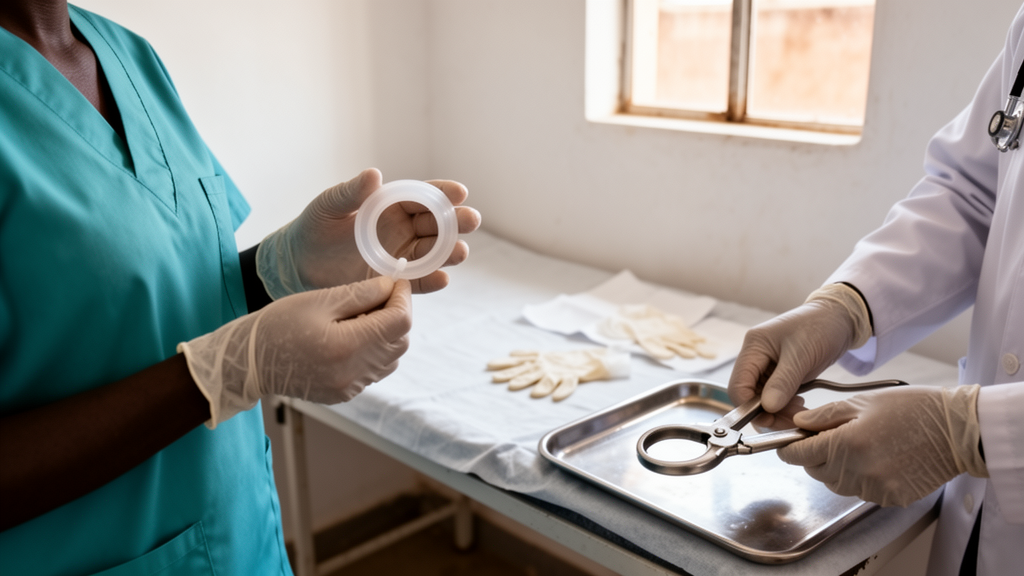
Male circumcision has become one of the most talked-about tools in the fight against HIV in eastern and southern Africa, and a new economic analysis published in PLOS One suggests that the device used to perform the procedure in newborns may matter less than public health planners once feared. In a randomized controlled trial spanning Kenya, Tanzania, and Uganda, researchers found that the ShangRing, a pre-qualified circumcision device endorsed by the World Health Organization, costs roughly the same per procedure as the Mogen clamp, the standard instrument long used for early infant male circumcision. The finding, drawn from 1,378 infant boys circumcised within the first sixty days of life, offers a rare head-to-head cost comparison between two competing technologies at a moment when countries are deciding how to scale up newborn circumcision services.
The study, led by Nahid Punjani and colleagues with contributors from Weill Cornell Medicine and public health institutions across East Africa, embedded a detailed economic evaluation inside a clinical trial. Rather than estimating costs from administrative records or modeling assumptions alone, the team collected resource utilization data prospectively as infants moved through the circumcision procedure in real clinical settings. They captured baseline facility costs, direct costs such as consumables and staff time, and indirect costs including patient transport and caregiver time lost. This granular approach allowed the investigators to build a bottom-up picture of what each device actually costs health systems when used by trained providers in routine conditions.
The numbers reveal a strikingly close race. In Kenya, a single early infant male circumcision performed with the ShangRing cost 61.30 United States dollars, compared with 56.38 dollars using the Mogen clamp. In Tanzania, the ShangRing came in at 47.14 dollars against 50.43 dollars for the clamp, actually making the device the cheaper option. In Uganda, the ShangRing cost 64.59 dollars while the Mogen clamp cost 58.57 dollars. Across all three countries, the differences amounted to a few dollars per procedure, a margin that the authors characterize as comparable rather than decisive. For health ministries weighing procurement decisions, the practical implication is that neither device carries a prohibitive cost penalty.
To put these figures in context, the researchers turned to two established modeling tools. The Decision Makers Program Planning Tool, version 1.0, was used to perform the direct cost comparison between the ShangRing and the Mogen clamp, translating observed resource use into standardized unit costs. The Goals model, developed to support HIV planning, was then deployed to answer a more strategic question: is it cheaper to circumcise a male infant now, or to wait and circumcise the same individual as an adolescent fifteen years later? By calculating the present value of money in 2023 dollars and comparing it against projected adolescent circumcision costs in 2038, the team could assess the economic logic of early intervention.
The answer depends heavily on geography. In Kenya, early infant male circumcision emerged as the less expensive strategy when nominal present costs in 2023 were weighed against the future cost of circumcising an adolescent at age fifteen in 2038. In Tanzania and Uganda, the calculation flipped, with adolescent circumcision projected to be the cheaper path under the model’s assumptions. This divergence reflects differences in current service delivery costs, discount rates, and projected future pricing across the three health systems. It underscores a central tension in HIV prevention economics: the clinical benefits of circumcising boys before sexual debut are well established, but the financial case for doing so in infancy varies with local cost structures and the time value of money.
The clinical trial itself deserves attention for its scale and design. Infants aged zero to sixty days were randomized across sites in Kenya, Tanzania, and Uganda, with 689 boys circumcised using the ShangRing and an equal number using the Mogen clamp. Randomization at this scale in a newborn population is unusual for device comparisons and lends considerable weight to the cost findings, since the economic data were collected under the same protocol, staffing, and facility conditions for both arms. The study does not report safety outcomes in the abstract, but the cost parity finding suggests that the ShangRing performed acceptably in routine hands without requiring additional resources that would drive up per-procedure expenses.
The ShangRing itself is worth understanding for readers unfamiliar with the technology. It is a disposable ring-based device that consists of an inner and outer ring clamped together over the foreskin, allowing the tissue to be removed and the device to remain in place for several days before removal at a follow-up visit. The World Health Organization has pre-qualified the device for adult voluntary medical male circumcision, and it has been widely adopted in adult programs across southern and eastern Africa. Extending its use to newborns represents a different clinical challenge, since infant anatomy, healing timelines, and follow-up requirements differ from those in adults. The Mogen clamp, by contrast, is a reusable metal instrument that has been the traditional standard for infant circumcision in many settings, requiring a single-visit procedure with immediate completion.
The authors conclude that the ShangRing is an attractive alternative for future early infant male circumcision initiatives in Sub-Saharan Africa, with the important caveat that costs may fall further as programs scale up. One of the most promising cost-reduction pathways involves task-shifting, meaning the use of lower-level personnel rather than physicians to perform the procedure. If nurses or clinical officers can be trained to apply and remove the ShangRing safely, the labor component of the cost equation could shrink substantially, potentially widening the device’s economic advantage. The study’s cost data were collected in trial conditions with trained providers, so real-world scale-up could yield per-procedure costs below those observed here.
From a public health strategy perspective, the stakes of this comparison extend well beyond device procurement. The World Health Organization endorses male circumcision as an effective HIV prevention intervention precisely in settings where the expected impact is greatest, and Sub-Saharan Africa remains the region carrying the heaviest HIV burden. Circumcising male infants before sexual debut offers a lifetime of reduced acquisition risk, but the intervention requires health systems to reach newborns and their families in the first weeks of life, a delivery challenge distinct from adult voluntary circumcision campaigns that have reached millions of adolescent and adult men over the past fifteen years. Economic evidence like this study’s helps ministries decide whether to invest scarce prevention dollars in newborn services now or to continue focusing on older age groups.
The finding that early infant circumcision is cost-effective in Kenya but not in Tanzania or Uganda under the Goals model highlights the importance of country-specific analysis rather than one-size-fits-all recommendations. Health planners in each country will need to weigh the present value calculations against their own service delivery costs, projected adolescent circumcision prices, and epidemiological priorities. What the study establishes firmly is that the ShangRing does not carry a cost premium over the Mogen clamp in randomized trial conditions across three East African countries, removing one potential barrier to its adoption in newborn programs. As countries in Sub-Saharan Africa work toward reducing HIV incidence through combination prevention, the ShangRing now has economic evidence to match its clinical and regulatory credentials, positioning it as a serious contender for the next phase of circumcision scale-up in the region.
Subject of Research: Cost-effectiveness of early infant male circumcision devices for HIV prevention in Sub-Saharan Africa
Article Title: Cost comparison of the ShangRing device versus Mogen clamp for early infant male circumcision in Sub-Saharan Africa
Article References: Cost comparison of the ShangRing device versus Mogen clamp for early infant male circumcision in Sub-Saharan Africa. (n.d.). https://doi.org/10.1371/journal.pone.0360356
Image Credits: AI Generated
DOI: 10.1371/journal.pone.0360356
Keywords: HIV prevention, male circumcision, ShangRing, Mogen clamp, Sub-Saharan Africa, health economics, Cost, comparison, device, versus, Mogen, clamp
Cite Scienmag News
Harold Sullivan. (October 16, 2026). ShangRing Device Matches Mogen Clamp on Cost for Infant Circumcision in Africa. Scienmag. https://scienmag.com/shangring-device-matches-mogen-clamp-on-cost-for-infant-circumcision-in-africa/
Harold Sullivan. "ShangRing Device Matches Mogen Clamp on Cost for Infant Circumcision in Africa." Scienmag, 16 October 2026, https://scienmag.com/shangring-device-matches-mogen-clamp-on-cost-for-infant-circumcision-in-africa/. Accessed 16 October 2026.
Harold Sullivan. "ShangRing Device Matches Mogen Clamp on Cost for Infant Circumcision in Africa." Scienmag. October 16, 2026. https://scienmag.com/shangring-device-matches-mogen-clamp-on-cost-for-infant-circumcision-in-africa/


