


Language acquisition has long intrigued educators and researchers alike, with ongoing debates centering around what truly contributes to fluent speech in a second language. A recent study conducted by Kotaro Takizawa, a Ph.D. student, alongside Research Assistant Professor Shungo Suzuki from Waseda University, presents groundbreaking findings that upend conventional wisdom regarding vocabulary use. Instead of advocating for the incorporation of sophisticated vocabulary, their research posits that the use of common phrases can significantly enhance fluency perception among listeners.
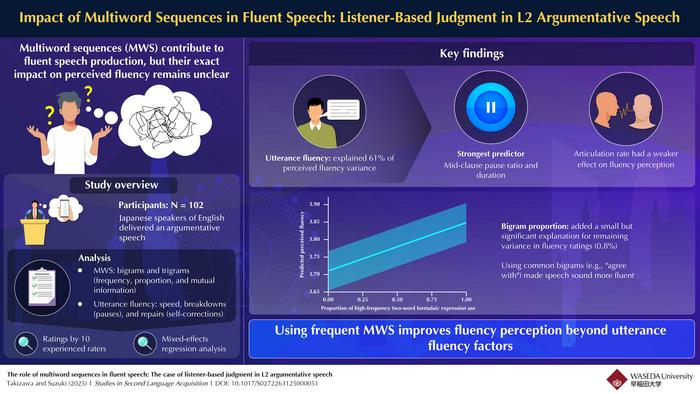
In this meticulously crafted study, Takizawa and Suzuki analyzed the speech patterns of 102 Japanese speakers of English who were tasked with delivering argumentative speeches. This analysis aimed to uncover the nuanced relationship between formulaic expressions—specifically, bigrams and trigrams (two- and three-word combinations)—and the fluency judgments made by experienced raters. The researchers undertook a comprehensive approach, controlling for a variety of critical fluency metrics such as articulation rate, speech pauses, and self-corrections. This methodical isolation allowed them to discern the specific impact that prevalent phrases have on listeners’ perceptions of fluency.
The results of the study, published in the prestigious journal Studies in Second Language Acquisition, reveal a striking correlation between utterance fluency and perceived fluency. The smooth delivery of speech was determined to be the strongest predictor of overall fluency, accounting for an impressive 61% of the variance in fluency ratings given by the raters. Importantly, while the presence of high-frequency formulaic expressions garnered an incremental boost of 0.8% in fluency judgments, the impact of elusive and complex phrases was found to be negligible at best. These insights challenge the belief that rare words are a pathway to sounding more proficient.
The implications of this research are profound, especially in the context of language learning and the evaluation processes involved in standardized tests like the TOEFL and IELTS. These assessments place a significant emphasis on fluency, wherein expert raters consider not only the rapidity of speech but also its naturalness and fluidity. Despite previous studies hinting at the role of formulaic expressions, Takizawa and Suzuki’s work is pioneering in that it explicitly investigates the extent to which these phrases influence fluency judgment.
Suzuki articulated the practical ramifications of the findings, suggesting a paradigm shift in how language education is approached. He noted that it has been commonplace for teachers and learners to gravitate towards complex vocabulary and challenging phrases, mistakenly believing that such choices would signal greater proficiency. Instead, the research advocates for a focus on everyday expressions that frequently emerge in natural conversations, emphasizing that notable advancements in perceived fluency can be achieved through the application of these common phrases.
For aspiring speakers, this study serves as a critical guide. It emphasizes the necessity of integrating high-frequency phrases into speech rather than struggling with the adoption of intricate vocabulary. For instance, exchanging a stiff expression like "I agree the idea" for the more natural "I agree with the idea" can make an indelible impact on the listener’s impression of fluency. This guidance is particularly relevant for learners at all levels, as such expressions are amply represented in educational resources and commonplace dialogue.
The study highlights a crucial detail: fluency is not solely about speed or ease of speech but also involves the strategic use of language. In recognizing the importance of standard phrases, learners can adopt a more effective approach for enhancing their fluency. The findings underscore the necessity of balancing the intuitive aspects of speech with an awareness of speech delivery mechanics. Notably, Takizawa mentioned that there exists an undeniable connection between smoothness in utterance and favorable fluency judgments, prompting a reconsideration of established norms in language acquisition.
In the realm of language testing, where fluency is often a central criterion for scoring, the implications of this research could lead to significant changes in how learners prepare. Emphasizing the importance of mastering natural phrasal expressions while simultaneously ensuring the smoothness of speech can be a game-changer for test-takers striving for high scores. The research elucidates a clear connection: enhancing fluency in utterance undeniably contributes to more favorable evaluations in testing scenarios.
In a larger context, the findings allude to a broader understanding of communication strategies that could benefit individuals beyond academic pursuits. Proficient use of formulaic expressions is vital in day-to-day interactions, where the resonance of one’s speech can have lasting impacts on social engagement and relationships. This research undoubtedly provides a comprehensive framework for revisiting how we conceive of language acquisition and fluency.
In summary, Takizawa and Suzuki’s work marks a significant milestone in the field of language studies. By emphasizing the importance of everyday expressions over complex vocabulary, their findings offer a robust foundation for educators and learners alike. Their research not only challenges prevailing assumptions about language proficiency but also opens up new avenues for improving fluency among second language speakers. This transformative perspective offers promising insights into how language education can evolve to better serve learners in an increasingly interconnected world.
The study lays bare the essential role that common expressions play in shaping perceptions of fluency, thus equipping learners and educators with valuable insights that can redefine their approach to language acquisition. This newfound understanding serves as a reminder that the path to sounding fluent may be less about the complexity of words and more about the artful execution of familiar phrases.
Cite Scienmag News
Courtney Benton. (April 3, 2025). Simple phrases can help you sound more fluent in a foreign language. Scienmag. https://scienmag.com/simple-phrases-can-help-you-sound-more-fluent-in-a-foreign-language/
Courtney Benton. "Simple phrases can help you sound more fluent in a foreign language." Scienmag, 3 April 2025, https://scienmag.com/simple-phrases-can-help-you-sound-more-fluent-in-a-foreign-language/. Accessed 3 September 2026.
Courtney Benton. "Simple phrases can help you sound more fluent in a foreign language." Scienmag. April 3, 2025. https://scienmag.com/simple-phrases-can-help-you-sound-more-fluent-in-a-foreign-language/


