


…
…
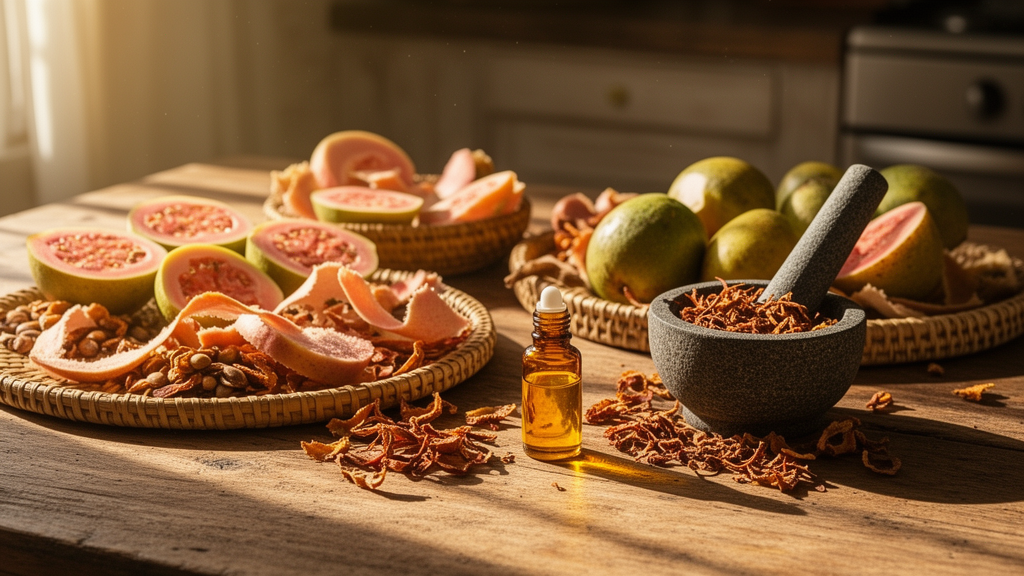
The findings carry practical weight for anyone thinking about how fruit-processing by-products might be handled after the pulp has been removed. Guavira peels and seeds are rich in water when they leave the processing line, which makes them heavy, perishable, and costly to keep in cold storage before any further use. The study shows that simply allowing the material to dry, whether in a controlled oven at 40 °C or at ambient room temperature near 22 °C, transforms it into a lighter and more stable raw material that can be stored and transported without refrigeration. This logistical benefit alone could lower operational barriers for small producers and cooperatives in the Cerrado region who currently discard these residues or face high costs in preserving them for later valorization.
The choice of drying temperature proved to be a decisive variable rather than a trivial detail of sample preparation. Oven drying at 40 °C produced the largest gain in essential oil recovery, raising the yield from roughly 0.105 percent of the fresh residue mass to about 0.276 percent, a 2.63-fold increase. Room-temperature drying, while gentler on the volatile profile, still improved recovery relative to fresh material. The mechanism behind this gain is likely tied to the reduction of water content in the plant tissue: as moisture evaporates, the cellular structures that trap essential oils become more permeable, allowing volatile compounds to be released more efficiently during hydrodistillation. At the same time, moderate heat can promote the formation of new volatile constituents through oxidative and thermally driven reactions, which helps explain why the oil composition shifted so noticeably with oven drying.
Among the compositional changes, the emergence of 1,8-cineole stands out. This oxygenated monoterpene, also known as eucalyptol, was entirely absent from the essential oil of fresh residues yet became abundant after drying. Oxygenated monoterpenes such as 1,8-cineole are generally regarded as important contributors to the biological activity and aroma of essential oils, and their increased relative abundance after drying coincided with the marked enhancement of antibacterial activity observed in the assays. Conversely, the hydrocarbon monoterpenes, including the major constituents limonene and β-pinene, declined in relative abundance as drying progressed. This inverse relationship between hydrocarbon and oxygenated terpenes is a recurring pattern in drying studies of aromatic plants, reflecting both the selective loss of low-molecular-weight hydrocarbons and the oxidative conversion of some terpenes into their oxygenated derivatives.
The chemometric toolkit applied in the study deserves attention because it illustrates how modern analytical chemistry can extract order from complex volatile datasets. Partial least squares discriminant analysis, or PLS-DA, was able to clearly separate the essential oil samples according to drying treatment and duration, while hierarchical cluster analysis and heatmap visualization provided complementary views of the same patterns. These multivariate approaches are increasingly standard in natural products research because the chemical composition of an essential oil involves dozens of compounds whose individual abundance changes may be subtle but whose combined signature is highly informative. By applying such methods, the researchers could demonstrate that the differences among treatments were systematic and reproducible rather than random analytical noise.
The antimicrobial results are striking when placed against the broader context of essential oil research. Fresh residue oils showed minimum inhibitory concentration values of at least 2000 μg mL⁻¹ against the β-lactamase-producing Staphylococcus aureus strain, a level generally considered weak activity. After room-temperature drying for six to eight days, the MIC dropped to 7.5 μg mL⁻¹, representing an improvement of more than two orders of magnitude. The test organism is clinically relevant because β-lactamase-producing strains of S. aureus undermine a class of antibiotics that accounts for the majority of clinical antibiotic use, and the enzymatic hydrolysis these strains perform markedly reduces therapeutic options. Essential oils are thought to act mainly by disrupting bacterial membranes and increasing permeability, mechanisms that are less susceptible to the specific resistance enzymes that defeat β-lactam drugs, which is part of why plant-derived volatiles attract interest as potential adjuncts to conventional therapy.
The timing of the activity peak is also informative. The strongest antibacterial effect appeared after six to eight days of room-temperature drying, not immediately after one or two days, suggesting that the chemical transformations responsible for enhanced activity accumulate progressively as the plant material loses moisture and its volatile profile evolves. This finding implies that producers seeking to maximize the antimicrobial value of guavira residue oils would need to allow sufficient drying time rather than distill the material as soon as it is superficially dry. It also suggests that the relationship between drying duration and biological activity is not linear, and that intermediate time points may represent a balance between the loss of native hydrocarbon terpenes and the accumulation of oxygenated derivatives.
From a sustainability standpoint, the study connects several threads of the Cerrado bioeconomy. Guavira is an emblematic native fruit whose commercial value chains support local food systems, traditional knowledge, and regional tourism, yet the peels and seeds generated by pulp processing remain largely underutilized. Converting these by-products into a stable, high-value raw material for essential oil production adds a new revenue stream to existing fruit value chains without requiring additional land or cultivation. The improved storage stability of dried residues further supports decentralized collection, allowing residues to be aggregated from multiple small processing operations before distillation. Such a model could reduce waste, lower the environmental footprint of fruit processing, and strengthen the sociobiodiversity economy of the Cerrado region.
The potential applications extend across several industries. In cosmetics and dermatology, the antimicrobial and multifunctional properties of terpenic constituents can contribute to microbiological control of the skin and improve the stability of formulations, potentially reducing reliance on synthetic preservatives. In food systems, essential oils with strong antibacterial activity are explored as natural alternatives for controlling spoilage and pathogenic organisms. In pharmaceuticals, the search for novel agents against resistant pathogens has intensified as antimicrobial resistance is now recognized as one of the greatest threats to global public health. An essential oil whose activity can be enhanced through a simple, low-cost post-harvest treatment fits well within this landscape of applied natural products research.
It is worth noting the broader methodological lesson embedded in the work. Many studies of essential oils treat the plant material as a fixed input, distilling it fresh without considering how pre-processing conditions shape the outcome. The guavira residue study demonstrates that drying is not merely a preservation step but an active variable that modulates yield, composition, and biological activity. For any aromatic plant whose residues are being evaluated for essential oil recovery, the drying protocol deserves the same experimental scrutiny as the extraction method itself. The integration of chemical profiling with chemometric analysis and biological testing, as performed here, provides a template for how such evaluations can be conducted rigorously and interpreted meaningfully.
Finally, the study highlights the value of looking at residues rather than the fruit itself. The essential oils recovered from peels and seeds would otherwise be lost when the by-products are discarded, and the bioactive compounds they contain represent a resource already produced by the plant at no additional cultivation cost. By identifying drying conditions that simultaneously improve oil recovery, enhance antibacterial activity, and stabilize the raw material for storage, the research offers a concrete pathway for transforming an agro-industrial waste problem into a source of pharmaceutical, cosmetic, and food ingredients, consistent with the growing emphasis on circular economy approaches within the bioactive natural products field.
Subject of Research: …
Article Title: Drying modulates volatile composition and enhances antimicrobial activity of essential oils from Campomanesia adamantium fruit-processing residues: a chemometric study
Article References: Bittencourt, F. O., dos Santos, É. L., Santana, A. C., Micheletti, A. C., Figueiredo, P. D. O., & Yoshida, N. C. (2026). Drying modulates volatile composition and enhances antimicrobial activity of essential oils from Campomanesia adamantium fruit-processing residues: a chemometric study. Frontiers in Natural Products, 5, Article 1887930. https://doi.org/10.3389/fntpr.2026.1887930
Image Credits: AI Generated
DOI: 10.3389/fntpr.2026.1887930
Keywords: essential oils, Campomanesia adamantium, guavira, Cerrado, antimicrobial resistance, Staphylococcus aureus, GC-MS, chemometrics, drying, food waste valorization, monoterpenes, 1,8-cineole
Cite Scienmag News
Naomi Webster. (October 17, 2026). Simple Drying Turns Brazilian Fruit Waste Into Potent Antibacterial Essential Oil. Scienmag. https://scienmag.com/simple-drying-turns-brazilian-fruit-waste-into-potent-antibacterial-essential-oil/
Naomi Webster. "Simple Drying Turns Brazilian Fruit Waste Into Potent Antibacterial Essential Oil." Scienmag, 17 October 2026, https://scienmag.com/simple-drying-turns-brazilian-fruit-waste-into-potent-antibacterial-essential-oil/. Accessed 17 October 2026.
Naomi Webster. "Simple Drying Turns Brazilian Fruit Waste Into Potent Antibacterial Essential Oil." Scienmag. October 17, 2026. https://scienmag.com/simple-drying-turns-brazilian-fruit-waste-into-potent-antibacterial-essential-oil/


