


Every step you take is powered by a brief, precisely timed burst of force. As your body rolls over the foot that is about to leave the ground, the muscles of the calf and hip push against the floor, propelling your center of mass forward. Biomechanists call this propulsion, and how well a person generates it largely determines how fast and how efficiently they walk. Now researchers at the University of Houston have shown that one of the most promising clinical tools for measuring propulsion may be systematically misread, simply because of when it is measured during the walking cycle.
The tool in question is the trailing limb angle, or TLA, an angle that describes how far behind the body the pushing leg has swung at a given moment. It is defined as the angle between the vertical axis of the laboratory and a vector connecting the greater trochanter, the bony prominence at the top of the thigh, to a distal landmark on the leg, most commonly the head of the fifth metatarsal or the lateral malleolus. The larger the angle, the more the limb has extended behind the body, and the better positioned it is to push the ground backward rather than downward. Because TLA can be estimated with a small set of inertial measurement units rather than a laboratory full of force plates, it has been heralded as an accessible point-of-care estimate of the propulsive forces that are usually quantified with the anterior component of the ground reaction force, or AGRF.
But there is a hidden assumption baked into much of the literature: that the peak value of TLA, the maximum angle the limb reaches, is equivalent to the angle at the moment of peak propulsion. Sally Kenworthy and Stacey Gorniak set out to test that assumption directly, and their findings, published in Frontiers in Rehabilitation Sciences, challenge it in a way that could ripple through both research protocols and clinical practice. In a state-of-the-art review of 39 studies that used TLA as a measure of propulsion, the authors had already noted substantial variation in when researchers calculated the angle: some measured it at toe-off, some during double support, some at terminal stance, some in pre-swing, and some at peak AGRF. Crucially, none of the twelve studies measuring TLA at its peak reported measuring it at the time of peak AGRF, and studies measuring TLA at peak AGRF avoided calling it peak TLA. The new study validates that critical distinction with hard numbers.
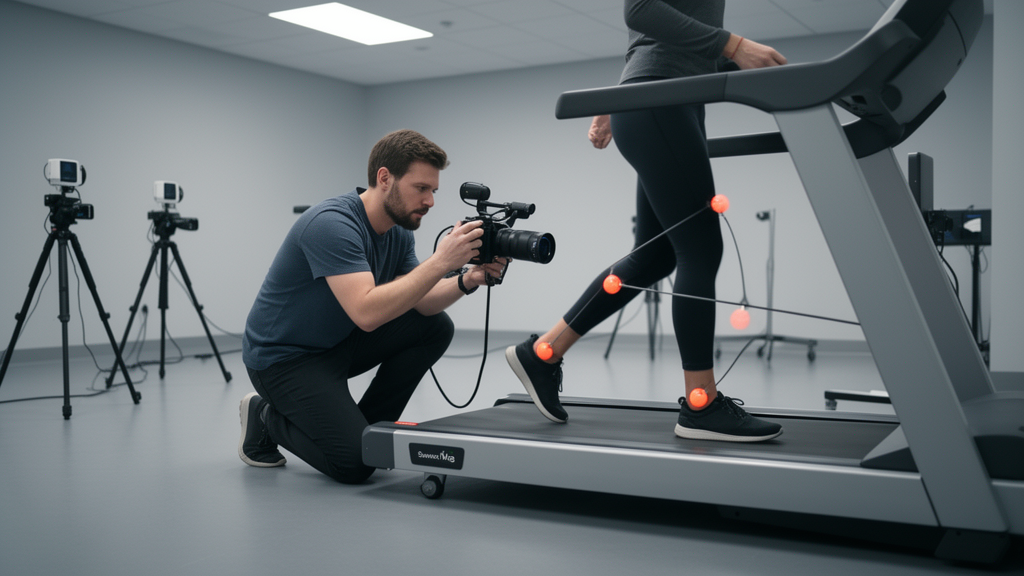
Nineteen middle-aged adults without impairment, with a mean age of 56.42 years, walked on an instrumented split-belt treadmill while a sixteen-camera motion capture system recorded three-dimensional positions of reflective markers on their lower extremities. Marker data were captured at 100 hertz and ground reaction force data at 2,000 hertz, with all data time-normalized to 100 percent of the gait cycle. The researchers defined propulsion as the peak amplitude of the AGRF, expressed as a percentage of body weight, and calculated TLA using the two most common definitions in the literature: one connecting the greater trochanter to the fifth metatarsal head, and one connecting it to the lateral malleolus. They then compared the peak value of each TLA measure to the value measured at the exact moment of peak AGRF, and described the timing of peak propulsion relative to key gait events such as contralateral heel strike and ipsilateral toe-off.
The results were striking. Peak propulsion occurred at 47.50 percent of the gait cycle, just before contralateral heel strike, which occurred at 49.99 percent. This timing aligns with the dynamic model of walking, which holds that generating push-off just before the opposite foot lands minimizes the energy cost of the step-to-step transition. But the peak value of TLA, measured with the fifth metatarsal head landmark, occurred at 57.83 percent of the gait cycle, a full 10.38 percent later than peak AGRF. When measured with the lateral malleolus, peak TLA occurred 8.61 percent later. Both timing differences were statistically significant, with enormous effect sizes. In amplitude terms, the gap was equally dramatic: peak TLA with the fifth metatarsal landmark averaged 22.77 degrees, while TLA at the moment of peak propulsion averaged just 16.08 degrees, a difference of 6.69 degrees. With the lateral malleolus, the difference was smaller but still significant at 4.20 degrees, with peak values of 27.94 degrees versus 23.50 degrees at peak propulsion.
Why does this matter clinically? Because when TLA is measured at its peak value rather than at the moment of peak propulsion, it is consistently overestimated by roughly four to seven degrees. A patient’s propulsive capacity may appear adequate when measured at peak TLA but is actually impaired when measured at the clinically relevant time point of peak propulsion. This misclassification can delay or prevent diagnosis of true propulsive deficits and can obscure whether a gait impairment reflects genuine motor control deficiency or merely compensatory limb positioning. While peak TLA may be adequate for tracking relative progress within a single patient over time, precision remains critical for establishing normative data, comparing outcomes across facilities, and determining whether propulsive deficits represent true motor control impairment or a measurement artifact due to inconsistent timing protocols. The authors also caution that the proportional relationship between peak TLA and TLA at peak propulsion may be fundamentally altered in individuals with movement disorders, potentially masking clinically meaningful changes in propulsive mechanics if peak TLA is used as a surrogate without verification in impaired populations.
The kinematic analysis adds further texture to the story. At the moment of peak propulsion, the trailing limb ankle was dorsiflexed at 12.07 degrees, the knee slightly flexed at 11.68 degrees, and the hip extended at 10.24 degrees behind neutral, near its position of maximum extension in the gait cycle. Meanwhile, the leading limb ankle was approaching a neutral position for heel strike, the knee slightly flexed, and the hip flexed at 22.18 degrees. These joint positions are reflective of the terminal stance phase of gait, occurring during single limb support just before the opposite foot lands, rather than during double limb support. This finding suggests that peak propulsion does not occur during the period of double support in middle-aged unimpaired adults, challenging diagrams in previous studies that depict TLA during double limb support. It also means that if TLA is measured at toe-off or in pre-swing, phases often used interchangeably, it is capturing the peak value of TLA rather than TLA at the time of peak propulsion, as originally intended.
The study also contributes to an ongoing debate about when propulsion actually peaks. While the dynamic model of walking and exoskeleton studies by Malcolm and colleagues support the idea that push-off before contralateral heel strike optimizes energy efficiency, Kuhman and Hurt found that in young unimpaired adults, all measures of propulsion occurred after contralateral heel strike, regardless of walking speed. The Houston team suggests that conflicting findings may stem from data processing decisions, such as the thresholds used to identify heel strike and toe-off events. In the current study, a vertical ground reaction force threshold of 30 newtons was used, in accordance with work by Revi and colleagues that validated a minimal set of wearable sensors for indirect AGRF measurement. But acceptable thresholds in the literature range from 10 to 30 newtons, and a lower threshold would detect heel strike earlier, potentially shifting the timing relationships reported here. Walking speed also modulates both TLA magnitude and propulsive force generation, so the specific timing percentages should be replicated across unimpaired and impaired populations walking at slower speeds.
The authors acknowledge limitations. Participants walked significantly slower on the treadmill than overground, and fourteen of the nineteen were recruited from a local running club, making the sample likely more active and healthier than the average middle-aged adult at risk of stroke. Significant left-right differences were also observed despite participants being unimpaired, likely reflecting natural biomechanical variation related to limb dominance or the unfamiliar task of split-belt treadmill walking. Still, the core message stands: the maximum value of TLA is not methodologically equivalent to TLA measured at the time of peak propulsion, which occurs just before contralateral heel strike in middle-aged unimpaired adults. The findings provide concrete evidence supporting standardized TLA reporting in future research and clinical practice, and underscore that whether in the laboratory or the clinic, timing is everything.
Subject of Research: Timing is everything: the effect of measurement timing on trailing limb angle in gait analysis
Article Title: Timing is everything: the effect of measurement timing on trailing limb angle in gait analysis
Article References: Kenworthy, S., & Gorniak, S. (2026). Timing is everything: the effect of measurement timing on trailing limb angle in gait analysis. Frontiers in Rehabilitation Sciences, 7, Article 1897235. https://doi.org/10.3389/fresc.2026.1897235
Image Credits: AI Generated
DOI: 10.3389/fresc.2026.1897235
Keywords: Timing, everything, effect, measurement, trailing, limb, angle, gait, analysis, scientific research
Cite Scienmag News
Ophelia Keating. (October 17, 2026). Timing Is Everything: Why When You Measure Trailing Limb Angle Changes the Answer in Gait Analysis. Scienmag. https://scienmag.com/timing-is-everything-why-when-you-measure-trailing-limb-angle-changes-the-answer-in-gait-analysis/
Ophelia Keating. "Timing Is Everything: Why When You Measure Trailing Limb Angle Changes the Answer in Gait Analysis." Scienmag, 17 October 2026, https://scienmag.com/timing-is-everything-why-when-you-measure-trailing-limb-angle-changes-the-answer-in-gait-analysis/. Accessed 17 October 2026.
Ophelia Keating. "Timing Is Everything: Why When You Measure Trailing Limb Angle Changes the Answer in Gait Analysis." Scienmag. October 17, 2026. https://scienmag.com/timing-is-everything-why-when-you-measure-trailing-limb-angle-changes-the-answer-in-gait-analysis/


