


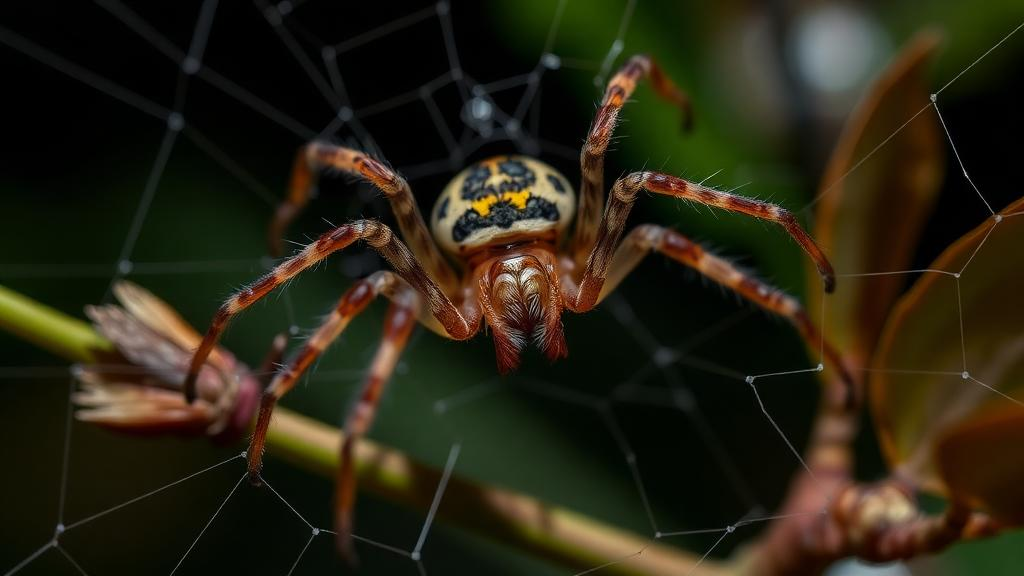
On the ancient routes of the Great Silk Road, where traders once carried silk, spices and ideas between East and West, a modern scientific expedition is now uncovering a different kind of treasure. A team of arachnologists working under the Caucasus Barcode of Life (CaBOL) project has completed the largest survey of Georgian spiders ever undertaken, and the results are reshaping our understanding of the region’s biodiversity. The study, published in the journal Caucasiana, documents 297 spider species collected across Georgia between 2006 and 2023, of which 100 species, 25 genera and one family were recorded from the country for the first time. Among these, 18 species and five genera had never before been recorded anywhere in the entire Caucasus region.
Georgia sits at a biogeographic crossroads where the Greater and Lesser Caucasus mountains meet the Black Sea and the semi-arid steppes of the south. Although more than 650 spider species from 43 families are already known from the country, representing roughly half of the total Caucasus spider diversity, researchers estimate that the true number should exceed 900 local species. The new survey, led by Armen Seropian and colleagues at Ilia State University in Tbilisi together with Stefan Otto of Leipzig, represents the second and largest contribution in a series of articles devoted to the faunistic study of Georgian spiders. The team collected 1,091 specimens during field expeditions and by spontaneous hand collection, using aspirators, soil sifters, beating methods and Malaise traps across both protected and unprotected areas.
The specimens were preserved in 96 percent ethanol and stored at minus 22 degrees Celsius in scientific collections at Ilia State University, the Zoologisches Forschungsmuseum Alexander Koenig in Bonn, and Otto’s personal collection in Leipzig. Identification was performed using a Zeiss Stemi 508 stereo microscope with 8:1 zoom, supported by literature sources on Caucasian spiders. The researchers also generated 283 quality DNA barcodes from 150 species using the cytochrome oxidase subunit I (COI) gene, the standard mitochondrial marker for animal DNA barcoding. Of these, 48 barcodes representing 26 species were submitted to the Barcode of Life Data Systems (BOLD) for the first time, providing critical reference sequences for future biodiversity assessments.
The DNA barcoding pipeline involved extracting genomic DNA from 25 milligrams of tissue using a Quick-DNA Miniprep Plus Kit, amplifying partial COI sequences by polymerase chain reaction with primer pairs LCOI490-JJ and HCO2198-JJ, and sequencing the unpurified PCR products in both directions at the Beijing Genomics Institute in Hong Kong. Sequence analysis was performed using Geneious Prime software, and Barcode Index Numbers (BINs) were calculated for each sequenced taxon. The team adopted an integrative taxonomic approach, reviewing identifications both morphologically and molecularly, since previous research indicates that the accuracy of spider identification through DNA barcodes alone is approximately 95 percent.
Among the most remarkable findings is the discovery of Baryphyma proclive, a tiny sheet-web weaver from the family Linyphiidae, which had been known only from Italy since its description from Rome in 1884. The Georgian record extends its known distribution 2,600 kilometres to the east. Similarly, Pritha pallida and Zelotes khostensis are indicated as species with an Italo-Caucasian disjunctive distribution, a pattern that suggests ancient biogeographic connections between the Mediterranean and the Caucasus. The team also recorded the first Palpimanidae family from Georgia, represented by an undescribed Palpimanus species collected in the semi-desert of Vashlovani National Park, and the first record of the aquatic spider Argyroneta aquatica from Tsundi Lake, the southernmost record from the Caucasus region.
The survey revealed particularly striking patterns among jumping spiders (Salticidae), which stood out with 23 new country records despite leading an active and open lifestyle. Among these, Saitis tauricus was recorded from Tbilisi apartments in two consecutive years, suggesting an established population possibly imported with goods from the Crimean Peninsula. Orchestina pavesiiformis, a minuscule spider originating from Europe known to spread easily by human activity, was found in Tbilisi bathrooms, representing the first record of the genus Orchestina from the entire Caucasus. Pseudeuophrys vafra was recorded from the Caucasus for the first time, with the nearest known record 940 kilometres away in Ukraine’s Crimean Peninsula.
Several records push the known limits of species distributions in unexpected directions. Seven species, including Palpimanus sp., Mesiotelus caucasicus, Silhouettella osmaniye, Walckenaeria bifasciculata, Titanoeca caucasica, Orchestina pavesiiformis and Zodarion nigrifemur, represent the northernmost limits of their ranges. Six species, including Enoplognatha mediterranea, Gnaphosa caucasica, Panamomops sulcifrons, Troglohyphantes birsteini, Attulus ammophilus and Titanoeca ukrainica, represent the southernmost limits of their distributions. Five species represent the easternmost limits, four the southeasternmost, and one, Sibianor turkestanicus, the westernmost limit of its known range.
The DNA barcoding results also exposed identification challenges that highlight the complexity of spider taxonomy. Interspecific lumps were detected in several species pairs, including Clubiona alpicola and C. frutetorum with a mean p-distance of 4.54 percent, and Walckenaeria alticeps and W. antica with a mean p-distance of 1.6 percent. Intraspecific genetic distances larger than 3.0 percent were found in seven species, including Haplodrassus silvestris at 4.43 percent and Gnaphosa steppica at 3.86 percent, suggesting potential cryptic species diversity. The team also documented reverse sexual dimorphism in Centromerus minor, confirming that males are larger than females, a rare phenomenon among spiders.
The endemic Caucasian fauna received particular attention. Cryptoparachtes adzharicus, the smallest species in its genus, was recorded from Kintrishi National Park in Adjara, while Dysdera gmelini and D. inopinata, both endemic to Georgia and described from the country in 1991, were documented for only the second time. Harpactea paradoxa remains restricted to the area between the Tsiv-Gombori Range and the Batsara-Babaneuri Protected Area. The troglobiont Troglohyphantes birsteini, previously recorded only from Russia’s Krasnodar Krai, was found in a rock pile in Samegrelo-Zemo Svaneti, marking its first record from Georgia.
Most of the new records originated from semi-arid or arid habitats, particularly the Paliurus spina-christi dry shrublands of central and southeastern Georgia. The researchers explain this pattern by the very limited studies previously performed in the central, central-southern and southeastern parts of the country, leaving many more species unexplored or undescribed. The team provided 140 diagnostic drawings of 76 preserved specimens, along with photos of 15 preserved species and one alive species, ensuring that future researchers can verify these records. As the CaBOL project continues to inventory the Caucasus biodiversity hotspot, the Georgian spider fauna is proving to be far richer than previously imagined, with each expedition yielding pearls from the ancient crossroads of the Silk Road.
Subject of Research: Spider diversity in Georgia revealed by Caucasus Barcode of Life project
Article Title: Picking pearls from the Silk Road: Insights into the spider ( Arachnida , Araneae ) diversity in Georgia from the Caucasus Barcode of life project. Part II
Article References: Seropian, A., Bulbulashvili, N., Otto, S., Krammer, H.-J., Kachlishvili, N., & Datunashvili, A. (2023). Picking pearls from the Silk Road: Insights into the spider (Arachnida, Araneae) diversity in Georgia from the Caucasus Barcode of life project. Part II. Caucasiana, 2, 231-297. https://doi.org/10.3897/caucasiana.2.e110536
Image Credits: AI Generated
DOI: 10.3897/caucasiana.2.e110536
Keywords: spiders, Georgia, Caucasus, DNA barcoding, biodiversity, arachnology, COI gene, faunistics, Picking, pearls, Silk, Road
Cite Scienmag News
Margaret Porter. (October 18, 2026). Silk Road survey reveals hidden spider diversity in Georgia. Scienmag. https://scienmag.com/silk-road-survey-reveals-hidden-spider-diversity-in-georgia/
Margaret Porter. "Silk Road survey reveals hidden spider diversity in Georgia." Scienmag, 18 October 2026, https://scienmag.com/silk-road-survey-reveals-hidden-spider-diversity-in-georgia/. Accessed 18 October 2026.
Margaret Porter. "Silk Road survey reveals hidden spider diversity in Georgia." Scienmag. October 18, 2026. https://scienmag.com/silk-road-survey-reveals-hidden-spider-diversity-in-georgia/


