


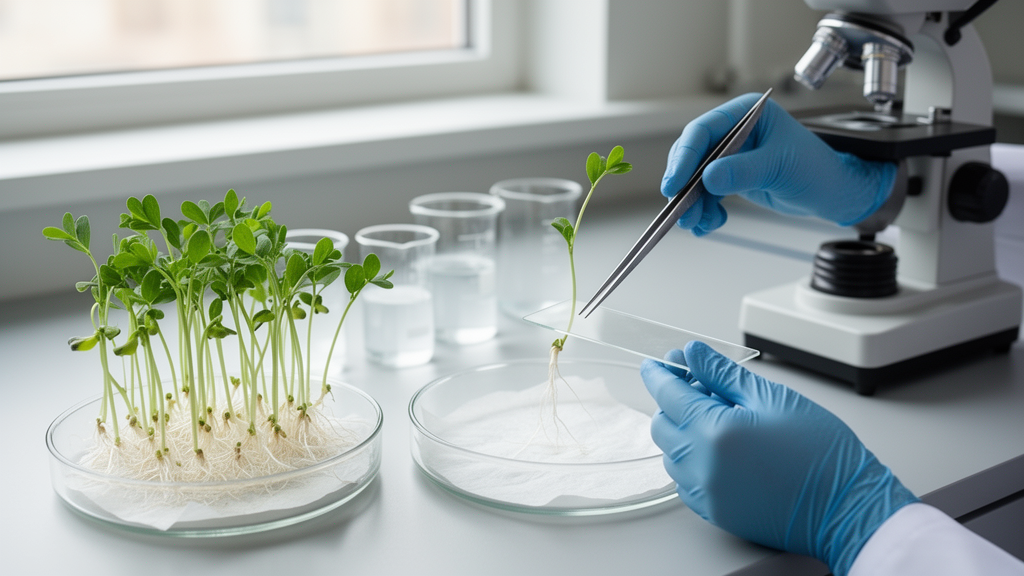
Salt is quietly rewriting the biology of one of India’s most climate-resilient pulse crops, and for the first time scientists have watched it happen at the level of individual chromosomes. In a new bio-assay guided study, researchers primed seeds of Lathyrus sativus L., the grass pea known locally as khesari, variety Mahatora, with sodium chloride concentrations ranging from 100 to 500 millimolar and then tracked what the salt did to germinating root cells over the following days. The results, published in Innovations in Agriculture, reveal that sodium chloride behaves as a genuine cytogenotoxicant in this crop, dismantling nuclear architecture, scrambling spindle formation and ultimately driving root cells into apoptosis once concentrations climb past a tolerable threshold.
The experimental design was deliberately simple and inexpensive, relying on root tip cells as living test models. Certified Mahatora seeds were sterilised, soaked in serially diluted NaCl solutions for 24 hours and then allowed to germinate in petri plates. Every 24 hours up to 168 hours, the researchers recorded germination percentages and radicle lengths. At 72 hours, root tips were fixed in Carnoy’s solution, hydrolysed with 1N HCl and stained with 2% aceto-orcein before being squashed onto slides for microscopic scoring. At least 500 cells per treatment were counted to calculate the mitotic index, the proportion of cells actively dividing, alongside the frequency of chromosomal abnormalities. A parallel set of root tips was stained with 0.05% hematoxylin to examine nucleolar morphology, while biochemical assays measured total soluble protein, peroxidase activity, electrolyte leakage and mitochondrial dehydrogenase activity via TTC staining.
The physiological data told a clear dose-response story. At 100 mM NaCl, germination was vigorous and root growth nearly matched control sets, suggesting mild salinity poses little threat to this variety. From 200 mM onwards, however, significant reductions in germination percentage and root length inhibition became apparent. At 300 mM, roughly half the seed coats showed visible stress symptoms, though germination still reached about 70% by day seven. At 400 mM, only four seeds germinated, their roots brownish to black at the tips, and at 500 mM almost all seed coats blackened with just a single stunted seed showing any sign of life. The authors concluded that 200 to 300 mM represents the maximum tolerance level for Mahatora, while 400 to 500 mM is highly cytotoxic.
Cytologically, the picture was even more dramatic. The mitotic index declined steadily as salt concentrations rose, and from 300 to 400 mM the researchers recorded a significant drop in normally dividing cells alongside a surge in abnormal mitotic figures. These included C-mitosis, somatic diads, polyploidy, binucleate cells, karyorrhexis and anaphasic bridges, hallmarks of both aneugenic and clastogenic damage. The presence of C-mitosis and polyploid formations at 200 to 300 mM conclusively established that NaCl disrupts spindle fibre formation in dividing root cells, producing somatic diads and subsequent polyploidy. At 500 mM, more than half the cells were enucleated or apoptotic, with giant strap cells showing multifragmented nuclear lobes, chromosomal erosions and nuclear blebbing shifted to cell corners, classic signatures of programmed cell death.
Nucleolar dynamics provided a second, remarkably sensitive cytological biomarker. In control roots, interphase nuclei typically contained one or two nucleoli. From 200 mM onwards, nucleolar volume and frequency were visibly altered, with cells containing three to eight micronucleoli, some pear-shaped, dumbbell-shaped or eye-shaped, scattered throughout the cytoplasm. At 300 mM, tetra-, penta- and hexanucleolate populations together accounted for 63% of the cellular population. At 400 mM, cells with five to six nucleoli made up 43% and those with seven to nine reached 20%. By 500 mM, up to 60% of the population consisted of giant strap cells with no nuclear masses remaining, and only two to three micronucleoli lingered at cell corners within ruptured walls. The authors noted that nucleolar activity is the most sensitive indicator of cytotoxicity when compared with chromosomal aberrations, mitotic index or micronucleus tests, making these volumetric and frequency changes powerful cytogenetic markers of salt-induced stress.
Biochemically, the roots mounted a defence that collapsed at the highest doses. Total soluble protein content rose in the 100 to 300 mM treatment groups, consistent with plants accumulating protective proteins to maintain osmolyte balance under stress. Peroxidase activity, an elicitor against reactive oxygen species, climbed from 6.6 mg/mL/min in controls to peaks of 11.3 mg/mL/min at 300 mM. Yet at 500 mM, peroxidase activity plummeted to 3.4 mg/mL/min, roughly half the control value, and total soluble protein fell below control levels, indicating that cellular poisoning at the highest dose halted both protein synthesis and enzyme activity outright.
Membrane integrity told a parallel story of progressive damage. Electrolyte leakage from untreated roots remained below 10%, but germinating roots exposed to increasing NaCl showed an almost dose-dependent rise in membrane permeability, with roughly 50% leakage falling in the 200 to 300 mM range. The authors interpreted this as a biophysical marker of cytotoxicity, the clearest sign that cell membranes had been structurally compromised. Sodium displaces calcium, which normally stabilises membranes, while chloride ions accumulating in the apoplast act as an osmoticum that thickens the plasma membrane and disrupts electrostatic potential at the lipid head groups.
Mitochondrial metabolism, measured through TTC-reduction of dehydrogenase activity, rose from 100 to 300 mM as roots tried to compensate for stress, but fell sharply at 400 and 500 mM, signalling root mitochondrial dysfunction. The authors linked this decline to ROS generation, membrane rupture and the leakage of intracellular ions and organic compounds, culminating in physiological metabolic disturbance and root cell death. Earlier studies in pea and wheat mitochondria had shown that NaCl stress specifically inhibits respiratory electron transport and triggers a metabolic shift from glycolysis to the pentose phosphate pathway, findings consistent with the downward trend observed here.
Taken together, the study positions Lathyrus sativus root tip cytogenetic biomarkers as an easy-to-handle, cost-effective alternative to conventional models like Allium cepa and Vicia faba for assessing salinity cytogenotoxicity in pulse crops. The authors argue that the grass pea, already valued as cheap animal feed and a protein source for underprivileged communities in India, could emerge as a future wonder crop given its readiness to adapt to ecological and anthropogenic stresses. Establishing optimum salt tolerance levels through cytological bioassays during seed germination, they suggest, offers a practical first step, though further molecular categorisation will be needed to fully characterise end-point suboptimal salt tolerance mechanisms in this and other key pulse crops.
Subject of Research: Salinity-induced cytogenotoxicity and biomarker responses in germinating roots of the pulse crop Lathyrus sativus (grass pea), variety Mahatora.
Article Title: Evaluation of salinity-mediated end-point cytogenotoxicity in Germinating Roots of Lathyrus sativus L., Variety Mahatora.: Bio-assay guided biomarker studies
Article References: Adhikari, D., Ghosh, R., & Dig, S. (2024). Evaluation of salinity-mediated end-point cytogenotoxicity in Germinating Roots of Lathyrus sativus L., Variety Mahatora.: Bio-assay guided biomarker studies. Innovations in Agriculture, 7, 1-17. https://doi.org/10.3897/ia.2024.124263
Image Credits: AI Generated
Keywords: Lathyrus sativus, grass pea, salinity stress, NaCl, cytogenotoxicity, mitotic index, chromosomal aberrations, nucleolus, peroxidase activity, electrolyte leakage, dehydrogenase activity, seed priming
Cite Scienmag News
Alan Morgan. (October 18, 2026). Evaluation of salinity-mediated end-point cytogenotoxicity in Germinating Roots of Lathyrus sativus L., Variety Mahatora.: Bio-assay guided biomarker studies. Scienmag. https://scienmag.com/evaluation-of-salinity-mediated-end-point-cytogenotoxicity-in-germinating-roots-of-lathyrus-sativus-l-variety-mahatora-bio-assay-guided-biomarker-studies/
Alan Morgan. "Evaluation of salinity-mediated end-point cytogenotoxicity in Germinating Roots of Lathyrus sativus L., Variety Mahatora.: Bio-assay guided biomarker studies." Scienmag, 18 October 2026, https://scienmag.com/evaluation-of-salinity-mediated-end-point-cytogenotoxicity-in-germinating-roots-of-lathyrus-sativus-l-variety-mahatora-bio-assay-guided-biomarker-studies/. Accessed 18 October 2026.
Alan Morgan. "Evaluation of salinity-mediated end-point cytogenotoxicity in Germinating Roots of Lathyrus sativus L., Variety Mahatora.: Bio-assay guided biomarker studies." Scienmag. October 18, 2026. https://scienmag.com/evaluation-of-salinity-mediated-end-point-cytogenotoxicity-in-germinating-roots-of-lathyrus-sativus-l-variety-mahatora-bio-assay-guided-biomarker-studies/


