


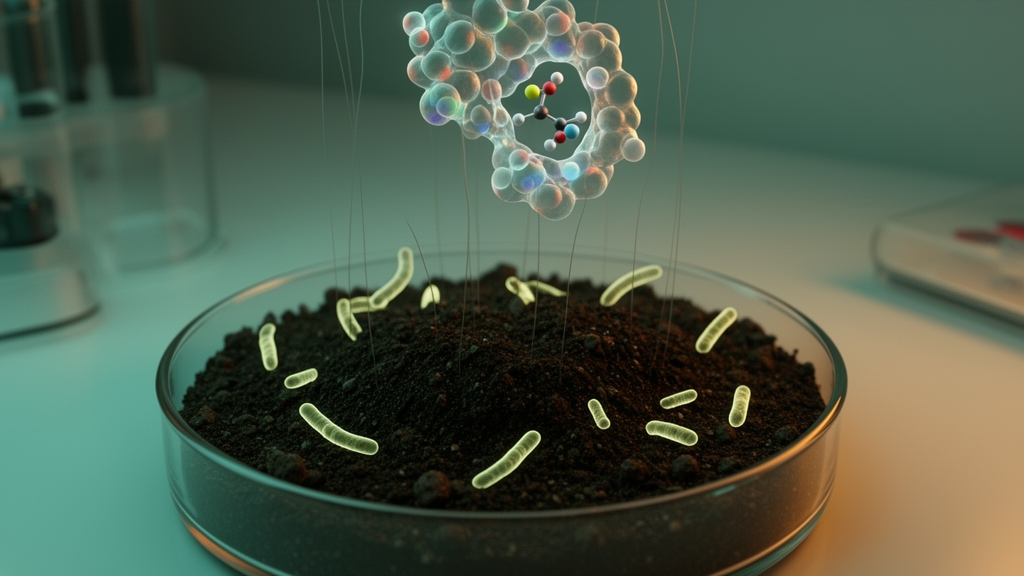
Researchers at the Helmholtz Centre for Infection Research (HZI) and its Saarland University partner site, the Helmholtz Institute for Pharmaceutical Research Saarland (HIPS), have discovered a new class of natural products called myxoglucamides, produced by soil-dwelling myxobacteria. The compounds are notable for combining building blocks derived from sugars, lipids, and amino acids in a way that clearly sets them apart from previously known natural products. In two studies published in Angewandte Chemie International Edition, the team activated a silent biosynthetic gene cluster in the bacteria, worked out the unusual chemistry behind the molecules’ assembly, and used laboratory synthesis to identify a human protein that myxoglucamides bind: AKR1C3, an enzyme implicated in several types of cancer.
Myxobacteria are renowned for generating a remarkable diversity of biologically active natural products, but many of the gene clusters encoding these compounds remain silent under laboratory conditions. Using modern genetic methods, the researchers specifically switched on the biosynthetic pathway for myxoglucamides that had remained dormant in the bacteria. This activation was the key to producing and detecting the compounds at all. The team led by Prof. Rolf Müller, scientific director of HIPS and head of the department Microbial Natural Products, was responsible for the initial discovery of the molecule and the determination of its structure. The researchers then analyzed the underlying biosynthetic gene cluster and the individual biochemical steps required for production, revealing a previously unknown biosynthetic pathway in which several enzymes act together in an unexpected way to generate a chemical structure not described before in this form.
“The discovery of myxoglucamides highlights how much chemical potential remains hidden in previously silent biosynthetic gene clusters of microorganisms,” said Dr Chengzhang Fu, head of the junior research group Genome Mining for Secondary Metabolites at HIPS. “By selectively activating and deciphering these biosynthetic pathways, we can gain access to entirely new natural products.” Müller added that the unusual building block produced by the bacteria opens up new avenues for research, since such molecular components can help in the development of more targeted drugs. “Nature has found ways here that we were previously unaware of,” he said. The biosynthetic findings provide new insights into how microorganisms construct complex natural products and how such hidden compounds may be identified more systematically in the future.
In the second study, the team explored the molecular targets of myxoglucamides in human cells. Because the myxobacterial producer generates the compound only in very small amounts, insufficient for further investigations, the researchers achieved the first total synthesis of myxoglucamide A in the laboratory. The synthetic route also enabled the team to test slightly modified variants and better understand which parts of the molecule are important for its activity. Some of these synthetic derivatives bound the target protein much more strongly than the natural compound. Using a method that systematically identifies the proteins a molecule binds to in the cell, the researchers showed that myxoglucamides interact primarily with the human protein AKR1C3.
AKR1C3 is an enzyme involved in the production of certain hormones and inflammatory signaling molecules, and it is known to be overproduced in several types of cancer, where it can promote tumor cell growth. The binding of myxoglucamides to this protein makes them a potential starting point for the development of novel anticancer drugs. However, the researchers were unable to demonstrate a strong effect of myxoglucamides on cancer cell growth. “Although we were unable to demonstrate a strong effect of myxoglucamides on cancer cell growth, the study nevertheless shows that natural products without an immediately obvious biological effect can still engage highly relevant targets in the human body,” said Prof. Mark Brönstrup, head of the department Chemical Biology at HZI. “This is exactly where great potential lies for identifying new concepts for the development of innovative drugs.” The work illustrates how systematically unlocking silent gene clusters, combined with total synthesis and activity-based protein profiling, can connect microbial chemistry to human disease biology even when a compound’s initial activity profile looks unremarkable.
Subject of Research: Discovery and biosynthesis of myxoglucamides from myxobacteria and identification of AKR1C3 as their human target protein
Article Title: From hidden natural product to potential drug lead
Article References: From hidden natural product to potential drug lead. Original publication (Bibliographic details unavailable.)
Image Credits: AI Generated
DOI: Not provided
Keywords: natural products, myxobacteria, myxoglucamides, biosynthesis, genome mining, AKR1C3, cancer research, drug discovery, HIPS, HZI, hidden, natural
Cite Scienmag News
Juliet Wilcox. (October 26, 2026). Silent soil bacteria genes yield new compounds targeting cancer-linked enzyme. Scienmag. https://scienmag.com/silent-soil-bacteria-genes-yield-new-compounds-targeting-cancer-linked-enzyme/
Juliet Wilcox. "Silent soil bacteria genes yield new compounds targeting cancer-linked enzyme." Scienmag, 26 October 2026, https://scienmag.com/silent-soil-bacteria-genes-yield-new-compounds-targeting-cancer-linked-enzyme/. Accessed 26 October 2026.
Juliet Wilcox. "Silent soil bacteria genes yield new compounds targeting cancer-linked enzyme." Scienmag. October 26, 2026. https://scienmag.com/silent-soil-bacteria-genes-yield-new-compounds-targeting-cancer-linked-enzyme/


