


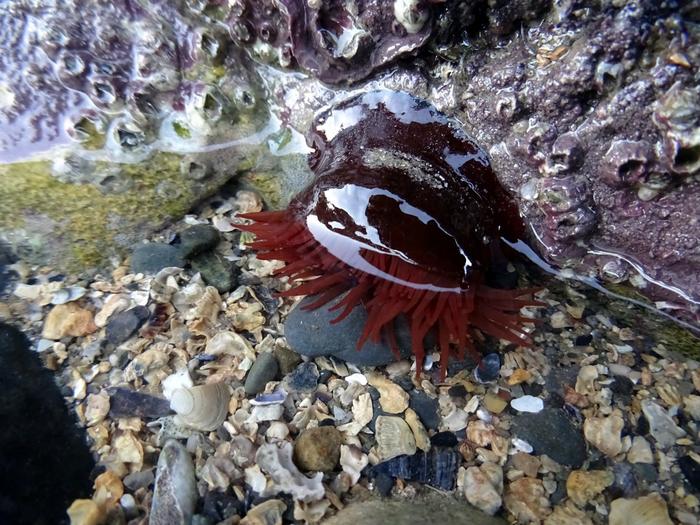
Even in nature, pride can prevail. A study with researchers from the University of Gothenburg shows that sea anemones that react more slowly to change can survive a heatwave better than individuals that change their behaviour quickly.

Credit: Jack Thomson
Even in nature, pride can prevail. A study with researchers from the University of Gothenburg shows that sea anemones that react more slowly to change can survive a heatwave better than individuals that change their behaviour quickly.
Along the Atlantic coasts of Europe, many species are exposed to abrupt shifts in habitat. Tides, storms and rapid temperature changes are commonplace for the marine species that live there. With climate change, heatwaves are expected to become more frequent, and researchers wanted to find out how coastal marine species cope with extreme water temperatures. They chose to study the sea anemone species Actinia equina, a species that exhibits individual behaviours.
Brave or shy
“We call them animal personalities. They are different behavioural life strategies found in the same species. The anemones we studied have two personality traits, bold and shy, and in extreme heat waves the shy anemones do better,” says Lynne Sneddon, a zoophysiologist at the University of Gothenburg and co-author of the study published in the Journal of Experimental Biology.
Being a shy or bold anemone describes the individual’s risk-taking. Both behaviours have advantages that have made them winners in evolution, otherwise they would not exist. A bold anemone reacts more quickly to changes in the environment than a shy anemone does. This means that the bold ones are quicker than the shy ones to open their tentacles to forage after a change. The bold anemones can trap more of the nutrients in the water, and this gives them a competitive advantage. On the other hand, they become more vulnerable in extreme conditions, such as heat waves. The researchers’ study shows that being a shy individual is a better survival strategy when the water is extremely hot.
“We measured the metabolism of the anemones and could see that when the water temperature was high, the metabolism of the bold anemones skyrocketed. This meant that they had to increase their nutrient intake so much that they risked dying. The shy anemones’ metabolism increased less, so they were better able to cope with the heat stress,” says Lynne Sneddon.
Rapid warming at low tide
In coasts with large tidal differences, water collects in “rock pools” that warm up quickly on the ebb tide before the next flood washes in with colder seawater. Anemones living in these pools are therefore particularly vulnerable to large temperature differences.
“Heat waves will become more common in the future and cold-blooded animals may find it difficult to cope. We studied anemones, but we have reason to believe that the phenomenon applies to other species as well. If the animals can’t cope, there will be a disruption in the ecosystems and this could have implications for the whole food web,” says Lynne Sneddon.
Journal
Journal of Experimental Biology
Method of Research
Experimental study
Subject of Research
Animals
Article Title
Differential metabolic responses in bold and shy sea anemones during a simulated heatwave
Article Publication Date
7-Feb-2024
Cite Scienmag News
Russell Cooper. (April 4, 2024). Shy sea anemones are more likely to survive heatwaves. Scienmag. https://scienmag.com/shy-sea-anemones-are-more-likely-to-survive-heatwaves/
Russell Cooper. "Shy sea anemones are more likely to survive heatwaves." Scienmag, 4 April 2024, https://scienmag.com/shy-sea-anemones-are-more-likely-to-survive-heatwaves/. Accessed 4 September 2026.
Russell Cooper. "Shy sea anemones are more likely to survive heatwaves." Scienmag. April 4, 2024. https://scienmag.com/shy-sea-anemones-are-more-likely-to-survive-heatwaves/

