


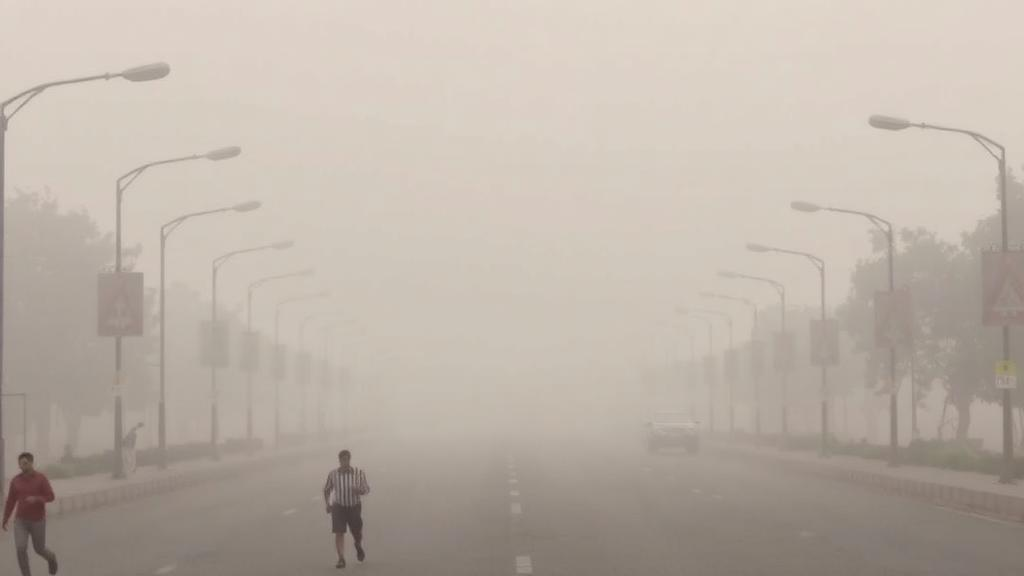
Across northern India, two of the most dangerous environmental hazards of the modern era are no longer arriving separately. Heat waves and severe fine particulate pollution, known as PM2.5, are increasingly striking the same regions at the same time, exposing hundreds of millions of people to simultaneous thermal stress and degraded air quality. A new study published in Advances in Atmospheric Sciences by a research team from Hong Kong Baptist University suggests that this dangerous overlap is not simply a coincidence of local emissions and hot weather. Instead, the researchers find that large-scale, climate-driven shifts in atmospheric circulation are actively creating the conditions for both extremes at once, stacking heat and pollution into compound events that are far more hazardous than either hazard alone.
The urgency of the problem was underscored during the pre-monsoon season of 2026, when temperatures climbed above 46 degrees Celsius across many parts of India. Northern and central regions of the country endured prolonged and intense heat waves, while compound heatwave-PM2.5 pollution events during the pre-monsoon season became increasingly frequent. The convergence of scorching temperatures and elevated particle concentrations during this period drew renewed attention from public health authorities and atmospheric scientists alike, raising a fundamental question: why are these compound extreme events becoming more common, and what mechanisms are driving their formation?
To answer that question, the research team, led by Professor Meng Gao of the Department of Geography at Hong Kong Baptist University, examined pre-monsoon heat-PM2.5 compound extreme events across India between 2017 and 2024. The study combined three complementary lines of evidence: ground-based observations, satellite measurements, and atmospheric chemistry simulations. This integrated approach allowed the researchers to track not only when and where heat and pollution overlapped, but also the physical and chemical processes that linked them. Their analysis revealed that the frequency of compound extreme events increased markedly after 2020, a shift that stands out clearly against the baseline of the preceding years.
The scale of the overlap during individual episodes is striking. In April 2022, more than 70 percent of severe PM2.5 pollution episodes across northern India occurred simultaneously with heat waves. That figure illustrates how tightly the two hazards have become coupled in the region. Rather than alternating between a heat crisis and an air quality crisis, populations in northern India increasingly face both at once, a pattern that public health researchers consider substantially more dangerous because extreme heat amplifies the physiological stress imposed by polluted air, stressing cardiovascular and respiratory systems simultaneously.
At the heart of the new findings is the role of a specific large-scale circulation feature: an anomalous anticyclonic circulation over northern India. Anticyclones, characterized by sinking air and suppressed vertical mixing, are well known for trapping heat near the surface and clearing skies of clouds, which allows more solar radiation to reach the ground and drives temperatures even higher. The study found that this anomalous anticyclone strengthened heat conditions over northern India while simultaneously generating anomalous southeasterly winds that transported additional pollution precursors into the region. In other words, a single meteorological pattern was working on both sides of the compound-extreme equation at once, intensifying the heat while feeding the chemical ingredients needed to build particle pollution.
The chemical consequences of these conditions proved to be just as important as the meteorological ones. The combination of extreme heat and an influx of pollution precursors accelerated atmospheric chemical processes, substantially enhancing the formation of secondary organic aerosols, or SOA, a major component of PM2.5. Unlike primary particles emitted directly from vehicles, industry, or biomass burning, secondary aerosols are manufactured in the atmosphere itself, as gaseous precursor compounds undergo chemical reactions and condense into particulate form. The atmospheric chemistry simulations conducted by the team showed that SOA production increased by approximately 2.3 times during compound events, contributing significantly to the elevated particle concentrations observed under extreme heat.
This finding carries significant implications for how scientists and policymakers understand air quality in a warming world. Secondary organic aerosol formation is highly sensitive to temperature, radiation, and the availability of reactive precursor gases, all of which are modulated by the large-scale circulation patterns described in the study. As heat waves intensify under climate change, the chemical environment of the boundary layer changes in ways that can amplify particle production even if emissions of primary pollutants remain constant. The Indian case demonstrates that climate variability can influence air quality through this pathway, meaning that emission control strategies alone may not fully capture the future trajectory of pollution extremes in densely populated regions.
Lead author Huibin Dai emphasized that the study reframes how compound extremes should be investigated. Most studies have focused on heat waves and air pollution separately, Dai noted, but this research shows that large-scale atmospheric circulation can simultaneously intensify heat and promote secondary aerosol formation, creating favorable conditions for compound heat-PM2.5 extremes. According to Dai, the results highlight an important pathway through which climate variability can influence both weather extremes and air quality, linking two research communities that have often worked along parallel but separate tracks.
The broader context makes these findings particularly consequential for India. The country is home to some of the world’s most densely populated urban corridors, and its pre-monsoon season has historically been associated with severe heat stress on agriculture, water resources, and human health. The demonstration that the same circulation anomalies that drive dangerous heat can also supercharge the atmospheric chemistry that produces PM2.5 suggests that the health burden of future warming may be compounded in ways that standard heat wave or air quality forecasts do not capture. As climate warming is expected to increase the occurrence of extreme heat, these coupled meteorological and chemical processes may further raise the risk of compound environmental extremes across South Asia.
Looking ahead, the research team plans to extend its analysis into the future. The next step, Dai said, is to investigate how compound heat-PM2.5 extremes will evolve under future climate change and to quantify their impacts on human health. The ultimate goal of the work, according to the researchers, is to better understand the mechanisms behind these compound events and to provide scientific evidence that can support early prevention, risk reduction, and climate adaptation strategies. The study was supported by grants from the National Natural Science Foundation of China and the Research Grants Council of the Hong Kong Special Administrative Region, China, and its findings arrive at a moment when the overlap of heat and pollution is emerging as one of the defining environmental health challenges of a rapidly warming century.
Subject of Research: Compound heatwave and PM2.5 pollution extremes driven by atmospheric circulation over India
Article Title: Climate-driven atmospheric circulation fuels dangerous heat-PM2.5 extremes over India
Article References: Climate-driven atmospheric circulation fuels dangerous heat-PM2.5 extremes over India. (n.d.). Original publication
Image Credits: AI Generated
DOI: Not provided
Keywords: India, heat waves, PM2.5, compound extremes, atmospheric circulation, anticyclone, secondary organic aerosols, air pollution, climate change, pre-monsoon, atmospheric chemistry, public health
Cite Scienmag News
Russell Cooper. (October 2, 2026). Shifting Winds and Warming Air Combine to Supercharge India’s Deadly Heat and Smog Extremes. Scienmag. https://scienmag.com/shifting-winds-and-warming-air-combine-to-supercharge-indias-deadly-heat-and-smog-extremes/
Russell Cooper. "Shifting Winds and Warming Air Combine to Supercharge India’s Deadly Heat and Smog Extremes." Scienmag, 2 October 2026, https://scienmag.com/shifting-winds-and-warming-air-combine-to-supercharge-indias-deadly-heat-and-smog-extremes/. Accessed 4 October 2026.
Russell Cooper. "Shifting Winds and Warming Air Combine to Supercharge India’s Deadly Heat and Smog Extremes." Scienmag. October 2, 2026. https://scienmag.com/shifting-winds-and-warming-air-combine-to-supercharge-indias-deadly-heat-and-smog-extremes/


