


Researchers from Japan uncover the genetic diversity and regional patterns of CARD9 deficiency in patients susceptible to fungal diseases

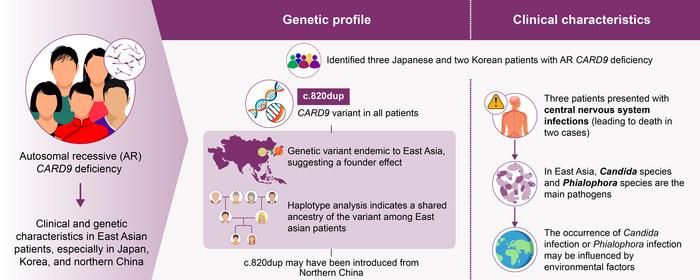
Credit: Department of Child Health and Development, TMDU
Researchers from Japan uncover the genetic diversity and regional patterns of CARD9 deficiency in patients susceptible to fungal diseases
Tokyo, Japan – Fungal infections pose life-threatening risks, especially when vital organs or the central nervous system are affected. Individuals harboring variants in the CARD9 gene are particularly susceptible to invasive fungal infections, given that the protein coded by this gene serves as a critical regulator of the immune system. A recent discovery by Tokyo Medical and Dental University (TMDU) researchers suggests that a specific variant of CARD9 prevalent across northern China, Korea, and Japan may have originated from a common ancestor.
In their study published on 17 May 2024 in the Journal of Clinical Immunology, the researchers from TMDU conducted genetic analyses on Japanese and Korean patients who suffered from severe or recurring fungal infections. Their goal was to shed light on the genetic and clinical traits of individuals affected by CARD9 deficiency in East Asia.
The study included a total of five patients who were deficient for CARD9. Among them, two Japanese patients were newly identified as carriers of biallelic variants of CARD9 via DNA sequencing conducted by the research team, prompted by their medical history of fungal infections. Notably, both of these patients, along with three other patients who had previously been investigated, two Korean and one Japanese, were identified as carriers of a CARD9 variant called c.820dup.
“The global distribution of CARD9 deficiency is biased, with high incidence in North Africa, the Middle East, and China. Notably, the distribution of CARD9 variants is also biased, with the c.820dup variant being relatively common in China,” explains Prof. Hirokazu Kanegane, the lead researcher of the study.
The fact that all five patients shared the same variant caught the researchers’ attention. They hypothesized that this scenario could be explained by the “founder effect,” where a variant becomes common in a population that originated from a small group of ancestors. To verify their hypothesis, the researchers performed haplotype analyses. Put simply, they examined groups of genes that are inherited together from a parent (haplotypes) to determine whether these genes were identical among the five patients and matched previously sequenced haplotypes from Chinese CARD9-deficient patients.
Interestingly, they found strong evidence suggesting that all haplotypes containing the c.820dup variant were exactly the same. With further statistical genetic analyses, the researchers estimated the age of the c.820dup variant itself, which turned out to be between 2,000 and 4,000 years. Remarkably, the estimated variant’s age and its distribution in Japan, Korea, and China are perfectly in line with the history of the East Asia region. “Modern Japanese and Koreans are believed to have a genetic background originating from northern China. During the late Neolithic to the Bronze Age, the migration of people from northern China to Korea and Japan spread rice and language. The origins of the variant identified in this study are consistent with this historical period,” remarks Prof. Kanegane. “We thus conclude that this variant originates from a common ancestor, estimated to have lived less than 4,000 years ago.”
Additionally, although the variant observed was the same, the clinical presentation of patients from Japan and Korea differed from that of Chinese patients according to medical records. More specifically, Chinese patients often suffered from black mold infections caused by the genus Phialophora, whereas none of the five patients from Japan and Korea exhibited such infections. The researchers ascribed this discrepancy to environmental factors, possibly related to the more rural lifestyle in northern China.
Together, the findings of this interdisciplinary study make important contributions to our knowledge of anthropology, genetics, and medicine, and shed light on how genetic variants can propagate across different regions and through generations.
###
The article, “Inherited CARD9 Deficiency Due to a Founder Effect in East Asia,” was published in the Journal of Clinical Immunology at DOI: 10.1007/s10875-024-01724-7
Journal
Journal of Clinical Immunology
Article Title
Inherited CARD9 Deficiency Due to a Founder Effect in East Asia
Cite Scienmag News
Juliet Wilcox. (June 11, 2024). Shedding light on the origin of a genetic variant underlying fungal infections. Scienmag. https://scienmag.com/shedding-light-on-the-origin-of-a-genetic-variant-underlying-fungal-infections/
Juliet Wilcox. "Shedding light on the origin of a genetic variant underlying fungal infections." Scienmag, 11 June 2024, https://scienmag.com/shedding-light-on-the-origin-of-a-genetic-variant-underlying-fungal-infections/. Accessed 4 September 2026.
Juliet Wilcox. "Shedding light on the origin of a genetic variant underlying fungal infections." Scienmag. June 11, 2024. https://scienmag.com/shedding-light-on-the-origin-of-a-genetic-variant-underlying-fungal-infections/

