


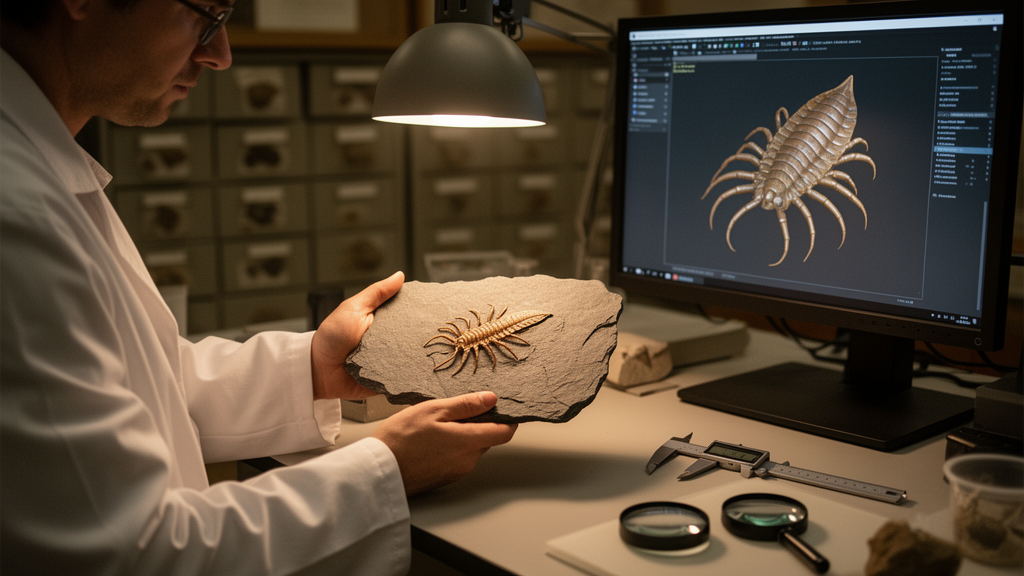
For more than a century and a half, two small, battered fossils from the hills of the Czech Republic have frustrated nearly every palaeontologist who tried to name them. Zonozoe drabowiensis, described in 1872 by the pioneering French palaeontologist Joachim Barrande, and Zonoscutum solum, named in 1999 from a single specimen, are arthropods known only from isolated moulds of their head shields, pressed into coarse quartzose sandstones of the Upper Ordovician Prague Basin. With just eight known specimens of Zonozoe and a single specimen of Zonoscutum, and with none of the anatomical details that normally settle questions of identity, the two genera have drifted between hypotheses for decades: ostracod, merostomate, aglaspidid, or something too poorly preserved to classify at all. A new study published in the Swiss Journal of Palaeontology has now brought a fresh weapon to this old fight, and the weapon is geometry.
The research team, working with material housed in the palaeontological collections of the National Museum in Prague, abandoned the traditional route of hunting for discrete anatomical characters, because there simply are none to find. The fossils preserve only the general vaulted outline of the cephalon, a raised longitudinal region, and a vague indication of the eyes; a single Zonozoe specimen shows what may be glabellar furrows, and Zonoscutum preserves similar structures in a different position. Crucially, all of the diagnostic features of the groups these fossils have been linked to, including the aglaspidids and their relatives within the clade Vicissicaudata, are post-cephalic, meaning they lie in body regions that were never preserved. Standard phylogenetic analysis, which depends on a matrix of observable traits, has therefore been effectively impossible. Earlier workers, including a major 2013 analysis of Vicissicaudata and a 2022 revision of the material, had concluded that the most anyone could honestly say was that the fossils belonged somewhere within the broad clade Artiopoda, the great assembly of extinct arthropods that includes trilobites and their kin.
The new study took a different path: instead of asking what features the fossils have, it asked what shape they are. The researchers compiled cephalic outlines from thirty-three early Palaeozoic arthropod species, spanning nine euchelicerates, six aglaspidids, three cheloniellids, two nektaspids, and a selection of other artiopodans, alongside Zonozoe and Zonoscutum themselves. Trilobites were deliberately excluded, a decision grounded in three practical reasons: Ordovician trilobite cephalic morphology is so extraordinarily diverse that it would have swamped the signal with noise, Zonozoe and Zonoscutum have never seriously been considered trilobite relatives, and the position of the eyes and glabella in the two enigmatic genera differs markedly from any contemporaneous trilobite. Each outline was traced as a black silhouette and converted into a mathematical description using elliptical Fourier analysis, a technique that decomposes a closed shape into a series of harmonic coefficients, capturing its geometry in a form that computers can compare objectively.
The mathematics behind the approach is elegant in its simplicity. Fifteen harmonics were retained, sufficient to capture 99.9 percent of the harmonic power in the dataset, meaning that nearly all of the meaningful shape information was preserved in the analysis. These coefficients were then fed into two complementary statistical frameworks. A principal component analysis compressed the high-dimensional shape data into a visual morphospace, where similar shapes cluster together and dissimilar ones drift apart. A linear discriminant analysis, trained on the known group memberships, tested how well the major groupings, euchelicerates, non-vicissicaudatan artiopodans, and vicissicaudatans, could be told apart on outline shape alone. The first two principal components alone explained 87.1 percent of the variation in the dataset, with PC1 accounting for 67.4 percent and PC2 for 19.7 percent, an unusually clean separation for fossil material this fragmentary.
The results were striking. In the principal component space, Zonozoe plotted squarely within the vicissicaudatan morphospace, nestled between the cheloniellid Neostrabops martini and the aglaspidid Aglaspis barrandei. Zonoscutum landed nearby, close to the cheloniellids Triopus and Drabovaspis complexa and the artiopodan Naraoia, in the lower region of the vicissicaudatan area. Both taxa fell far from the euchelicerate cluster, which occupied its own distinct corner of the morphospace. The discriminant analysis reinforced the pattern: euchelicerates were cleanly separated from all other groups, achieving 77.8 percent classification accuracy in leave-one-out cross-validation, while Zonozoe and Zonoscutum plotted at the edge of the artiopodan space, decisively outside the euchelicerate region. In plain terms, the shapes of these mysterious head shields look like vicissicaudatan artiopodans, and they emphatically do not look like the horseshoe crab relatives that some nineteenth-century workers once imagined.
This matters because the two genera have been dragged through nearly every possible interpretation since Barrande first described Zonozoe as a large ostracod carapace. Novák, in an unpublished 1887 manuscript, considered it a merostomate close to the synziphosurines. Chlupáč assigned it to Aglaspidida in 1963, an assignment he himself flagged as uncertain, and the same tentative label was later applied to Zonoscutum. Part of the confusion stemmed from the aglaspidids’ own turbulent taxonomic history: during the twentieth century they were shuffled between Xiphosura, Merostomata, and positions as sister group to the chelicerates, before modern phylogenies anchored them firmly within Vicissicaudata, a branch of Artiopoda. For much of that period, Aglaspidida functioned as something of a wastebasket taxon, a destination for any Ordovician arthropod too incomplete to place elsewhere, and Zonozoe and Zonoscutum, with their aglaspid-like head shields and their occurrence in the same palaeogeographic region as known aglaspidids, were natural candidates for that fate.
The authors are careful about the limits of their method, and that caution is itself instructive. Both Zonozoe and Zonoscutum plotted closer to cheloniellids than to aglaspidids in the two-dimensional outline space, but the team argues this is likely an artefact of compression: Zonoscutum has a highly vaulted cephalon and cheloniellids extremely flattened ones, and flattening three-dimensional shapes into two-dimensional outlines distorts exactly such extremes. Three-dimensional volume data would address the problem, but such data are difficult to obtain for fossils scattered across collections on multiple continents, and are themselves affected by flattening during fossilisation. The researchers therefore decline to overturn the 2022 conclusion that rejected a close relationship with the coeval and sympatric cheloniellid Triopus. What the analysis does firmly support is the negative result: an euchelicerate affinity is effectively excluded, and the most conservative classification of both genera within Artiopoda gains quantitative backing, with a more specific affinity to Vicissicaudata now considerably strengthened.
There is even a bonus finding buried in the morphospace. The proximity of Zonozoe to Neostrabops martini, a Late Cambrian form whose own classification has long rested on limited evidence, prompted the authors to suggest that Neostrabops itself may deserve re-examination, potentially toward Aglaspidida or, more parsimoniously, toward Xenopoda. Meanwhile, the close placement of Zonozoe beside Aglaspis barrandei is consistent with older qualitative observations, such as the position of the eyes and glabellar furrows behind them, traits that are not strongly diagnostic on their own but now align with an independent line of quantitative evidence. Neither conclusion is presented as definitive, but together they show how a method designed to squeeze information from unpromising material can generate genuinely new hypotheses about specimens that formal phylogenetics cannot touch.
The broader significance of the study extends well beyond two obscure Czech fossils. Mould-preserved specimens, which rarely retain fine anatomical detail, are routinely excluded from evolutionary and palaeoecological analyses precisely because the discrete characters needed for phylogenetic matrices are absent. Outline-based morphometrics offers a reproducible, quantitative alternative: less precise than a full phylogenetic analysis, but capable of admitting specimens that would otherwise sit forever in the too-difficult drawer. In this case, the technique has provided evidence for the presence of non-cheloniellid vicissicaudatans in the Letná Formation based on material that traditional qualitative methods would have overlooked entirely. A 150-year-old puzzle has not been solved with a new specimen or a spectacular discovery, but with a ruler’s worth of geometry applied to the outlines of what little remains, and that may prove to be the study’s most enduring legacy: a demonstration that even the most fragmentary fossils in the world’s museum drawers still have stories their shapes can tell.
Subject of Research: Morphometric reclassification of the enigmatic Ordovician arthropod fossils Zonozoe drabowiensis and Zonoscutum solum from the Czech Republic
Article Title: A morphometric approach to the taxonomic dilemma of Zonozoe drabowiensis Barrande, 1872 and Zonoscutum solum Chlupáč, 1999 (Upper Ordovician, Czech Republic)
Article References: Lustri, L., Laibl, L., Collantes, L., Bruthansová, J., Nohejlová, M., Liu, Y., & Pates, S. (2026). A morphometric approach to the taxonomic dilemma of Zonozoe drabowiensis Barrande, 1872 and Zonoscutum solum Chlupáč, 1999 (Upper Ordovician, Czech Republic). Swiss Journal of Palaeontology, 145, 145-155. https://doi.org/10.3897/sjp.145.179154
Image Credits: AI Generated
Keywords: palaeontology, Zonozoe drabowiensis, Zonoscutum solum, Ordovician, arthropods, morphometrics, elliptical Fourier analysis, Vicissicaudata, Artiopoda, Aglaspidida, Czech Republic, taxonomy
Cite Scienmag News
Violet Maxwell. (October 18, 2026). Shape Analysis Solves a 150-Year-Old Fossil Arthropod Mystery. Scienmag. https://scienmag.com/shape-analysis-solves-a-150-year-old-fossil-arthropod-mystery/
Violet Maxwell. "Shape Analysis Solves a 150-Year-Old Fossil Arthropod Mystery." Scienmag, 18 October 2026, https://scienmag.com/shape-analysis-solves-a-150-year-old-fossil-arthropod-mystery/. Accessed 18 October 2026.
Violet Maxwell. "Shape Analysis Solves a 150-Year-Old Fossil Arthropod Mystery." Scienmag. October 18, 2026. https://scienmag.com/shape-analysis-solves-a-150-year-old-fossil-arthropod-mystery/


