


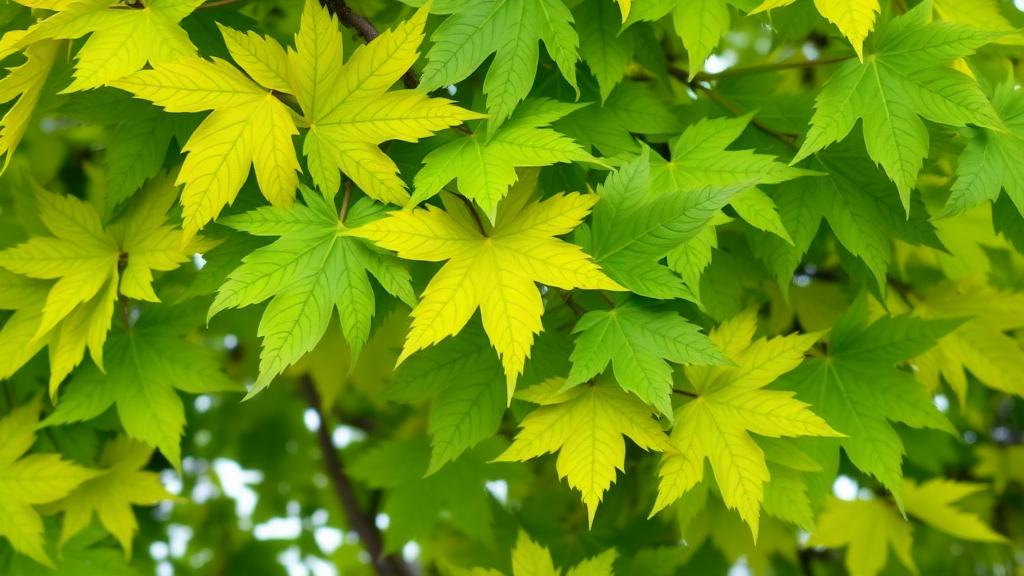
Variegated trees are prized in landscapes for the striking patchwork of yellow and green that they bring to parks, streets and gardens, but that beauty is notoriously fickle. When light conditions change, yellow sectors often fade or quietly revert to green, leaving growers with plants that no longer match the catalog photograph. A new study of the colored poplar cultivar Populus × euramericana ‘Xuanyang 2’, published in BMC Plant Biology, has now dissected exactly what happens inside the leaves of this ornamental hybrid when sunlight is rationed, and the findings carry a surprising twist about whether the variegated trait is truly stable at all.
The research team, led by Ying Xu, Yan Dong, Dandan Chai, Xiaozhi Huang, Longxiao Gao, Jun Zhang and Minsheng Yang of Hebei Agricultural University in Baoding, China, together with a colleague from Tangshan Hongsen Flowers & Trees Planting Co., subjected ‘Xuanyang 2′ saplings to four light regimes: full sunlight as a control, and shade treatments that reduced available light by 30, 50 and 80 percent. Because the leaves of this cultivar carry distinct yellow and green sectors on the same plant, the scientists could compare the two tissue types side by side under identical conditions, an arrangement that turns the chimeric leaf into a natural laboratory for studying how pigment systems respond to light stress.
The physiological measurements told a clear story. Chlorophyll content was significantly higher in the green regions than in the yellow regions under every treatment, and in the green tissue it climbed steadily as shade deepened. The yellow sectors behaved differently: their chlorophyll levels rose at first, peaked under the moderate 50 percent shading treatment, and then declined under the most severe 80 percent shade. In other words, a moderate dimming coaxed extra pigment out of the yellow tissue, while extreme shade pushed it past a tipping point. Net photosynthetic rate, stomatal conductance, initial fluorescence and maximum fluorescence were all significantly lower in the yellow regions than in the green ones, confirming that the yellow sectors are fundamentally weaker photosynthetic machines even before any stress is applied.
Shading also reshuffled the plant’s defensive chemistry, and the two sectors responded in opposite ways. Antioxidant enzymes such as superoxide dismutase, peroxidase and catalase, along with osmolytes like soluble sugars and soluble proteins, were differentially affected in green and yellow tissue depending on the shade intensity. The most telling marker was malondialdehyde, a breakdown product that signals damage to cell membranes from reactive oxygen species. Under the harshest 80 percent shade, malondialdehyde rose sharply in the yellow sectors compared with full sunlight, indicating that the yellow tissue was suffering genuine oxidative stress precisely at the light level where it also began to re-green. The plant, it seems, was rebuilding its photosynthetic apparatus under duress rather than thriving.
Transmission electron microscopy added a physical dimension to the biochemical data. In full sunlight, the chloroplasts inside the yellow sectors displayed conspicuously irregular shapes and blurred membrane boundaries, evidence that these organelles are particularly sensitive to high light intensity and struggle to maintain their architecture when illumination is strong. Under severe shading, the picture changed again: thylakoid membranes, the stacked internal sheets where the light reactions of photosynthesis take place, showed increased local stacking, while dark osmiophilic granules accumulated within the plastids. These ultrastructural shifts mirror the chlorophyll measurements, suggesting that the yellow sectors actively remodel their chloroplasts in an attempt to capture more of the scarce light, with mixed success.
To connect physiology with genetics, the team turned to transcriptomics and network analysis. A graphical Gaussian model, which infers regulatory relationships from correlations among gene expression patterns, identified four top-tier transcription factor families responding to low-light stress: C2H2, MBF1, C2C2-CO-like and HMG. Complementary weighted gene co-expression network analysis, integrated with the physiological measurements, revealed four gene modules significantly correlated with net photosynthetic rate, soluble sugar content, leaf lightness and the yellow-blue color parameter. Within those modules, the transcription factors bZIP, C2H2 and MYB emerged as hub regulators, sitting at the intersection of chloroplast development and pigment synthesis pathways. The implication is that shade does not merely starve the leaf of energy; it rewires a coordinated genetic program that governs how chloroplasts are built and how pigments are made and broken down.
According to the authors’ conclusions, shading promoted chlorophyll synthesis while simultaneously inhibiting chlorophyll degradation, modulated pigment metabolism and altered the expression of light-harvesting protein genes, all under the differential control of MYB, C2C2 and bZIP transcription factors. This dual action, building pigment up and slowing its teardown, explains why the yellow sectors re-greened under shade and why the green sectors deepened their color as light diminished. For nursery growers and landscape designers, the practical message is that the ornamental value of ‘Xuanyang 2’ is highly light-dependent: plant it in deep shade and the golden patches that justify its place in the design may gradually disappear into uniform green.
The most provocative result, however, came from the tissue culture experiments. When the researchers attempted to purify the cultivar through in vitro propagation, the chimeric tissue senesced and died in culture, while stable green plantlets regenerated from the explants. Those regenerated plantlets remained green even when returned to full sunlight, the very condition under which the parent plant displays its yellow variegation. This outcome suggests that the chimeric trait may not be genetically stable, and that the yellow sectors could arise from a non-genetic mechanism rather than a fixed mutation that tissue culture could simply lock in.
The authors point to generational segregation of the variegated traits as further support for a possible non-genetic or epigenetic basis. In classic chimeras, the yellow and green layers carry distinct genotypes, and tissue culture typically allows one genotype to overrun the other, producing either all-yellow or all-green offspring depending on which layer dominates. Here, the fact that only green plantlets survived and stayed green under full light hints that the yellow phenotype depends on an unstable balance between tissue layers or on regulatory states that collapse when the plant is isolated in culture. If confirmed, this would reframe ‘Xuanyang 2’ not as a stable ornamental cultivar but as a living equilibrium whose signature colors exist only as long as the underlying tissues remain in tension.
For the broader plant science community, the study offers a technically rich template for dissecting variegation: paired sector sampling, gradient shading, chlorophyll fluorescence, antioxidant profiling, electron microscopy and co-expression network modeling, all integrated around a single cultivar. It also raises questions that extend beyond ornamental horticulture. Understanding how bZIP, C2H2 and MYB factors coordinate chloroplast biogenesis and pigment turnover under fluctuating light could inform breeding of crops and forestry species that maintain photosynthetic efficiency in shaded environments, from understory plantings to agroforestry systems. Meanwhile, for anyone tempted to plant a golden-leaved poplar along a shaded walkway, the science delivers a caution: the color you buy is a negotiation between the plant’s genome and the light you give it, and in ‘Xuanyang 2’, shade wins the argument.
Subject of Research: Shade-induced leaf color change and tissue culture purification in the variegated poplar cultivar 'Xuanyang 2'
Article Title: Response of colored poplar ‘Xuanyang 2’ to shading and purification by tissue culture
Article References: Xu, Y., Dong, Y., Chai, D., Huang, X., Gao, L., Zhang, J., & Yang, M. (2026). Response of colored poplar ‘Xuanyang 2’ to shading and purification by tissue culture. BMC Plant Biology. https://doi.org/10.1186/s12870-026-10014-w
Image Credits: AI Generated
DOI: 10.1186/s12870-026-10014-w
Keywords: colored poplar, Xuanyang 2, variegation, shading, chlorophyll, chloroplast ultrastructure, photosynthesis, transcription factors, WGCNA, oxidative stress, tissue culture, chimera
Cite Scienmag News
Alan Morgan. (September 30, 2026). Shade Turns Yellow Poplar Leaves Green Again, Revealing Fragile Color Trait. Scienmag. https://scienmag.com/shade-turns-yellow-poplar-leaves-green-again-revealing-fragile-color-trait/
Alan Morgan. "Shade Turns Yellow Poplar Leaves Green Again, Revealing Fragile Color Trait." Scienmag, 30 September 2026, https://scienmag.com/shade-turns-yellow-poplar-leaves-green-again-revealing-fragile-color-trait/. Accessed 4 October 2026.
Alan Morgan. "Shade Turns Yellow Poplar Leaves Green Again, Revealing Fragile Color Trait." Scienmag. September 30, 2026. https://scienmag.com/shade-turns-yellow-poplar-leaves-green-again-revealing-fragile-color-trait/


