


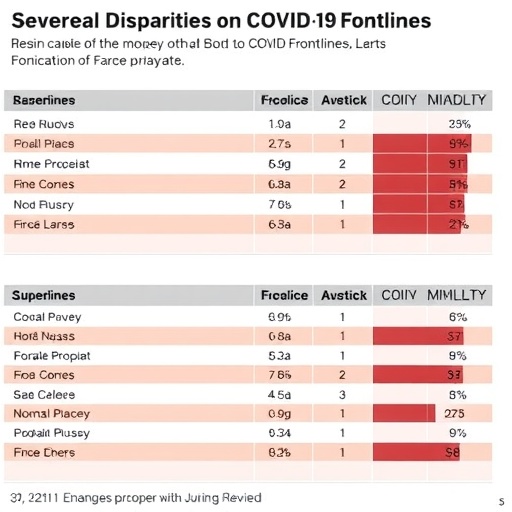
As the COVID-19 pandemic unfolded, the world witnessed an unparalleled strain on healthcare systems, with frontline workers standing as the bulwark against the relentless virus. Yet, beyond the visible heroism and tireless dedication, a darker, more troubling disparity has emerged—one of deep disadvantage in mortality rates among those closest to the viral frontlines. This disparity, as meticulously detailed in a pivotal new study by Heiland, Brite, and Balk, published in Scientific Reports, delves into the nuanced and multifaceted dimensions of mortality disadvantage during the pandemic, shedding light on systemic factors that exacerbate vulnerability and mortality risk.
The research focuses on mortality burdens experienced by healthcare workers, first responders, and essential personnel who faced disproportionate exposure to SARS-CoV-2, the virus responsible for COVID-19. This demographic, despite often receiving public acclaim, bore a disproportionate share of the pandemic’s fatal toll. The study harnesses data across multiple waves of the pandemic, integrating epidemiological statistics with social determinants of health, revealing that the frontline workers’ mortality rates were influenced not merely by viral exposure but by a quagmire of social, economic, and occupational inequities.
At the core of the findings lies the intersectionality of risk factors that compound frontline workers’ vulnerability. Essential workers, especially those from socioeconomically disadvantaged backgrounds, experienced heightened mortality rates linked to inadequate personal protective equipment (PPE) access, higher comorbidities, and intense work schedules that limited timely medical intervention. The researchers underscore how systemic failures in resource distribution disproportionately affected marginalized groups within the frontline workforce, amplifying the deadly consequences of viral exposure.
The study also delves into the intricate biological and environmental pathways that magnify risks. Chronic stressors associated with frontline duty, including prolonged exposure to fear and trauma, are shown to exacerbate immune system dysregulation, potentially increasing susceptibility to severe COVID-19 complications. The physiological impacts of psychosocial stress, coupled with viral pathogenicity, create a lethal synergy that has often gone unrecognized in mainstream discourse but is central to understanding the mortality disparities observed.
One of the most salient technical revelations arises from the temporal analysis of mortality trends. Using advanced statistical modeling, the research identifies specific pandemic phases where mortality risk for frontline workers peaked, correlating these phases with waves of viral variants and fluctuating vaccination rates. This dynamic temporal framework provides critical insights into how evolving virological and immunological landscapes interacted with frontline occupational hazards, shaping differential survival outcomes.
Importantly, the authors contextualize mortality differentials within broader systemic and policy frameworks. They critically evaluate how national and local pandemic response strategies—ranging from lockdown measures to prioritization of vaccine distribution—failed to equitably shield frontline workers. These gaps manifested in delayed vaccinations for critical personnel subsets, inconsistently enforced workplace safety protocols, and insufficient mental health support, all factors that deepened the mortality disadvantage.
Further dissecting sociodemographic variables, the study highlights racial and ethnic disparities embedded within frontline mortality statistics. Minority groups, often overrepresented in low-wage essential jobs, faced compounded risks not only from virus exposure but from structural inequities in healthcare access, housing density, and chronic disease prevalence. The layering of these determinants constructs a grim portrait of systemic vulnerability that transcends mere occupational hazard, signaling urgent policy imperatives to address entrenched social determinants.
Technological and data-analytic methodologies undergirding the research are noteworthy. The authors employed machine learning algorithms to analyze large-scale, multi-modal datasets encompassing clinical records, social indices, and workplace environments. This integrative approach enabled identification of complex, non-linear relationships between exposure levels, social vulnerability indices, and mortality outcomes, setting a new benchmark for pandemic impact research and occupational health sciences.
Moreover, the research extends into post-mortem analysis and genomic sequencing to explore whether viral load and variant-specific pathogenicity differed in occupational cohorts with high mortality. Preliminary genomic data suggest that certain frontline workers, due to sustained high viral loads and repeated exposure, harbored viral quasi-species variants linked to more severe clinical trajectories, although these findings warrant further investigation.
Moral and ethical dimensions permeate the study’s discourse, with the authors calling attention to society’s collective responsibility to protect those who bear the heaviest brunt of pandemics. The pandemic exposed fissures in healthcare equity and occupational safety that amplify mortality risks for frontline workers, highlighting an imperative for robust ethical frameworks in emergency preparedness, including equitable allocation of lifesaving resources and sustained operational support.
Importantly, the study sets a forward-looking agenda for pandemic resilience. It advocates for the institutionalization of comprehensive surveillance systems that monitor frontline worker health in real-time, integrating epidemiological, occupational, and psychosocial data streams. Such systems could facilitate rapid risk stratification and proactive intervention, potentially mitigating mortality disparities in future public health crises.
Critically, the findings impel reconsideration of existing occupational health policies. The disproportionate mortality calls for expanded definition and enforcement of occupational safety standards, encompassing not only physical safety but also mental health provisions, adequate rest periods, and accessible healthcare. Evolving these frameworks to anticipate and address pandemic-specific hazards is posited as essential by the study.
From a global perspective, the study’s implications are profound. The mortality disadvantage delineated transcends national boundaries, revealing common patterns in resource-poor settings where frontline workers operate with minimal protective apparatus. The authors underscore international collaboration and equitable global health financing as pivotal in rectifying these disparities and fortifying pandemic frontline defenses worldwide.
In sum, this comprehensive analysis by Heiland and colleagues unearths stark truths about mortality inequities experienced during the COVID-19 pandemic’s frontline engagements. It weaves a complex narrative of biological vulnerability, social inequity, and systemic neglect that culminated in disproportionate loss of life among those society relied on most. Their work serves not only as a clarion call to remediate these injustices but also as a scientific beacon guiding future pandemic responses toward equity, resilience, and humanity.
Cite Scienmag News
Kristina Jarvis. (April 7, 2026). Severe Mortality Disparities on COVID-19 Frontlines. Scienmag. https://scienmag.com/severe-mortality-disparities-on-covid-19-frontlines/
Kristina Jarvis. "Severe Mortality Disparities on COVID-19 Frontlines." Scienmag, 7 April 2026, https://scienmag.com/severe-mortality-disparities-on-covid-19-frontlines/. Accessed 3 September 2026.
Kristina Jarvis. "Severe Mortality Disparities on COVID-19 Frontlines." Scienmag. April 7, 2026. https://scienmag.com/severe-mortality-disparities-on-covid-19-frontlines/


