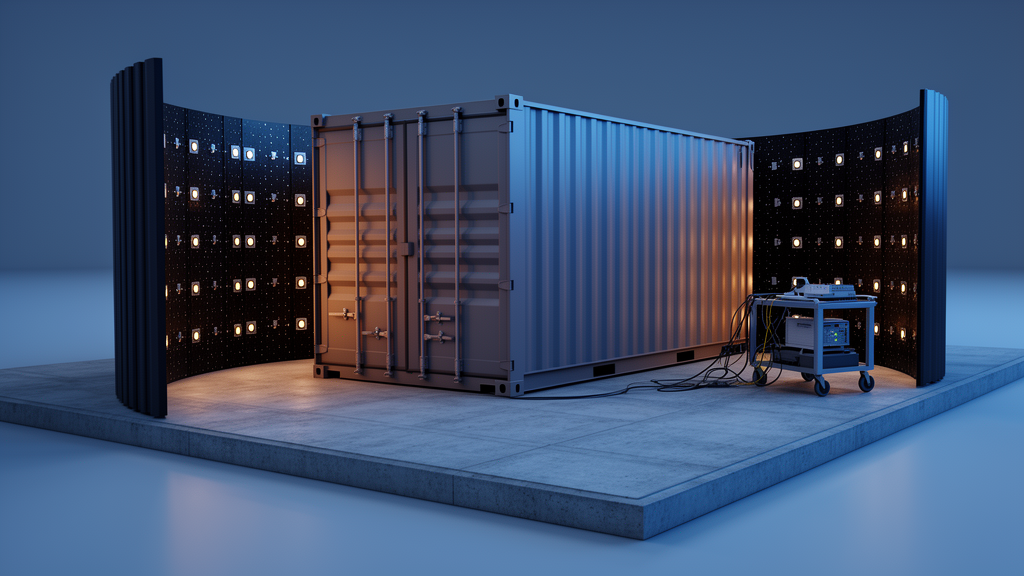
When nuclear material sits at the bottom of a container too large for any conventional detector to wrap around, weighing it without opening the container becomes a genuine measurement problem. A new simulation study published in EPJ Techniques and Instrumentation proposes a way around that constraint: a semi-wrapped neutron multiplicity counter designed to assay kilogram-scale quantities of nuclear material in containers where full 4π detector encapsulation is physically impossible. Using Geant4 Monte-Carlo simulations, a research team optimized a detection system built from 60 helium-3 proportional tubes and found that its configuration could deliver mass estimates with relative errors between 4.76 and 5.60 percent across a simulated range of 1000 to 5000 grams.
The work, led by Shanhong Chen and colleagues, addresses a scenario that is increasingly relevant in nuclear safeguards: materials consisting of enriched uranium and plutonium compounds of known composition resting at the bottom of a container roughly 3 meters by 0.5 meters by 5 meters. Conventional neutron multiplicity counters rely on a 4π geometry, completely surrounding the sample in moderating material such as polyethylene to maximize detection efficiency and minimize statistical uncertainty. That approach works well for compact samples, but it fails when the material is spread across a large area inside a vessel with restricted access. The team’s answer was a detector array that covers only part of the solid angle around the sample, sacrificing some efficiency in exchange for a configuration that can actually be deployed.
Neutron multiplicity counting itself is an established technique in nuclear material accountancy. Unlike simple total neutron counting, which cannot distinguish target signals from background neutrons, or neutron coincidence counting, which depends heavily on empirical calibration standards, multiplicity counting extracts the single, double, and triple neutron count rates from a measurement. From those three rates, the method solves for the spontaneous fission rate, the neutron leakage multiplication, and the ratio of (α,n) reactions to spontaneous fission, all without requiring representative calibration standards. The technique is particularly well suited to samples dominated by spontaneous fission emitters: in the material studied here, curium-244 accounts for approximately 99.3 percent of the total spontaneous fission neutron yield, so the assay reports an effective curium-244 mass that represents the combined contribution of all spontaneous-fission nuclides.
The simulated measurement scenario is deliberately specific. A planar layer of nuclear material with a density of 10.41 grams per cubic centimeter sits at the bottom of a large container with a 2-centimeter-thick Zircaloy shell. The sample region is approximated as two planar zones, and the container’s geometry makes any cylindrical 4π counter infeasible. The detector assembly itself is layered, working from the inside out: stainless steel for structural support, lead shielding to attenuate intense gamma-ray backgrounds from fission products, a stainless steel shell, a cadmium layer that absorbs thermal neutrons scattered back from the sample to sharpen the timing response, and a polyethylene moderator that thermalizes fast neutrons to match the peak absorption cross-section of the helium-3 tubes.
Optimization was systematic. The team evaluated four detector array configurations, including single-layer arrangements of 15, 30, and 60 tubes and a double-layer configuration with 60 tubes in total. The double-layer layout achieved the highest detection efficiency at 12.85 percent, and although it produced a slightly longer neutron die-away time of 35 microseconds, the net gain in efficiency yielded the optimal figure of merit, defined as the detection efficiency divided by the square root of the die-away time. The final figure of merit was 2.17. The researchers also varied the helium-3 fill-gas pressure across 1, 2, 4, and 6 atmospheres, finding that efficiency increased monotonically with pressure; 6 atmospheres was selected to maximize neutron capture probability while balancing practical constraints such as high-voltage breakdown risks and manufacturing costs. An active tube length of 100 centimeters offered the best trade-off between efficiency and die-away time, and it was long enough to fully encompass the spatial extent of the target material.
Shielding and moderator choices were tuned with equal care. Unshielded, the gamma-ray background dose rate peaked at 4.66 gray per hour, far above the 100 milligray per hour limit required by the neutron detectors’ radiation tolerance. A 5-centimeter-thick lead shield reduced the dose rate to 21.5 milligray per hour. Cadmium filters of 0.5, 1, 2, and 3 millimeters were tested with a californium-252 source; as thickness increased, detection efficiency fell while the die-away time shortened, and 2 millimeters achieved the optimal balance. The high-density polyethylene moderator was optimized over a range of 15.5 to 50 millimeters, with efficiency peaking at 20 millimeters. Beyond that threshold, parasitic neutron capture by hydrogen nuclei dominates and efficiency declines, while the die-away time increases monotonically with moderator volume.
For context, the optimized system’s performance sits below that of state-of-the-art 4π counters, and the authors are explicit about why. The Plutonium Scrap Neutron Multiplicity Counter achieves a detection efficiency of 55 percent with a die-away time of 47 microseconds, and the Scrap Neutron Multiplicity Counter reaches 66.3 percent efficiency with a die-away time of 40.9 microseconds. The semi-wrapped array, with its relatively large radius and limited number of detectors, cannot match those figures. What it does achieve, however, is a die-away time of 35 microseconds, shorter than that of conventional commercial multiplicity instruments, and a configuration that can operate where those instruments cannot be installed at all.
The performance verification relied on simulations of five nuclear material samples with masses ranging from 1000 to 5000 grams, with sample mass varied primarily by adjusting the height of the fuel assembly while keeping the radial geometry and isotopic composition constant. For each sample, the team recorded the single, double, and triple neutron count rates and used them to infer the sample mass, the leakage multiplication factor, and the (α,n)-to-spontaneous-fission ratio. The relative error of the inferred mass fluctuated stably between 4.76 and 5.60 percent throughout the range, without a significant trend with increasing sample mass, which the authors interpret as evidence of consistent linearity and reliability across the tested range. The leakage multiplication factor showed a clear upward trend with increasing total heavy metal mass, consistent with neutron multiplication physics: a taller fuel column improves the geometric efficiency for neutron interaction and raises the probability of induced fission chains. The α value, by contrast, fluctuated within 0.025 to 0.045 without a clear monotonic dependence on mass, suggesting it is governed primarily by isotopic composition and burnup characteristics rather than sample geometry.
It is important to be clear about what this study does and does not demonstrate. All results come from Geant4 Monte-Carlo simulations using the QGSP_BIC_HP physics list with the G4NDL4.7.1 evaluated neutron data library, with each simulation run corresponding to an effective simulated time of 1000 seconds. The multiplicity analysis was implemented in the ROOT framework and mimics the logic of a shift-register circuit, applying a pre-delay, a real-plus-accidental gate, and an accidental gate to extract the net count rates. No experimental validation has yet been carried out; the authors state that future research will focus on experimental validation, the integration of machine learning for parameter inversion, and application to mixed-oxide fuels. The reported efficiencies and mass errors are therefore model predictions for a specific simulated scenario, not measurements from a built instrument.
Even so, the study fills a documented gap in safeguards methodology. Non-destructive analysis underpins nuclear material accountancy during storage, transportation, and reprocessing, and gamma-ray spectrometry, the other main NDA approach, is limited by self-absorption of low-energy gamma rays in high-density materials and interference from high radiation backgrounds. Neutron signals penetrate more readily and are more specific to fissionable materials, but existing multiplicity counters assume geometries that large containers preclude. By demonstrating in simulation that a semi-wrapped configuration can achieve performance metrics comparable to traditional 4π systems while operating under restricted access conditions, the authors offer a transferable design framework for next-generation non-destructive assay systems. As storage scenarios for nuclear materials become more diverse, detector architectures that adapt to constrained spaces rather than demanding idealized geometries may become an increasingly important part of the verification toolkit.
Subject of Research: Simulation-based design of a semi-wrapped neutron multiplicity counter for assaying nuclear materials in large-volume containers
Article Title: Neutron multiplicity counting for mass determination of nuclear materials in large-volume containers
Article References: Chen, S., Huang, Y., Zhang, W., Song, Y., Hu, X., Yang, K., Wang, X., & Chang, X. (2026). Neutron multiplicity counting for mass determination of nuclear materials in large-volume containers. EPJ Techniques and Instrumentation, 13(1), Article 4. https://doi.org/10.1140/epjti/s40485-026-00122-0
Image Credits: AI Generated
DOI: 10.1140/epjti/s40485-026-00122-0
Keywords: neutron multiplicity counting, nuclear safeguards, non-destructive assay, Geant4 simulation, helium-3 detectors, die-away time, detection efficiency, curium-244, spontaneous fission, neutron moderation, EPJ Techniques and Instrumentation, mass determination
Cite Scienmag News
Katie Riggs. (October 27, 2026). Semi-Wrapped Neutron Detector Simulated to Weigh Nuclear Material in Oversized Containers. Scienmag. https://scienmag.com/semi-wrapped-neutron-detector-simulated-to-weigh-nuclear-material-in-oversized-containers/
Katie Riggs. "Semi-Wrapped Neutron Detector Simulated to Weigh Nuclear Material in Oversized Containers." Scienmag, 27 October 2026, https://scienmag.com/semi-wrapped-neutron-detector-simulated-to-weigh-nuclear-material-in-oversized-containers/. Accessed 28 October 2026.
Katie Riggs. "Semi-Wrapped Neutron Detector Simulated to Weigh Nuclear Material in Oversized Containers." Scienmag. October 27, 2026. https://scienmag.com/semi-wrapped-neutron-detector-simulated-to-weigh-nuclear-material-in-oversized-containers/