


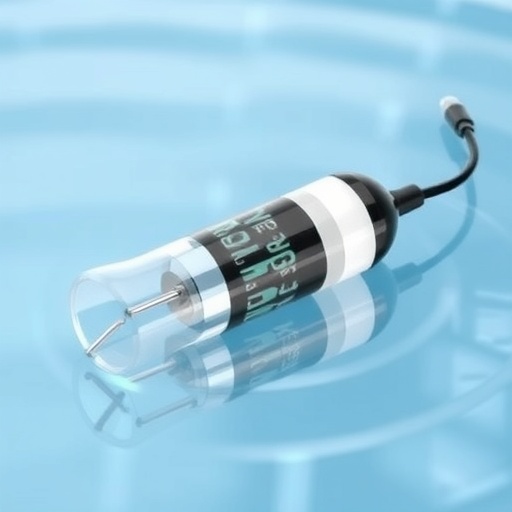
In a groundbreaking advancement poised to revolutionize global access to safe drinking water, researchers have unveiled a self-powered, floating capsule that simultaneously detects chemical pollutants and disinfects water without the need for external power sources or chemical additives. This innovative device brings hope to communities worldwide facing water safety challenges, particularly in regions where infrastructure and resources are limited. The device’s seamless integration of chemical sensing and microbial disinfection in a single, user-friendly platform addresses a critical barrier to equitable water access and quality.
At its core, the capsule detects total dissolved solids (TDS) as a proxy for chemical contaminants, offering rapid assessments of water quality. TDS commonly includes inorganic salts and small amounts of organic matter that affect water’s chemical safety. By using TDS as an indicator, the capsule provides an essential first layer of analysis to determine water safety concerning chemical pollutants. This approach obviates the need for complex and costly laboratory analyses that are inaccessible in many parts of the world. The ability to autonomously monitor TDS levels empowers users with immediate knowledge about their water’s chemical status.
What makes this capsule truly remarkable is its complete energy independence. The device harnesses energy solely from manual agitation—shaking by hand for just three seconds—transforming this simple mechanical motion into electrical power through an electromagnetic induction mechanism integrated within the capsule. This self-sufficiency removes reliance on batteries, electricity grids, or solar power, enabling deployment in the most remote and resource-constrained environments without concerns over recharging or maintenance. The democratization of water testing becomes achievable through this elegant energy harvesting design.
Once chemical safety is confirmed by measuring TDS below a critical threshold, the capsule autonomously initiates its microbial disinfection function. It achieves this using a unique electrostatic field generation system embedded in its dielectric outer shell. The gentle movements of the water propel the capsule, causing its dielectric surface to collect electrostatic charges at the water–dielectric interface. The charges then concentrate at the tips of nanorod structures on the capsule surface, creating intense local electric fields capable of damaging microorganisms through electroporation—a process where cell membranes are disrupted by high voltage, leading to microbial death without chemical disinfectants.
The electroporation mechanism implemented here offers a chemical-free disinfection strategy that circumvents common issues associated with chlorine or other chemical disinfectants, such as byproduct formation, taste and odor problems, and residual toxicity. By relying on a physical disruption of pathogen membranes, the capsule ensures effective microbial inactivation, achieving greater than six-log reductions (over 99.9999% removal) of microbial contaminants. This level of performance rivals traditional disinfection approaches, making the capsule a viable alternative in scenarios where chemical additives are undesirable or impractical.
Durability and scalability are also highlighted features of this floating sensor-disinfector. The device has been engineered to function effectively over at least 120 disinfection cycles without degradation of performance. Its robust design and cost-effective materials contribute to an affordable price point under $25 per unit, an essential consideration for widespread adoption, especially in low-income regions where cost constraints are paramount. Such longevity paired with affordability positions this device as a potent tool to improve water safety on a large scale.
Moreover, the capsule’s ability to float and operate in various container sizes enhances its versatility. It can be deployed in household water storage containers, small-scale reservoirs, or natural water bodies by simply tossing it into the water and shaking briefly. No specialized training or additional equipment is required, fostering user-friendly operation across diverse populations. This accessibility is critical to enabling decentralized water quality monitoring and treatment, empowering individuals and communities to take proactive control over their drinking water safety.
Connecting the dots between sensing and intervention, the integration of Bluetooth technology allows the capsule to transmit real-time TDS readings wirelessly to a smartphone or remote monitoring system. This feature facilitates centralized data aggregation for water quality management at community or municipal levels and enables early warning for contamination incidents. Such digital connectivity promotes data-driven water safety strategies, bridging the gap between field measurements and policy decision-making processes.
The design ethos underlying this capsule emphasizes sustainability and minimal environmental footprint. By eschewing chemicals and external power requirements, it reduces waste generation and ecological impact compared to conventional water treatment methods reliant on chemical dosing or energy-intensive infrastructure. Its biodegradable or recyclable materials further align with green technology principles, enhancing environmental stewardship while delivering vital public health benefits.
Scientifically, this innovation intersects multiple disciplinary domains, including materials science, environmental engineering, microbiology, and energy harvesting technology. The sophisticated interplay of electromagnetic induction for energy capture paired with advanced electrostatic surface engineering illustrates how cutting-edge nanotechnology and physics can be harnessed to tackle pressing environmental health challenges. The research team’s multidisciplinary approach underscores the importance of cross-field collaboration in generating transformative solutions.
Looking ahead, further research could explore enhancements such as expanding the detection capabilities beyond TDS to include specific chemical contaminants or biological markers, thereby widening the capsule’s diagnostic scope. Integration with advanced data analytics and predictive modeling could enable anticipatory water quality management, preempting contamination episodes before they reach hazardous levels. Such developments would amplify the device’s impact and utility in safeguarding drinking water supplies globally.
In sum, this self-powered floating capsule represents a significant technological leap in decentralized water quality assurance. By combining rapid chemical detection, autonomous microbial disinfection, and wireless connectivity within an accessible, low-cost, and energy-independent device, it redefines what is achievable outside centralized water treatment systems. As water scarcity, pollution, and infrastructure deficits persist worldwide, innovations like this provide tangible, scalable pathways toward universal safe water access, directly contributing to improved public health and resilience against waterborne diseases.
The implications for public health policy and community empowerment are profound. Deploying these capsules in underserved regions can dramatically reduce exposure to contaminated water, cutting incidence rates of diarrheal diseases and other infections caused by waterborne pathogens. Their ease of use fosters community engagement in water safety initiatives, raising awareness and education alongside technological intervention. Such grassroots empowerment is essential in achieving the United Nations’ Sustainable Development Goal 6: universal access to clean water and sanitation.
With its compelling blend of practicality, scientific ingenuity, and social relevance, the floating capsule has captured the imagination of the water research community and public health advocates alike. As commercial production ramps up and field trials begin in diverse environments, this innovation could become a mainstay in global efforts to secure safe drinking water for millions. Its story is a testament to how simple yet sophisticated design can bridge critical gaps in environmental health technologies and deliver real-world impact.
Park et al.’s work elegantly encapsulates the potential to transcend conventional water safety paradigms through innovative engineering, marking a pivotal moment in the ongoing quest for sustainable, equitable water solutions. Their chemical- and energy-independent device offers a blueprint for future water treatment technologies that harmonize user autonomy, environmental sensitivity, and cutting-edge science. As water challenges evolve, such pioneering research lights the path toward resilient and inclusive water security worldwide.
Cite Scienmag News
Violet Maxwell. (June 8, 2026). Self-Powered Floating Capsule Enables Water Detection, Disinfection. Scienmag. https://scienmag.com/self-powered-floating-capsule-enables-water-detection-disinfection/
Violet Maxwell. "Self-Powered Floating Capsule Enables Water Detection, Disinfection." Scienmag, 8 June 2026, https://scienmag.com/self-powered-floating-capsule-enables-water-detection-disinfection/. Accessed 5 September 2026.
Violet Maxwell. "Self-Powered Floating Capsule Enables Water Detection, Disinfection." Scienmag. June 8, 2026. https://scienmag.com/self-powered-floating-capsule-enables-water-detection-disinfection/


