


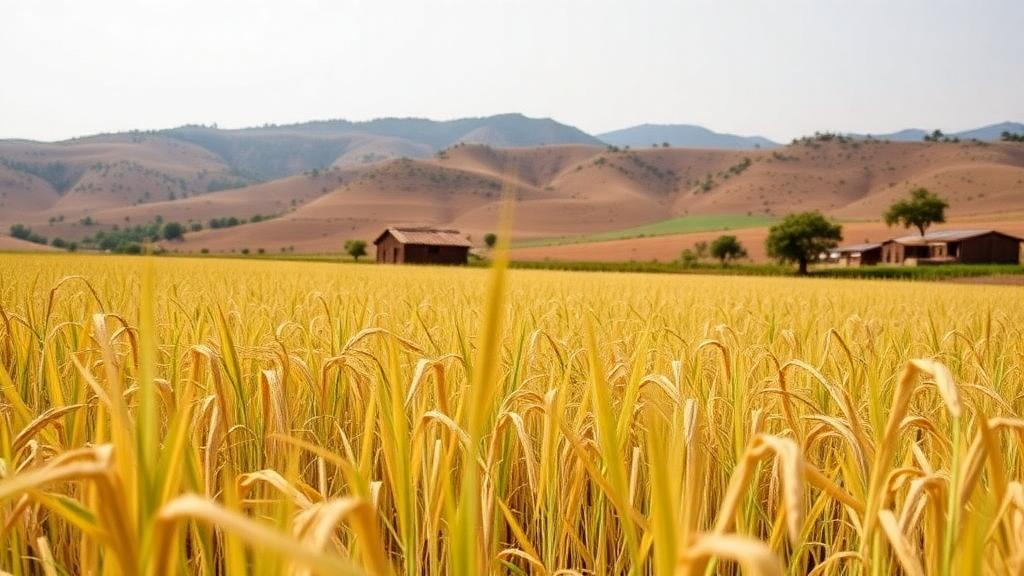
In the central highlands of Ethiopia, a tiny grain with an outsized cultural footprint is getting a careful agronomic overhaul. Teff, the staple cereal ground into the spongy flatbread injera, covers close to three million hectares of Ethiopian farmland, yet the yields farmers actually harvest remain far below what the crop’s genetics should allow. A new field study from Mojana Wodera Woreda, published in PLOS One by Yemanebirhane Tesfa, Fresew Belete, and Wondwosen Tena, demonstrates that closing that gap is not a matter of tweaking one variable at a time. Instead, the variety a farmer chooses, the rate at which seed is sown, and the method used to place that seed in the soil interact with one another in ways that can make or break a season.
The research team set up a factorial experiment that crossed three teff varieties with three seed rates and three sowing methods. The varieties included Quncho and Kora, both improved releases, alongside Abolse, a local landrace that farmers in the area have long relied upon. Seed rates of 10, 15, and 20 kilograms per hectare reflected the spectrum of practice commonly seen in the highlands, where farmers often oversow in the belief that more seed means more plants and, ultimately, more grain. The sowing methods compared traditional broadcasting, in which seed is scattered by hand across the surface, with row planting at 15-centimeter and 20-centimeter inter-row spacings, a technique increasingly promoted by extension services because it makes weeding and management easier.
The statistical outcome was unambiguous: the three-way interaction of variety, seed rate, and sowing method significantly affected crop growth and yield parameters at a probability level below 0.01. In practical terms, no single recommendation could be extracted from the data and applied universally. A variety that performed well under one combination of spacing and seed rate did not necessarily hold that advantage under another. This kind of interactive response is exactly what agronomists expect when a crop’s architecture, its competition for light and nutrients, and its susceptibility to lodging are all shaped simultaneously by how densely it stands and how its seeds are distributed in the field.
Some of the most striking results concerned plant height and biomass. The tallest plants, measuring 128.33 centimeters, came from the variety Quncho when it was sown in rows 20 centimeters apart at the lowest seed rate of 10 kilograms per hectare. Wider spacing at a lower density evidently gave individual plants room to elongate, reducing aboveground competition during the vegetative phase. Aboveground biomass, the total weight of stems, leaves, and panicles produced per unit area, peaked at 10.76 tonnes per hectare with a different combination: Quncho sown at 10 kilograms per hectare in rows spaced 15 centimeters apart. The contrast between the two combinations shows how different objectives, such as maximizing forage versus maximizing eventual grain, may call for different field layouts even with the same variety and seed rate.
Lodging, the tendency of cereal stems to bend or collapse under their own weight, emerged as a critical limiting factor and one of the study’s most consequential findings. The highest lodging index, 44 percent, was recorded when Quncho was broadcast at the highest seed rate of 20 kilograms per hectare. Dense, uniformly scattered stands produce crowded plants that stretch for light, grow taller and thinner-stemmed, and then fall over, often in response to wind or rain. Lodged teff is notoriously difficult to harvest, suffers grain losses, and can spoil in contact with wet soil. The data suggest that the very practices many farmers use to chase higher yields, thick broadcasting of an improved, high-potential variety, can instead push the crop toward structural failure.
Beyond the interaction effects, each factor on its own left a measurable imprint on the crop’s development. Seed rate, sowing method, and variety all significantly influenced the number of days to 50 percent heading, the point at which half the plants in a plot have produced their flowering heads, with a significance threshold below 0.05. Variety Kora was the slowest, taking 59.18 days to reach 50 percent heading, a meaningfully longer duration than either Quncho or the local Abolse. In highland environments where the growing season is bounded by unreliable rains, maturity time is not a trivial trait; later heading can expose the crop to end-of-season moisture stress and shorten the window for grain filling.
Sowing method and seed rate also shifted the crop’s timetable. Widening the row spacing to 20 centimeters prolonged the time to 50 percent heading across the varieties tested, while sowing at 15 kilograms per hectare likewise delayed heading compared with other rates. These phenological shifts matter for farmers synchronizing planting with rainfall patterns, and they illustrate that agronomic choices ripple through the entire life cycle of the crop, not just its final yield. A decision made at sowing about how far apart to place rows can determine whether the crop flowers before the rains taper off or weeks after.
When it came to the harvest itself, the variety effect dominated. Quncho produced the longest panicle, at 45.14 centimeters, and the highest grain yield, at 2.47 tonnes per hectare. That figure represents a 15.96 percent advantage over Kora and a 26.67 percent advantage over the local Abolse variety, margins that at field scale translate into substantial additional food and income for farming households. Sowing method made its own contribution: teff planted in rows 20 centimeters apart achieved the maximum panicle length of 44.46 centimeters and a grain yield of 2.32 tonnes per hectare, outperforming both the narrower 15-centimeter spacing and broadcasting. Among seed rates, the lowest tested rate, 10 kilograms per hectare, produced the highest grain yield and the largest panicles, a result that challenges the intuition that spending more on seed pays for itself.
The economic and practical implications of that last finding are considerable. If 10 kilograms of seed per hectare outyields 15 and 20 kilograms, farmers can simultaneously cut their seed costs and raise their harvests, provided they also adopt row planting and an appropriate improved variety. Lower seed rates also mean thinner stands, which in this study correlated with reduced lodging risk, though the lodging index peaked specifically under the broadcast, high-density treatment. For a crop that anchors the diet and the farming identity of millions of Ethiopians, a package combining variety selection, reduced seed rate, and row planting offers a rare triple win: more grain, less seed expense, and more resilient stands that stay upright through the storms of the highland rainy season.
The study’s authors frame the results as evidence that teff productivity in the central highlands depends on managing the cropping system as an integrated whole rather than adjusting inputs one at a time. The three-way interactions they documented, significant at the one percent level, mean that extension recommendations calibrated for one variety or one district may not transfer cleanly to another. As Ethiopia works to lift teff yields toward the crop’s genetic potential across its three million hectares, findings like these point toward a more precise agronomy: matching the right variety to the right seed rate and sowing method for local conditions, and in Mojana Wodera at least, that match appears to favor Quncho, low seed rates, and wide rows over the thick broadcast sowings of tradition.
Subject of Research: Interactive effects of seed rate, sowing method, and variety on teff yield and lodging in the central highlands of Ethiopia
Article Title: Interactive effects of seed rate, sowing method, and variety on Teff ( Eragrostis tef ) yield, yield components, and lodging trait performance in the central highlands of Ethiopia
Article References: Tesfa, Y., Belete, F., & Tena, W. (2026). Interactive effects of seed rate, sowing method, and variety on Teff (Eragrostis tef) yield, yield components, and lodging trait performance in the central highlands of Ethiopia. PLOS One, 21(10), e0360297. https://doi.org/10.1371/journal.pone.0360297
Image Credits: AI Generated
DOI: 10.1371/journal.pone.0360297
Keywords: teff, Eragrostis tef, Ethiopia, seed rate, sowing method, row planting, broadcasting, lodging, grain yield, varietal performance, highlands, agronomy
Cite Scienmag News
Alan Morgan. (October 13, 2026). Seed Rate, Sowing Method, and Variety Team Up to Shape Teff Yields in Ethiopia’s Highlands. Scienmag. https://scienmag.com/seed-rate-sowing-method-and-variety-team-up-to-shape-teff-yields-in-ethiopias-highlands/
Alan Morgan. "Seed Rate, Sowing Method, and Variety Team Up to Shape Teff Yields in Ethiopia’s Highlands." Scienmag, 13 October 2026, https://scienmag.com/seed-rate-sowing-method-and-variety-team-up-to-shape-teff-yields-in-ethiopias-highlands/. Accessed 13 October 2026.
Alan Morgan. "Seed Rate, Sowing Method, and Variety Team Up to Shape Teff Yields in Ethiopia’s Highlands." Scienmag. October 13, 2026. https://scienmag.com/seed-rate-sowing-method-and-variety-team-up-to-shape-teff-yields-in-ethiopias-highlands/


