

Friday, September 4, 2026
Science
No Result
View All Result
  • Login
  • HOME
  • SCIENCE NEWS
  • CONTACT US
  • HOME
  • SCIENCE NEWS
  • CONTACT US
No Result
View All Result
Scienmag
No Result
View All Result
Home Science News Marine

Seawater barium and sulfide removal improved marine habitability for the Cambrian Explosion of early animals

August 2, 2024
in Marine
Violet Maxwell
By Violet Maxwell Scienmag Editorial Profile - Natural Hazards
Reading Time: 3 mins read
0
Seawater barium and sulfide removal improved marine habitability for the
66
SHARES
603
VIEWS
Share on FacebookShare on Twitter
ADVERTISEMENT

This study is led by Dr. Wei Wei, PhD student Lin-Hui Dong, and Prof. Fang Huang at the University of Science and Technology of China. Excess barium contents (Baexcess) and isotope compositions (δ138Baexcess) were analyzed by Lin-Hui Dong at the State Key Laboratory of lithospheric and Environmental Coevolution. She noticed that there is a negative logarithmic correlation between the Baexcess and δ138Baexcess values. Such a relationship indicates a Rayleigh-type fractionation associated with Ba removal from a protected basin of the Yangtze Block.

Barium removal and the Cambrian Explosion

Credit: ©Science China Press

This study is led by Dr. Wei Wei, PhD student Lin-Hui Dong, and Prof. Fang Huang at the University of Science and Technology of China. Excess barium contents (Baexcess) and isotope compositions (δ138Baexcess) were analyzed by Lin-Hui Dong at the State Key Laboratory of lithospheric and Environmental Coevolution. She noticed that there is a negative logarithmic correlation between the Baexcess and δ138Baexcess values. Such a relationship indicates a Rayleigh-type fractionation associated with Ba removal from a protected basin of the Yangtze Block.

The correlation between ln(Baexcess) and δ138Baexcess yields an isotope fractionation of –0.22 ± 0.03‰, well consistent with the equilibrium fractionation between the barite and fluid from first-principle calculations (–0.23 ± 0.04‰). “Enhanced barite precipitation and subsequent sedimentation were responsible for the Ba enrichments in the lower Cambrian metalliferous black shales”, Lin-Hui says.

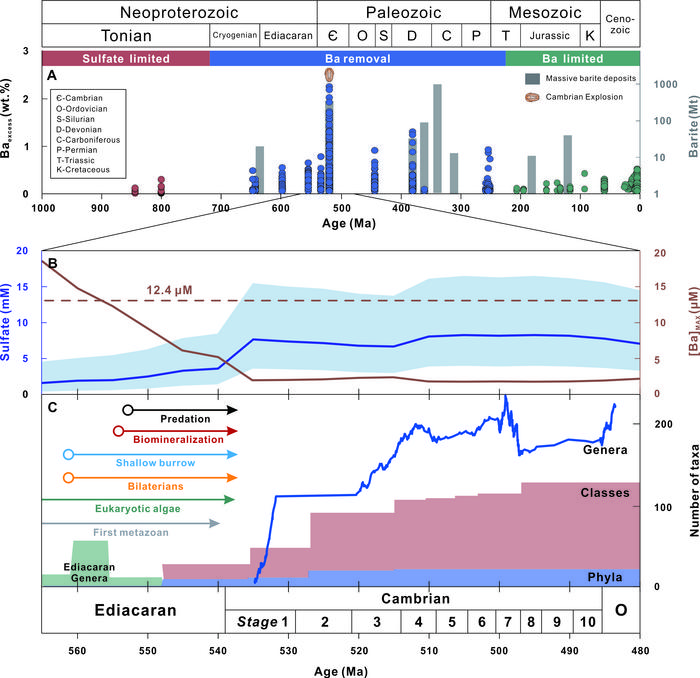
Barite precipitation in the marine system requires a nexus of Ba- and sulfate-bearing solutions. A replete and homogeneous Ba reservoir that should be isotopically light, might have existed in the predominantly anoxic to euxinic protected basin during the Ediacaran and the earliest Cambrian. The sulfate source may have come from the upwelling of sulfate-sufficient deep seawater. As the upwelled seawater migrated onshore toward the northwest of the basin, both sulfate and Ba concentrations decreased while the δ138Ba value increased progressively due to Rayleigh-type distillation related to barite precipitation. “The spatial patterns of the Baexcess and δ138Baexcess suggest the deep-ocean oxygenation at ca. 521 Ma”, Wei Wei says.

A sensitivity analysis reveals that the majority (>99%) of the replete and homogeneous Ba reservoir in the protected basin had been scavenged at ca. 521 Ma. Such Ba removal should not be restricted to the protected basin of the Yangtze Block during the early Cambrian. From the late Ediacaran to early Cambrian, the progressive oxygenation of deep oceans, could have increased the sulfate reservoir via oxidation of sulfide and concurrently decreased the Ba reservoir by barite precipitation. Coincidently, animal diversity rapidly increased and genus-level diversity reached the first peak at the onset of the Cambrian Stage 3. Soluble Ba compounds are toxic to marine animals. “It is plausible that the removal of toxic Ba and H2S corresponding to marine oxygenation may have ultimately expanded the habitable area and paved the road for further radiation of early animals”, Fang Huang says.


See the article:

Seawater barium removal improved marine habitability for Cambrian Explosion of early animals


Journal

National Science Review

DOI

10.1093/nsr/nwae237

Subject of Research: Marine

Article Title: Seawater barium and sulfide removal improved marine habitability for the Cambrian Explosion of early animals

Article References: Original research article

Image Credits: AI Generated

DOI: Not provided

Keywords: Not provided

Cite Scienmag News

Violet Maxwell. (August 2, 2024). Seawater barium and sulfide removal improved marine habitability for the Cambrian Explosion of early animals. Scienmag. https://scienmag.com/seawater-barium-and-sulfide-removal-improved-marine-habitability-for-the-cambrian-explosion-of-early-animals/

Violet Maxwell. "Seawater barium and sulfide removal improved marine habitability for the Cambrian Explosion of early animals." Scienmag, 2 August 2024, https://scienmag.com/seawater-barium-and-sulfide-removal-improved-marine-habitability-for-the-cambrian-explosion-of-early-animals/. Accessed 4 September 2026.

Violet Maxwell. "Seawater barium and sulfide removal improved marine habitability for the Cambrian Explosion of early animals." Scienmag. August 2, 2024. https://scienmag.com/seawater-barium-and-sulfide-removal-improved-marine-habitability-for-the-cambrian-explosion-of-early-animals/

Share26Tweet17
Previous Post

KTU researchers’ eye-tracking study provides valuable insights into learning mathematics

Next Post

Machine learning: Geometry ensures more reliable results

Related Posts

Tiny beach creatures reveal how microplastics move through food webs
Marine

Tiny beach creatures reveal how microplastics move through food webs

September 4, 2026
Applied nucleation helps restore vast marine forests from small starts
Marine

Applied nucleation helps restore vast marine forests from small starts

September 4, 2026
Fish-prawn hybrid observed walking backward for the first time
Marine

Fish-prawn hybrid observed walking backward for the first time

September 3, 2026
Making climate governance actionable: a corpus-based analysis of institutionalizing climate change in tuna fisheries governance
Marine

Making climate governance actionable: a corpus-based analysis of institutionalizing climate change in tuna fisheries governance

September 3, 2026
Federal research chair program brings two global scholars to UVic
Marine

Federal research chair program brings two global scholars to UVic

September 3, 2026
Climate-smart marine planning framework designed to support biodiversity goals
Marine

Climate-smart marine planning framework designed to support biodiversity goals

August 29, 2026
Next Post
Machine learning: Geometry ensures more reliable results

Machine learning: Geometry ensures more reliable results

  • Mothers who receive childcare support from maternal grandparents show more optimized

    Mothers who receive childcare support from maternal grandparents show more parental warmth, finds NTU Singapore study

    27656 shares
    Share 11059 Tweet 6912
  • University of Seville Breaks 120-Year-Old Mystery, Revises a Key Einstein Concept

    1061 shares
    Share 424 Tweet 265
  • Bee body mass, pathogens and local climate influence heat tolerance

    682 shares
    Share 273 Tweet 171
  • Researchers record first-ever images and data of a shark experiencing a boat strike

    546 shares
    Share 218 Tweet 137
  • Groundbreaking Clinical Trial Reveals Lubiprostone Enhances Kidney Function

    531 shares
    Share 212 Tweet 133
Science

Embark on a thrilling journey of discovery with Scienmag.com—your ultimate source for cutting-edge breakthroughs. Immerse yourself in a world where curiosity knows no limits and tomorrow’s possibilities become today’s reality!

RECENT NEWS

  • Fungal vesicles spur ovarian cancer growth via JAK2/STAT3 macrophage switch
  • Scientists create 3D-printed device for heating and magnetic stirring
  • Optimizing MICP-enhanced underwater repair grout mix designs with data-driven methods
  • Plant polyphenol extracts boost surimi gel quality and prevent oxidation

Categories

  • Agriculture
  • Anthropology
  • Archaeology
  • Athmospheric
  • Biology
  • Biotechnology
  • Blog
  • Bussines
  • Cancer
  • Chemistry
  • Climate
  • Earth Science
  • Editorial Policy
  • Marine
  • Mathematics
  • Medicine
  • Pediatry
  • Policy
  • Psychology & Psychiatry
  • Science Education
  • Social Science
  • Space
  • Technology and Engineering

Subscribe to Blog via Email

Enter your email address to subscribe to this blog and receive notifications of new posts by email.

Join 5,151 other subscribers

© 2025 Scienmag - Science Magazine

Welcome Back!

Login to your account below

Forgotten Password?

Retrieve your password

Please enter your username or email address to reset your password.

Log In
No Result
View All Result
  • HOME
  • SCIENCE NEWS
  • CONTACT US

© 2025 Scienmag - Science Magazine

Discover more from Science

Subscribe now to keep reading and get access to the full archive.

Continue reading