


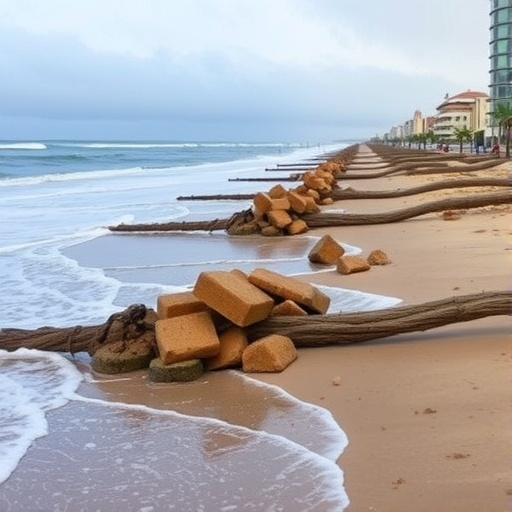
Rising tides threaten to redefine coastal flooding along Spain’s Mediterranean shores, according to a groundbreaking study published in Communications Earth & Environment. The research highlights how incremental sea-level increases will significantly alter the dynamics of compound flooding—a phenomenon arising when various flooding drivers such as storm surges, high tides, and heavy precipitation converge simultaneously, amplifying coastal hazard risk. While microtidal environments, characterized by small tidal ranges, may have been perceived as relatively less vulnerable, this new research underscores their susceptibility to complex flood events under future climatic shifts.
The study meticulously combines hydrodynamic modeling with regional climate projections to simulate flood scenarios under rising sea levels specifically targeting microtidal zones—a classification that accounts for tidal variations typically under two meters. Along the Mediterranean coast of Spain, where coastal topography and urban development intersect with limited tidal fluctuations, the interplay of storm surge, river discharge, and mean sea-level rise produces a unique confluence of conditions that exacerbate flooding. These zones face an elevated risk of compound events unlike more macro-tidal systems, where tidal cycles significantly modulate flood severity.
One of the key technical breakthroughs in this research is the application of advanced numerical models that incorporate nonlinear interactions between different flooding drivers. Unlike linear additive approaches previously prevalent, the study employs sophisticated hydrodynamic tools allowing for emergent behaviors, including feedback loops between storm surge elevation and wave-driven overtopping under higher baseline sea levels. This method reveals how small increases in mean sea level can disproportionately magnify flooding potential, especially in heavily urbanized estuaries and river mouths where drainage capacity is restricted.
The researchers detail the methodology wherein diverse datasets, including high-resolution Digital Elevation Models (DEMs), localized meteorological records, and river flow projections, were integrated into a coupled modeling framework. This synergy between atmospheric, oceanic, and terrestrial components provides an unprecedented nuanced forecast of flood risk at a fine spatial scale. By simulating a range of sea-level rise scenarios consistent with the latest IPCC projections, the study captures the escalating likelihood of extreme compound flooding events during storm seasons over the coming decades.
Their findings paint a sobering picture of increasing flood hazard frequencies, with up to a threefold rise in the occurrence of extreme compound flooding events by 2100 under intermediate emissions scenarios. Importantly, the vulnerability is not uniform throughout the coast—localized geomorphology and urban infrastructure modulate the impact severity. Deltas, estuaries, and low-lying beach plains exhibit pronounced shifts in flood hazard patterns, often exacerbated by constrained drainage and human modifications to natural watercourses.
This research echoes growing concerns about the multifaceted nature of climate impacts on coastal resilience. Sea-level rise does not merely raise the baseline water level but redefines the system’s hydrodynamic thresholds, effectively altering how storm surges and riverine floods interact. For microtidal environments, where tidal action contributes minimal mitigating influence, this translates into a heightened frequency of coincident events. Consequently, traditional flood defense strategies based solely on historical tidal or river flow records risk severe underestimation of future hazards.
The study offers policy-relevant insights by emphasizing the need for integrated coastal zone management that accounts for compound flooding. Recognizing the nonlinear amplification effects documented, planners and engineers should move beyond single-hazard frameworks, adopting multifactorial risk assessments to inform infrastructure design and emergency preparedness. Upgrading drainage systems, reinforcing natural buffer zones like wetlands, and recalibrating floodplain zoning are identified as critical adaptive measures to accommodate projected compound flood magnitudes.
Furthermore, the paper pioneers an approach to flood risk communication by connecting advanced scientific understanding with real-world societal implications. This articulation bridges the gap between complex model outputs and actionable knowledge for stakeholders ranging from municipal authorities to vulnerable communities. By visualizing compound risk in forecast maps with probabilistic interpretations, the researchers strive to enhance public awareness and foster proactive mitigation investments.
At the scientific frontier, the findings provoke important questions about feedback mechanisms within coastal systems under future climate uncertainties. The interplay between episodic heavy precipitation events—expected to intensify in Mediterranean climates—and storm-driven marine inundation introduces nonlinear thresholds that challenge existing predictive paradigms. Continuous improvements in observing networks and machine learning-driven model refinement are paramount to capturing these emergent dynamics with greater precision.
In essence, the study becomes a seminal work illustrating that microtidal Mediterranean coastlines, long underestimated for their flooding vulnerability, are on the cusp of profound environmental shifts driven by rising seas. The compound nature of coastal floods engenders risks far beyond what individual factors would suggest, demanding a reconceptualization of how we assess, communicate, and prepare for coastal climate hazards. This sets the stage for future research integrating socioeconomic vulnerability metrics to holistically assess risk exposure.
By illuminating regional nuances with advanced technical rigor, the research contributes fundamentally to the global discourse on sea-level rise and compound flooding. The implications resonate not only across Spain but extend to similar microtidal environments worldwide, where coastal societies confront an accelerating climate threat. As the Mediterranean basin embodies a climate change hotspot, such insights are vital for informed policy formulation aligned with sustainable adaptation goals.
In conclusion, Jiménez and colleagues’ work marks a pivotal advancement in understanding compound flooding dynamics influenced by rising seas. Their multi-disciplinary approach, harnessing state-of-the-art modeling and high-resolution data, reveals the intricate and alarming flood hazards awaiting microtidal coasts. The study thereby challenges conventional hazard paradigms, urging a paradigm shift towards comprehensive, resilient coastal management informed by integrated scientific foresight.
With climate change accelerating, the urgency of translating these findings into tangible adaptation strategies grows ever more pressing. Protecting the vulnerable Mediterranean coastlines requires embracing the complexity illuminated here—future-proofing infrastructure, empowering communities, and enhancing early warning systems anchored in robust compound flood science. This research thus stands as both a crucial scientific contribution and a clarion call to action in the face of imminent environmental transformation.
Cite Scienmag News
Thomas Green. (June 4, 2026). Sea-Level Rise Threatens Spanish Microtidal Flooding. Scienmag. https://scienmag.com/sea-level-rise-threatens-spanish-microtidal-flooding/
Thomas Green. "Sea-Level Rise Threatens Spanish Microtidal Flooding." Scienmag, 4 June 2026, https://scienmag.com/sea-level-rise-threatens-spanish-microtidal-flooding/. Accessed 3 September 2026.
Thomas Green. "Sea-Level Rise Threatens Spanish Microtidal Flooding." Scienmag. June 4, 2026. https://scienmag.com/sea-level-rise-threatens-spanish-microtidal-flooding/


